
GLM 5.2 is Z.ai (Zhipu AI)'s coding-first model headlined by a 1 million token context window, and it shipped on June 13, 2026. Here's the honest part most launch coverage skips: it arrived with no official benchmarks, so this GLM 5.2 review separates what's actually confirmed from what's still on the roadmap — and tells you whether it earns a slot in your stack today.
What Is GLM 5.2? (Quick Summary)
GLM 5.2 is a coding-first large language model from Z.ai (Zhipu AI), launched June 13, 2026, with a 1 million token context window built for agentic, repository-scale software engineering. It runs through the GLM Coding Plan inside agents like Claude Code and Cline, and ships MIT-licensed open weights.
GLM 5.2 is the newest model in Z.ai's GLM family, and it's squarely aimed at one thing: agentic, repository-scale coding. The lineage is easy to follow — GLM-4.5 → GLM-5 → GLM-5.1 → 5.2 — and each step has leaned harder into long-horizon software engineering rather than general chat. Think of 5.2 as the version that finally hands you a context window big enough to drop a whole project in at once.
The catch, and we'll repeat this a few times because it matters: Z.ai published zero official 5.2 benchmarks at launch. Any hard performance number you see floating around right now is inherited from GLM-5.1. We'll label those clearly so you never mistake a 5.1 result for a measured 5.2 one.
Here's what's actually confirmed at a glance:
- 1,000,000 token context window (live across all GLM Coding Plan tiers)
- 131,072 token maximum output per response
- Model id:
glm-5.2[1m](the full-window variant) - Two thinking modes: High and Max (Max recommended for complex coding)
- MIT-licensed open weights (intent confirmed; the drop comes shortly after launch)
- Out-of-the-box support in eight popular coding agents
That's the skeleton. Now let's pull the confirmed facts apart from the "coming soon" promises, because the gap between the two is the whole story here.
What's Confirmed vs What's Still Coming
This is where most launch-day write-ups get sloppy. GLM 5.2 shipped as a real, usable model — but several of its headline selling points (open weights, a standalone API, chatbot access) were announced as "next week" promises, not shipped features. So before you make any decision, get the status of each piece straight.
| Feature | Status | Detail |
|---|---|---|
| 1M token context | Confirmed | Live across all Coding Plan tiers |
| 131,072 max output | Confirmed | Per response |
| Coding-agent integrations | Confirmed | Claude Code, Cline, OpenCode, Roo Code, Goose, Crush, OpenClaw, Kilo Code |
| High / Max thinking modes | Confirmed | Max recommended for complex coding |
| MIT open weights | Coming | Promised "next week" as of launch |
| Standalone API | Coming | Scheduled shortly after launch |
| chat.z.ai chatbot access | Coming | Not available at launch |
| Official 5.2 benchmarks | Not published | No SWE-bench, Terminal-Bench, or Code Arena numbers at launch |
The pattern is clear: everything you need to actually code with GLM 5.2 today is live, as long as you go through the GLM Coding Plan inside a supported agent. The things still in transit are the ones that matter for self-hosting, for non-coding use, and for anyone who wants independent proof before adopting. None of that is a dealbreaker — it just means "GLM 5.2 is open source and has an API" is a half-true statement this week. Treat the roadmap items as promises, not features, until they land.
The Headline: A Usable 1 Million Token Context Window
GLM 5.2's context window is 1,000,000 tokens (1M) — roughly five times what GLM 5.1 offered — and it's available on every Coding Plan tier, not gated behind an enterprise upsell. Every model launch loves a big number, but this is the genuinely useful kind.
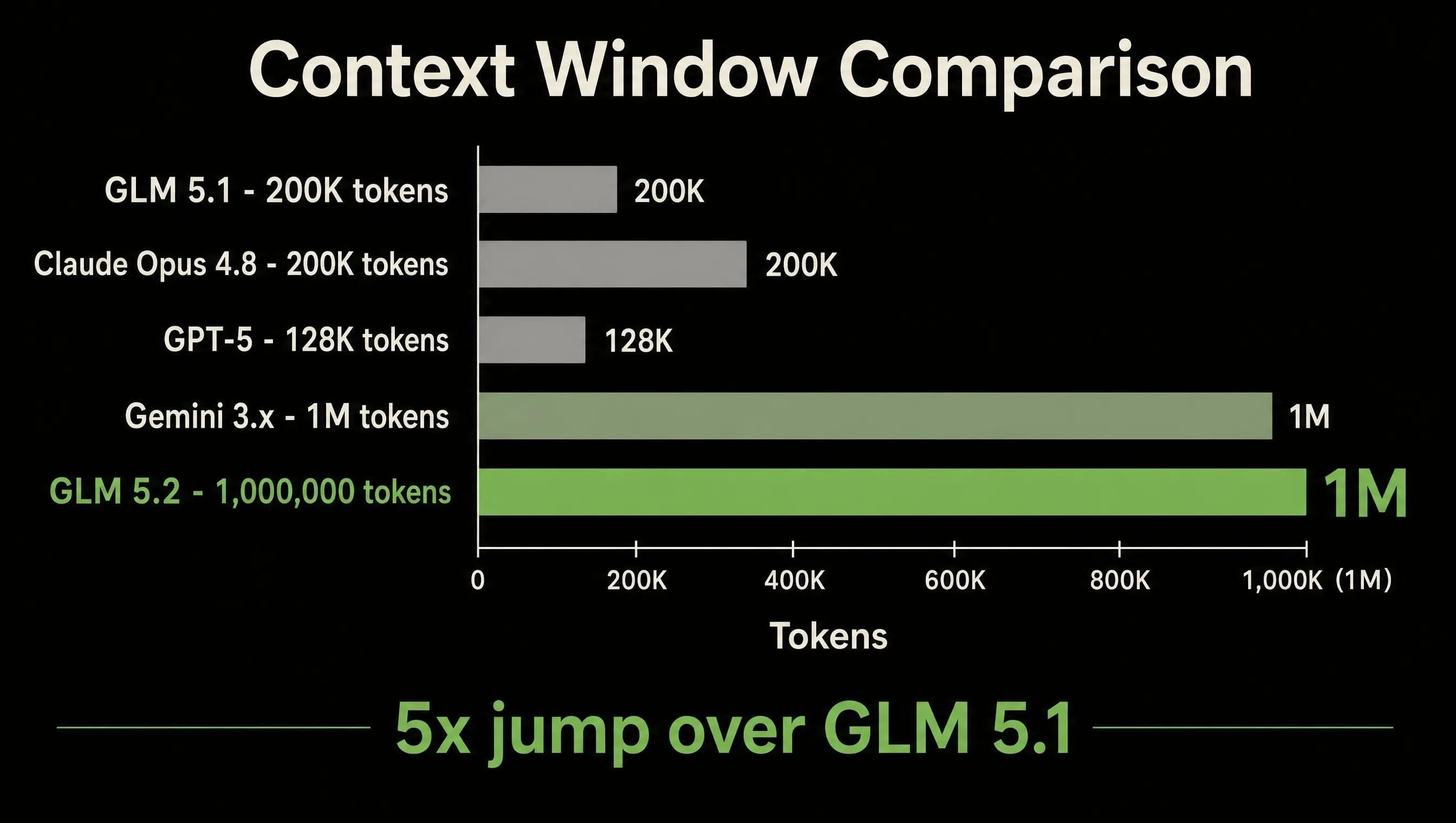
Why 1M tokens matters for repo-scale work
Here's the everyday analogy: a 200K context window is like handing a contractor a few rooms of your house and asking them to renovate without seeing the rest. A 1M window lets you hand over the entire blueprint — the whole mid-size codebase, the docs, the open tickets, the style guide — all in one prompt.
For agentic coding, that's a real workflow change. You stop doing chunking gymnastics, stop manually feeding files one at a time, and stop watching the model lose track of a function it read 40 messages ago. For repository-scale refactoring, where the model needs to understand how a change in one module ripples through twenty others, that bigger window is exactly where the long-context payoff shows up.
Max output: 131,072 tokens
Context is what the model reads; output is what it writes back. GLM 5.2 can produce up to 131,072 tokens in a single response. In practical terms, that means a large multi-file diff in one shot instead of "continue?" prompts every few hundred lines — handy when an agent is generating a whole feature scaffold or a sweeping refactor.
The model id: glm-5.2[1m]
When you wire it into an agent, the model identifier for the full-window variant is glm-5.2[1m]. The [1m] tag is doing real work — it's the flag that tells the endpoint you want the million-token context variant. Get this string right in your config and you're set; we'll show the exact snippet further down.
GLM 5.2 vs GLM 5.1: What Actually Changed
If you already use GLM 5.1, the question is simple: is 5.2 worth the switch? Here's the honest side-by-side.
| Spec | GLM 5.1 | GLM 5.2 |
|---|---|---|
| Context window | ~200K (200,000–202,752) | 1,000,000 (5x jump) |
| Max output | 5.1 baseline | 131,072 tokens |
| Thinking modes | Prior presets | High / Max (no Auto/Low) |
| Positioning | Strong all-rounder | Coding-first / agentic |
| Open weights | MIT, on Hugging Face | MIT (dropping shortly after launch) |
The real story is two things: the 5x context jump and the sharper coding-first framing. Everything else is incremental polish. Z.ai trimmed the thinking modes down to just High and Max — there's no Auto or Low anymore — which is a small nudge telling you this model expects to be doing serious work, not quick lookups. If your workload is long-context or repo-scale, 5.2 is a meaningful upgrade. If you were happy with 5.1 on small, focused tasks, the gain is smaller than the marketing suggests.
Benchmarks: What We Know (and the Honest Caveat)
Let's say it plainly one more time: there are no official GLM 5.2 benchmarks as of launch. No SWE-bench numbers, no Terminal-Bench, no Code Arena Elo for 5.2 specifically. Anyone claiming a measured 5.2 score this week is either guessing or quietly reusing 5.1 data.
So what can we honestly say about its likely performance? The best available proxy is GLM-5.1, which 5.2 builds directly on. Here's that 5.1 data — clearly labelled as a proxy, not a 5.2 result.
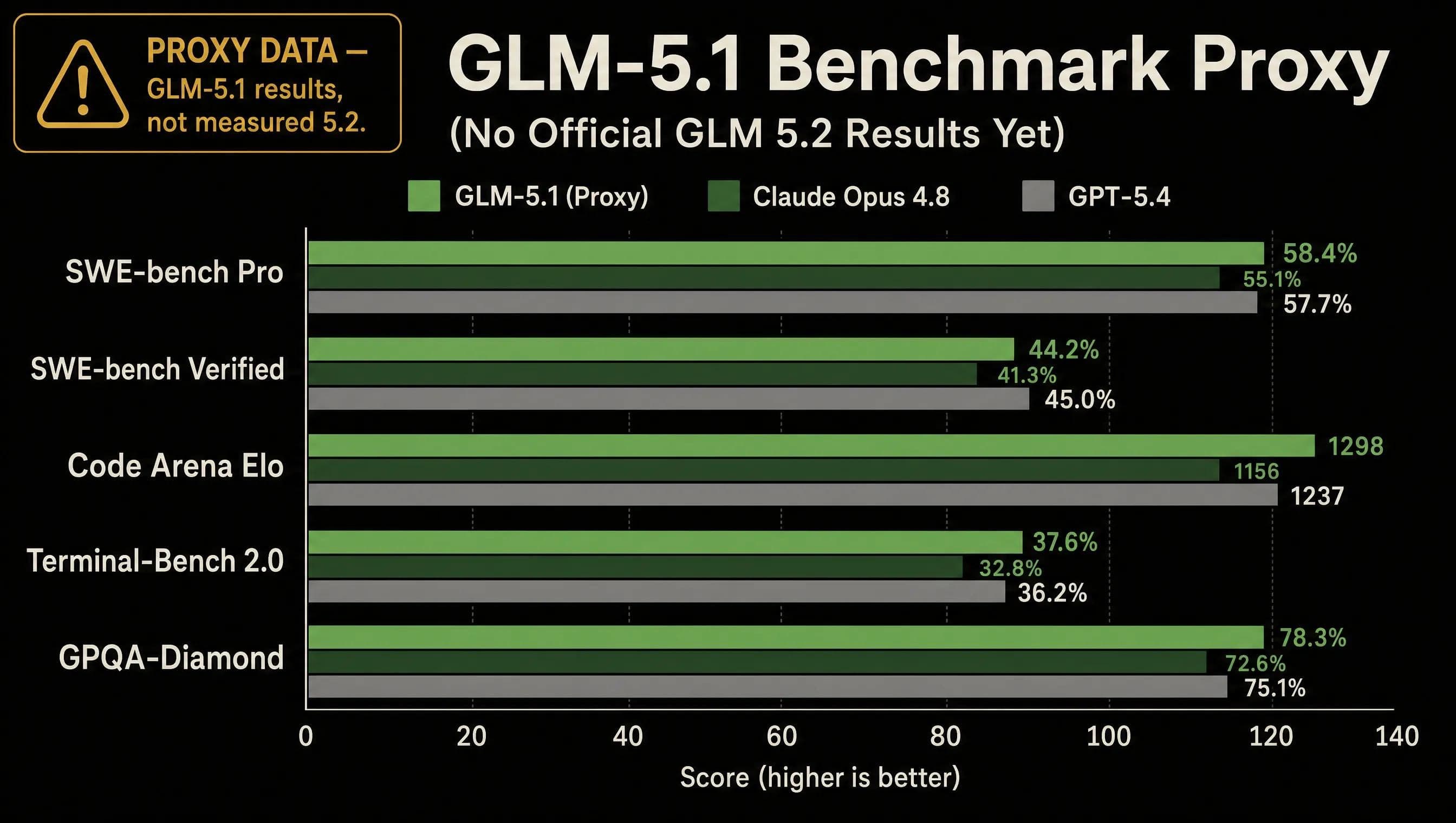
| Benchmark (GLM-5.1 proxy) | GLM-5.1 | Comparison |
|---|---|---|
| SWE-bench Pro | 58.4% (claimed #1, vendor) | GPT-5.4 57.7%, Opus 4.6 57.3% |
| SWE-bench Verified | 77.8% (GLM-5 base) | Opus 4.6 ~81.4% |
| Code Arena (Elo) | 1530 (3rd globally) | Opus 4.6 ~1542 (2nd) |
| Terminal-Bench 2.0 | 63.5% (66.5% w/ Claude Code scaffold) | — |
| Claude Code eval | 45.3 pts → 94.6% parity (self-reported) | Opus 4.6 47.9 |
| GPQA-Diamond | 86.2% | — |
| AIME 2026 | 95.3% | — |
One quick note on the comparison column: those rivals (Opus 4.6, GPT-5.4) reflect the 5.1-era leaderboard, not today's frontier — the current proprietary leaders are Claude Opus 4.8 and GPT-5, which you'll see in the landscape table below.
Two caveats you genuinely need before you trust any of this. First, these are GLM-5.1 numbers — the best proxy we have until Z.ai publishes 5.2 results. Second, the flashiest claims — the SWE-bench Pro "#1" and the "94.6% of Opus 4.6" parity figure — started as Z.ai internal, self-reported numbers. Treat them as vendor claims pending broad third-party replication, not settled facts. The picture they paint is "near-frontier and closing the gap," which is impressive for an open-weight model — but impressive-with-an-asterisk until independent evaluators confirm it on 5.2 itself.
How GLM 5.2 Fits in the 2026 Frontier Landscape
So where does GLM 5.2 actually sit in a year that's gotten genuinely crowded at the top? Honestly, it's a strong open-weight contender that's closing the gap on the proprietary leaders — with the fair-comparison caveat that its coding-strength column rests on 5.1 proxy data, not measured 5.2 results.
| Model | Open weights? | Context | Coding strength (proxy) | Best for |
|---|---|---|---|---|
| GLM 5.2 | MIT (coming) | 1M | Near-frontier (5.1 proxy) | Repo-scale agentic coding, open-weight teams |
| Claude Opus 4.8 / Fable 5 | No | Large | Frontier | Highest-stakes reasoning + coding |
| GPT-5 | No | Large | Frontier | Broad ecosystem, tooling |
| Gemini 3.x | No | Very large | Strong | Multimodal + Google stack |
| DeepSeek V4 | Open | Large | Strong | Cost-efficient open option |
| Qwen (latest) | Open | Large | Strong | Open multilingual + China stack |
Here's the fair read. On independently verified results, Claude and GPT still lead — if you're shipping the highest-stakes reasoning or want the most battle-tested coding model, the latest from Anthropic and OpenAI remains the safer call. If you're weighing the Claude side specifically, our breakdown of what's new in Claude Opus 4.8 and the Claude Fable 5 / Mythos 5 lineup covers where those models pull ahead.
What GLM 5.2 brings that the proprietary frontier doesn't is the combination of a 1M context window, MIT open weights, and aggressive pricing in one package. For teams that value vendor independence — or that want to eventually run the model on their own infrastructure — that's a compelling trade even if the raw benchmark lead belongs to Claude or GPT for now. Against the other open players, DeepSeek V4 wins on cost-efficiency and Qwen on multilingual breadth, but neither matches GLM 5.2's context window. If you're trying to slot any of these into an automated build pipeline, it helps to first compare leading agent frameworks so the model and the orchestration layer actually fit together.
Pricing & Access: GLM Coding Plan + the Coming API
Updated for 2026: the GLM Coding Plan now runs GLM-5.2, and the tiers changed. Pro is now $72/mo and Max $160/mo (Lite stays $18). For the full breakdown of weekly limits, throttle mechanics, and our 3-week hands-on test, see our dedicated GLM 5.2 Coding Plan guide.
Now the part founders care about: what does it cost, and how do you get in? Today, the confirmed access path is the GLM Coding Plan — a subscription that meters by prompts per week rather than per-token billing.
| Tier | Prompts/week | Price (2026) |
|---|---|---|
| Lite | ~400 | ~$18/mo (some sources: $10/mo regular, $3 first month) |
| Pro | ~2,000 | ~$30/mo ($15 first month) |
| Max | ~8,000 | Higher tier |
| Team | seat-based | Org pricing |
From a startup-perspective, that pricing is aggressive. A Lite plan at roughly $18/mo for ~400 prompts a week is genuinely cheap for a frontier-class coding model, and the first-month discounts make it nearly free to trial. For most solo devs and small teams, Pro at ~$30/mo is the sweet spot.
One honest gap: the standalone GLM 5.2 API pricing wasn't published at launch. Until Z.ai posts official 5.2 rates, the best reference point is the inherited GLM-5 base API — $1.00 per 1M input tokens and $3.20 per 1M output tokens. Use that as the expected ballpark, not a quote. If your usage is metered and unpredictable, wait for the real API numbers before you model your costs around them.
How to Use GLM 5.2 in Claude Code & Cline
Here's the genuinely cool part: because GLM 5.2 exposes an Anthropic-compatible endpoint, you can point an agent you already use — like Claude Code or Cline — straight at it. No new tooling to learn.
The flow is four steps:
- Get a GLM Coding Plan key from Z.ai.
- Point your agent at the Z.ai base URL.
- Set the model id to
glm-5.2[1m]. - Pick your thinking mode — Max for complex, multi-file work.
Here's the actual config snippet for wiring GLM 5.2 into Claude Code via environment variables:
# Point Claude Code at the GLM Coding Plan endpoint
# (verify the exact base URL against current Z.ai docs)
export ANTHROPIC_BASE_URL="https://api.z.ai/api/anthropic"
export ANTHROPIC_AUTH_TOKEN="your-glm-coding-plan-key"
export ANTHROPIC_MODEL="glm-5.2[1m]"

# Then run Claude Code as usual — it routes to GLM 5.2
claude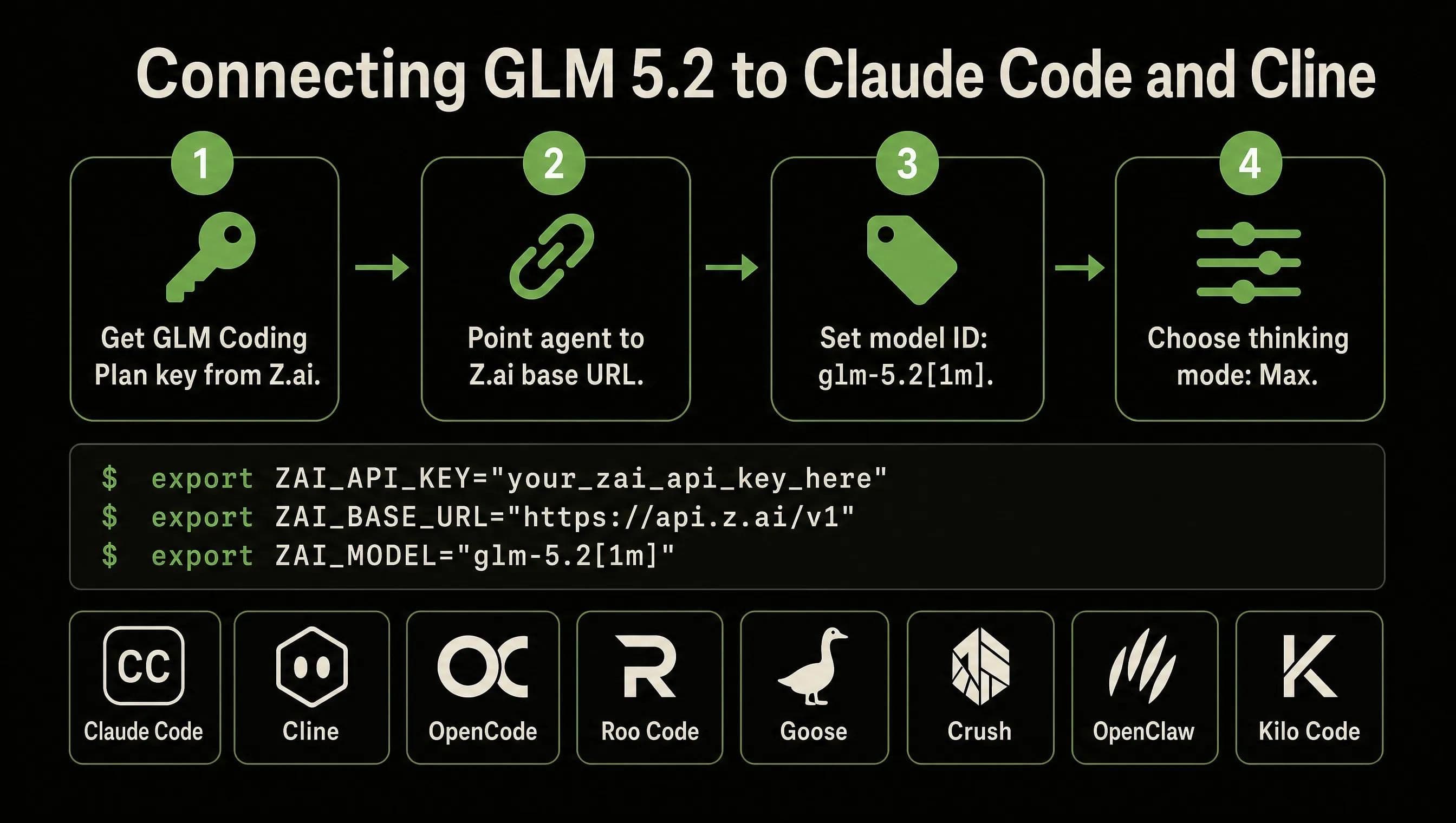
GLM 5.2 works out of the box with Claude Code, Cline, OpenCode, Roo Code, Goose, Crush, OpenClaw, and Kilo Code — so whatever agent fits your workflow, you're probably covered. If you're still picking one, the best AI coding agents this year walks through the trade-offs, and for long-running jobs it's worth seeing how background coding agents stack up before you commit. Already on Claude Code? Our writeup of proven Claude Code workflows translates almost directly once GLM 5.2 is wired in, and if you want to extend the setup with custom tools, start with wiring it up through MCP.
Self-hosting reality check
"MIT open weights" sounds like you can run it on your laptop. You can't — at least not realistically. Once the weights drop, GLM 5.2 will run on vLLM and SGLang, the standard high-throughput serving stacks. But the FP8 checkpoint needs roughly 860GB of VRAM. That's a multi-GPU server decision, not a side project. Self-hosting is real and supported; it's just an infrastructure investment, so budget for it honestly before you promise your team an on-prem deployment.
Our Take: Should You Switch Today?
Let's turn all of that into a decision. The honest framing is "try" versus "fully migrate" — and those are two very different risk levels.
| Switch / try now if… | Wait if… |
|---|---|
| You do repo-scale / long-context coding and want the 1M window today | You need published, independent benchmarks before adopting |
| You want an open-weight path (MIT) and value vendor independence | You're locked into proprietary tooling GLM agents don't support |
| You're cost-sensitive and the Coding Plan tiers fit your budget | You need the standalone API or chatbot (still "coming") |
| You can tolerate evolving access while features ship | Your compliance demands stable, GA'd APIs |
Our verdict: trying GLM 5.2 is a strong, low-risk call. The Coding Plan is cheap, it drops into agents you already run, and the 1M context window is a real, today benefit. A full production migration is higher-risk until independent benchmarks land and the weights actually ship — you don't want to bet a roadmap on self-reported numbers. If your decision also hinges on which agent to standardize on, the OpenHands vs Devin vs Manus breakdown is a useful companion read, since the agent choice often matters more than the underlying model.
How Techsy Approaches This
Trying to decide which LLM to put into production — GLM 5.2, Claude, or GPT — isn't a benchmark-reading exercise. We've shipped AI features on all of them, and our evaluation always comes down to four real-world questions: How big is the gap between the benchmark and your actual repo? What's the true cost-per-task at your volume? Does it integrate with the agents and CI your team already runs? And how much lock-in are you signing up for?
For a fresh release like GLM 5.2, that means we'd happily pilot it on a real task this week — but we'd hold a production migration until independent numbers confirm the proxy data and the weights ship. Sometimes a proprietary frontier model is genuinely the better call, and we'll say so when it is. **Trying to decide which model belongs in your stack? **Get a free consultation → and we'll help you weigh the trade-offs against your actual workload.
Frequently Asked Questions
What is GLM 5.2 and who makes it?
GLM 5.2 is a coding-first frontier model from Z.ai (Zhipu AI), launched on June 13, 2026. Its headline feature is a 1 million token context window, and it's positioned for agentic, repository-scale software engineering.
Is GLM 5.2 open source?
Yes — GLM 5.2 is open source under an MIT license with open weights, continuing the GLM family's permissive track record. The catch is timing: the weights were promised "next week" as of the June 13, 2026 launch and weren't yet on Hugging Face, so it's open source on the roadmap, not quite downloadable on day one.
How big is GLM 5.2's context window?
1,000,000 tokens — a roughly 5x jump over GLM 5.1's ~200K window. It also supports up to 131,072 tokens of output per response, which is enough for large multi-file diffs in a single shot.
How is GLM 5.2 different from GLM 5.1?
The big changes are the 5x context window increase, two streamlined thinking modes (High and Max, no Auto/Low), and a sharper coding-first, agentic positioning. Everything else is incremental — the context jump is the real upgrade.
Does GLM 5.2 have published benchmarks?
No. There are no official GLM 5.2 benchmarks as of launch. The numbers circulating online are GLM-5.1 proxies. Treat the "#1 SWE-bench Pro" and "94.6% of Opus 4.6" claims as Z.ai self-reported figures until independent evaluators replicate them on 5.2 itself.
Is GLM 5.2 better than Claude Opus 4.8 or GPT-5?
Not on verified results — Claude Opus 4.8 and GPT-5 still lead the independently benchmarked frontier, and there's no GLM 5.2-specific proof yet. On inherited GLM-5.1 proxy data, GLM 5.2 looks near-frontier and closing the gap, which is especially valuable for open-weight teams. But for the highest-stakes work, the proprietary leaders remain the safer pick today.
How much does GLM 5.2 cost?
Through the GLM Coding Plan: Lite is ~$18/mo (~400 prompts/week), Pro ~$30/mo (~2,000/week), Max is a higher tier (~8,000/week), and Team is seat-based. Standalone API pricing wasn't published at launch — the GLM-5 base rate of $1.00/1M input and $3.20/1M output is the best reference for now.
How do I access and use GLM 5.2?
The confirmed path today is the GLM Coding Plan, wired into Claude Code, Cline, OpenCode, Roo Code, Goose, Crush, OpenClaw, or Kilo Code. You set the base URL to the Z.ai endpoint and the model id to glm-5.2[1m]. A standalone API and chat.z.ai access are both "coming" rather than live.
Can I self-host GLM 5.2?
Once the MIT weights drop, yes — via vLLM or SGLang. But the FP8 checkpoint needs roughly 860GB of VRAM, so it's a serious multi-GPU infrastructure decision, not a laptop or single-card project. Plan your hardware budget accordingly.
Should I switch to GLM 5.2 right now?
It's low-risk to try — the Coding Plan is cheap and it drops into agents you already use. Hold off on a full production migration until independent benchmarks land and the weights ship, so you're not basing a critical dependency on vendor-reported numbers.
Key Takeaways
- The 1M token context window is the real headline — a usable 5x jump that genuinely changes repo-scale and agentic coding workflows.
- The benchmarks are inherited GLM-5.1 proxies, not measured 5.2 results. The "#1 SWE-bench" and "94.6% of Opus" figures are vendor self-reported claims awaiting independent replication.
- MIT open weights and a standalone API are "coming," not shipped. Today's confirmed access path is the GLM Coding Plan inside a supported agent.
- It's cheap and low-risk to try via Claude Code or Cline; a full migration should wait for independent numbers and the weights drop.
- For open-weight teams who want vendor independence and the biggest context window in the field, GLM 5.2 is one of 2026's most interesting bets.
Want a second opinion before you wire a frontier model into your stack? Talk to our team → — we've put GLM, Claude, and GPT into production and can help you choose the right one for your workload.