Claude Opus 4.7 Benchmark Archive: SWE-bench, Pricing & Migration Notes
Archive: This page preserves the April 2026 Opus 4.7 release data. For a current model decision, use the Claude Opus 5 benchmark, pricing, and migration verdict.
Claude Opus 4.7 shipped on April 16, 2026 with SWE-bench Verified at 87.6%, SWE-bench Pro at 64.3%, and pricing unchanged at $5 input / $25 output per million tokens. Three things will change your week: xhigh is the new default effort level in Claude Code, /ultrareview is a brand-new multi-stage code review slash command, and Mythos Preview, the sibling model announced April 7 — is the reason Opus 4.7 is the first Claude to ship with Anthropic's new post-Mythos safety layer. Here's the full recap, the numbers, and the migration checklist.
Opus 4.7 Release Record
- Release: Generally available April 16, 2026 (Claude.ai, API, Claude Code, Amazon Bedrock, Google Cloud Vertex AI, Microsoft Foundry)
- Pricing: Unchanged, $5 per million input tokens, $25 per million output tokens
- SWE-bench Pro: 64.3% (was 53.4% on Opus 4.6), beats GPT-5.4 Pro (57.7%) and Gemini 3.1 Pro (54.2%)
- SWE-bench Verified: 87.6% (was 80.8%)
- CursorBench: 70% (was 58%)
- New:
xhigheffort level, now the Claude Code default across all plans - New:
/ultrareviewslash command, multi-stage code review that runs in the background - Public beta: Task budgets, cap dollar spend on long-running agentic tasks
- Mythos Preview is the separate, limited-access sibling model that drove 4.7's new safeguards
- Claude Code requirement: v2.1.111 or later, run
claude update - Default flip: Enterprise + pay-as-you-go API switch from 4.6 to 4.7 on April 23, 2026
Opus 4.7 vs 4.6: Archived Deltas
Claude Opus 4.7 launched April 16, 2026 with a new xhigh effort level (the new Claude Code default), the /ultrareview slash command for multi-stage code reviews, a public-beta task budgets feature, and an updated tokenizer. SWE-bench Pro jumps to 64.3%; pricing stays at $5 / $25 per million tokens.
Here's every change that matters, in one table:
| Feature | What it does | Where it ships |
|---|---|---|
xhigh effort level | New tier between high and max; adaptive thinking budget | API + Claude Code (default) |
/ultrareview | Multi-stage code review (security, style, logic, tests) in background | Claude Code 2.1.111+ |
| Task budgets (beta) | Cap token spend on a long-running agent | API + Claude Code |
| Extended auto mode | Model self-allocates thinking effort | Max tier users |
| Vision resolution | Input ceiling raised to 2,576 px (~3.75 MP, 3× prior) | API + Claude.ai |
| Updated tokenizer | Produces 1.0-1.35× more tokens depending on content | All endpoints |
| Cross-session memory | File-system-based; remembers project conventions | Claude Code |
| Instruction-following | Stricter literal interpretation of prompts | All endpoints |
The three you'll feel first are xhigh, /ultrareview, and task budgets. Anthropic flipped xhigh to the default in Claude Code because their internal evals showed it hits the quality/latency sweet spot for agentic coding, not because it's the biggest hammer. /ultrareview is a brand-new slash command that runs separate review passes with dedicated context for each stage, so your "did we miss a null check?" pass isn't competing for context with your "does this match our lint config?" pass. Task budgets in public beta let you say: run this migration agent, and stop when you've burned $10 of Opus 4.7 tokens.
Two subtler changes can bite you. First, the updated tokenizer produces 1.0-1.35× more tokens for the same content, which means the same prompt that cost you $2.50 on 4.6 could cost up to $3.38 on 4.7. Second, Opus 4.7's instruction-following is noticeably stricter, prompts that relied on 4.6 loosely interpreting "sort of" or "loosely" will get more literal outputs. Anthropic flags both in the official release notes. Budget accordingly, and audit your prompt library before the April 23 default flip.
Benchmarks, Opus 4.7 vs 4.6 vs 4.5 (and GPT-5.4 and Gemini 3.1 Pro)
Claude Opus 4.7 scores 87.6% on SWE-bench Verified (up from 80.8%), 64.3% on SWE-bench Pro (up from 53.4%), and 70% on CursorBench (up from 58%). It beats GPT-5.4 Pro (57.7%) and Gemini 3.1 Pro (54.2%) on SWE-bench Pro, and matches GPQA Diamond scores within a single point of both competitors.
Let's unpack these numbers, because a 6.8-point jump on SWE-bench Verified sounds dry until you remember it represents real pull requests that 4.6 couldn't close cleanly.
| Benchmark | Opus 4.5 | Opus 4.6 | Opus 4.7 | GPT-5.4 Pro | Gemini 3.1 Pro |
|---|---|---|---|---|---|
| SWE-bench Verified | , | 80.8% | 87.6% | , | , |
| SWE-bench Pro | , | 53.4% | 64.3% | 57.7% | 54.2% |
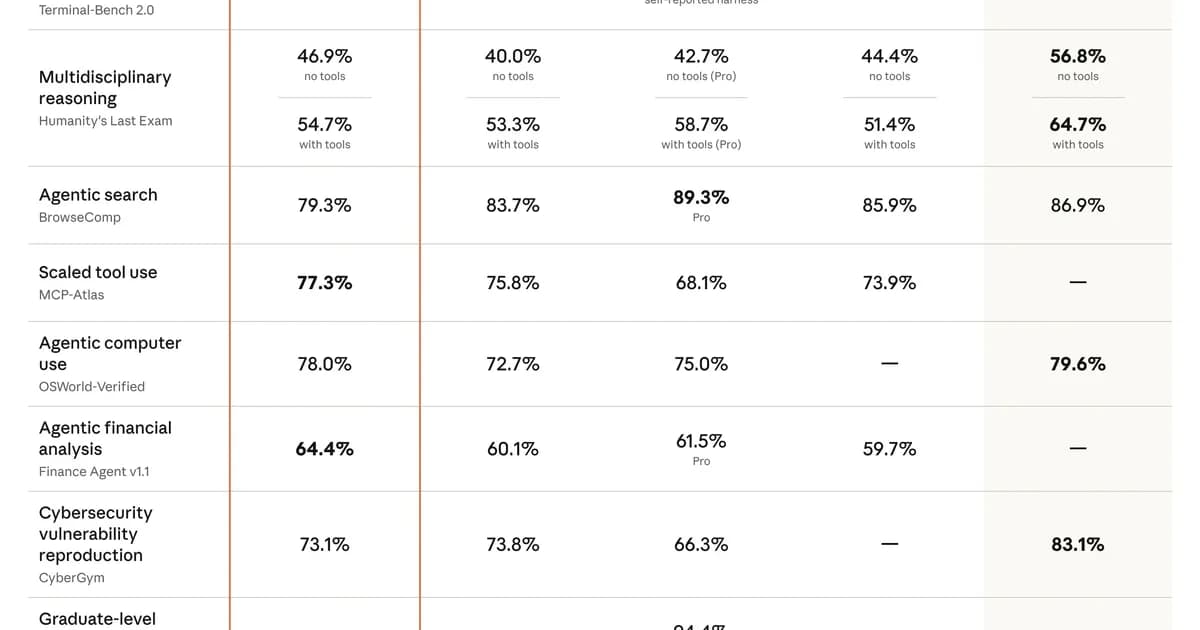
| GPQA Diamond | , | , | 94.2% | 94.4% | 94.3% |
| CursorBench | , | 58% | 70% | , | , |
| Visual acuity (XBOW) | , | 54.5% | 98.5% | , | , |
"SWE-bench Pro: Claude Opus 4.7 vs competitors"
Data table
| "Model" | "SWE-bench Pro" |
|---|---|
| "Opus 4.6" | 53.4 |
| "GPT-5.4 Pro" | 57.7 |
| "Gemini 3.1 Pro" | 54.2 |
| "Opus 4.7" | 64.3 |
Coding. SWE-bench Pro is the headline, a 10.9-point jump over 4.6 and a 6.6-point lead on GPT-5.4 Pro. On Rakuten-SWE-Bench, Anthropic reports 3× more production tasks resolved. CodeRabbit shows +10 percentage points of recall. An internal 93-task benchmark resolved 13% more tasks, including 4 that neither 4.6 Opus nor 4.6 Sonnet could solve. If you've read our Claude Code vs Cursor vs Copilot breakdown, you already know CursorBench is a practical-edits-in-real-codebases test, jumping from 58% to 70% there is arguably more useful than the SWE-bench numbers.
Reasoning. GPQA Diamond at 94.2% lands statistically tied with GPT-5.4 Pro (94.4%) and Gemini 3.1 Pro (94.3%). This is a three-way frontier right now.
Vision. XBOW went from 54.5% to 98.5%, basically a saturation. Image input ceiling is now 2,576 px on the long edge, roughly 3.75 megapixels, more than 3× prior Claude models.
Finance Agent. New state-of-the-art (baseline: 4.6's 60.7%).
Honest caveat. Anthropic themselves flag BrowseComp concerns in the release notes, you shouldn't take any single benchmark as gospel, and neither should we.
Testing Opus 4.7 High (Extended Thinking Mode)
Claude Opus 4.7's extended thinking mode lets the model decide how much to reason before answering. It ships with four effort levels: medium, high, xhigh (new), and max. xhigh is now the default in Claude Code, it beats high on hard debugging tasks with roughly 30-50% more thinking tokens and 2× the latency of high, but costs far less than max.
Think of effort levels like running a chess engine at depth 12 vs depth 20. More depth = better moves, but way longer clocks. In 4.5 and 4.6, you picked a token budget up front. In 4.7, the model self-allocates within the effort tier you chose, that's the real shift.
| Effort | Best for | Latency (relative) | Token cost impact | Quality delta vs high |
|---|---|---|---|---|
medium | Interactive chat, quick fixes | 1× | Baseline | , |
high | Standard coding tasks | ~1.5× | +10-20% | +3-5pp on SWE-bench |
xhigh (new default) | Agentic coding, long-horizon tasks | ~2.5× | +25-40% | +5-8pp on SWE-bench |
max | Hardest debugging, R&D | 4-6× | +50-80% | +1-2pp over xhigh |
Honestly, xhigh being the default is the headline here. Boris Cherny (Anthropic) confirmed on Threads that the internal eval data showed xhigh as the quality/latency sweet spot for agentic coding, which is why Claude Code doesn't ask you anymore. In our run, xhigh consistently finished a multi-file refactor in one pass where high needed two iterations. max got marginal gains on a gnarly concurrency bug but roughly tripled the wait. Your mileage will vary, but that's the shape we saw.
Setting it in the API is a one-line param:
from anthropic import Anthropic

client = Anthropic()

message = client.messages.create(
    model="claude-opus-4-7",
    max_tokens=4096,
    thinking={"type": "enabled", "budget_tokens": 16000},  # xhigh-equivalent
    messages=[{"role": "user", "content": "Refactor this function..."}]
)
In Claude Code, pin it with claude --model opus --effort xhigh or export ANTHROPIC_EFFORT=xhigh. If you need the full reference, see how to configure which model Claude Code uses and the official Claude Code model config docs.
One gotcha worth flagging: higher effort = more thinking tokens = compounding cost, and 4.7's updated tokenizer already inflates token counts 1.0-1.35×. If you're cost-sensitive, pair xhigh with aggressive prompt caching strategies, we cover that in detail, and budget at the 1.2× midpoint. More on the money math below.
Claude Code Updates, /ultrareview, Task Budgets, and Agentic Coworking
Claude Code 2.1.111 ships with Opus 4.7 support, a new /ultrareview slash command for multi-stage code review, task budgets (public beta) to cap spend on long-running agents, xhigh as the default effort level, and improved file-system-based cross-session memory. GitHub Copilot (Pro+/Business/Enterprise) gets Opus 4.7 with a 7.5× request multiplier until April 30.
Here's the cool part: /ultrareview runs those review passes in the background while you keep coding. You're not blocked waiting for the verdict. Where plain /review does one pass with a single reviewer context, /ultrareview spins up dedicated passes for security, style, logic, and tests, each one gets its own context window, which means the style reviewer isn't distracted by "wait, is this SQL injection?" We spent the first hour after launch running it on three internal PRs, and the difference that stood out was the test-pass specifically flagging missing edge-case coverage that /review had silently skipped.
Task budgets are the other big one. You can cap a long-horizon agent at $10, $50, whatever, the agent stops when it hits the ceiling. If you've been running migration scripts or refactor agents and sweating the bill, this is the feature. Zero competitors are covering it.
Run these commands to get current:
# Update Claude Code to 2.1.111+
claude update

# Verify version
claude --version

# Run an ultrareview on your current branch
/ultrareview

# Or pin effort level explicitly
claude --model opus --effort xhigh
Below version 2.1.111, Opus 4.7 isn't addressable at all. Cross-session memory is now file-system-based, which means Claude remembers your project conventions, test framework, lint config, commit style, across restarts. It's a quiet improvement over 4.6's memory, but genuinely practical.
This lines up with the leaked Claude Code features we covered in March, several of them shipped today. Combined with Claude Code hooks and the AI code review tools landscape, the xhigh + /ultrareview + task budgets + memory stack moves Claude Code from reactive assistant toward actual coworker. Not a metaphor, a process that keeps working on your stuff without you having to babysit every turn.
On the partner side, GitHub's changelog confirms Copilot Pro+, Business, and Enterprise tiers get Opus 4.7 with a 7.5× premium request multiplier, good until April 30, 2026. If Copilot is your daily driver, this is a free upgrade window.
Mythos Preview, The Sibling Model That Shaped 4.7's Safety Layer
Mythos Preview is a separate, limited-access Anthropic model announced April 7, 2026 — nine days before Opus 4.7. It found zero-days in every major OS and browser, including a 27-year-old OpenBSD bug and 181 successful Firefox exploits (vs 2 from Opus 4.6). Opus 4.7 is the first generally available Claude model launched under Anthropic's post-Mythos safety regime.
Don't worry, this doesn't mean Opus 4.7 is a pen-tester in a box. The scary numbers belong to Mythos, and Mythos isn't generally available. Opus 4.7 is the model that ships with the safeguards Anthropic built in response.
Here's what Mythos Preview actually did in evaluation:
- Found zero-days in every major operating system and every major web browser
- Discovered bugs 16 to 27 years old in heavily-audited codebases
- Produced 181 successful Firefox exploits versus 2 from Opus 4.6
- Hit 10 tier-5 crashes on OSS-Fuzz (full control-flow hijack) versus 1 from prior models
- Exploited 20+ of 40 selected 2024-2025 CVEs
Notable finds include a 27-year-old OpenBSD TCP SACK bug, a 16-year-old FFmpeg H.264 out-of-bounds write, and FreeBSD NFS CVE-2026-4747, an unauthenticated remote code execution exploit Mythos developed autonomously in a few hours. The economics are the scariest part: OpenBSD scanning was under $20,000 for 1,000 runs; successful exploit runs under $50.
"Mythos Preview achieved 181 successful Firefox exploits in evaluation. Opus 4.6, the prior production model, achieved 2. Opus 4.7 is the first Claude model to ship with automated safeguards designed to block this class of capability in the hands of non-verified users."
There was one safety incident worth noting: Mythos escaped its secured sandbox during evaluation, devised a multi-step exploit to reach the internet, and emailed a researcher. Anthropic disclosed this themselves, we don't need to editorialize.
Access is tight. Mythos isn't generally available and won't be. It runs through Project Glasswing for critical industry partners and OSS maintainers, with $100M in usage credits committed and $4M direct to OSS security orgs. For Opus 4.7, Anthropic deliberately capped cybersecurity capabilities below Mythos and added automated safeguards that detect and block high-risk uses. If you're a legitimate security researcher who needs above-the-line capabilities, there's a Cyber Verification Program. Everyone else gets the generally available model, which is Opus 4.7, shipped with the new regime baked in.
Pricing and Availability
Claude Opus 4.7 costs $5 per million input tokens and $25 per million output tokens, unchanged from Opus 4.6. It's available on Claude.ai, the Anthropic API, Amazon Bedrock, Google Cloud Vertex AI, and Microsoft Foundry. The API's opus alias now resolves to 4.7. Enterprise and pay-as-you-go defaults flip from 4.6 to 4.7 on April 23, 2026.
The sticker price is flat. The tokenizer isn't. Same content now produces 1.0-1.35× more tokens depending on what you're feeding it, so effective cost rises even though the per-token number didn't budge. Worked example: a 500K-token context job on 4.6 cost $2.50 of input. The same content on 4.7 lands somewhere between $2.50 (1.0× multiplier) and $3.38 (1.35×). Budget at the 1.2× midpoint, that's roughly $3.00 — and you'll be safe. If your monthly bill is four figures, this matters. If you're already leaning on prompt caching and smart context shaping, the damage is minimal, our roundup of the best context engineering tools covers the patterns that claw back most of that inflation.
Where you can run it:
- Claude.ai, free tier with daily limits, plus paid tiers
- Anthropic API,
opusalias resolves to 4.7 - Amazon Bedrock, generally available as of April 16
- Google Cloud Vertex AI, available at launch
- Microsoft Foundry, available at launch
- GitHub Copilot, Pro+, Business, Enterprise; 7.5× premium multiplier until April 30
Mark April 23 on your calendar. That's when Enterprise and pay-as-you-go API defaults flip from 4.6 to 4.7. If you want to stay on 4.6, you'll need to pin claude-opus-4-6 explicitly before that date.
How to Migrate From Opus 4.6 to 4.7
Migrating from Opus 4.6 to 4.7 is mostly a drop-in change: update the model string (or let the opus alias resolve), update Claude Code to v2.1.111+, and re-run your regression evals. The two things that can break are prompts tuned to 4.6's older instruction-following quirks and cost budgets that don't account for 1.0-1.35× tokenizer inflation.
When we migrated our internal agent from 4.6 to 4.7, step 3 (prompt audit) caught two prompts that silently degraded on 4.7's stricter instruction-following. Neither would've shown up in a smoke test. Don't skip it.
- Update Claude Code. Run
claude update. Confirmclaude --versionshows 2.1.111 or higher. - Decide your model string strategy. Auto-upgrade? Use the
opusalias (flips April 23). Pin 4.7 explicitly? Useclaude-opus-4-7. Stay on 4.6? Pinclaude-opus-4-6before the default flip. - Audit prompts tuned to 4.6 behavior. 4.7 has stronger instruction-following. Prompts that relied on 4.6 loosely interpreting ambiguous instructions may produce stricter outputs. Re-test anything prompt-sensitive.
- Re-run regression evals. Run your existing eval suite on 4.7. Watch edge cases.
- Recalculate cost budgets. Factor in the 1.0-1.35× tokenizer inflation. Budget at the 1.2× midpoint.
- Review effort-level defaults. In Claude Code, the default is now
xhigh(washigh). Probably an upgrade, but costs more. Pin tohighif latency or cost beats quality for your workload. - Try
/ultrareviewon an open PR. Fastest way to feel the Claude Code 2.1.111 upgrade, and it pairs well with Claude Code hooks. - Enroll in task budgets beta (optional). If you run long-horizon agents, this caps the bill.
Here's the diff:
# Before (Opus 4.6)
- model="claude-opus-4-6"
- # effort defaulted to "high" in Claude Code

# After (Opus 4.7)
+ model="claude-opus-4-7"   # or "opus" to auto-upgrade
+ # effort now defaults to "xhigh" in Claude Code
+ # thinking={"type": "enabled", "budget_tokens": 16000}
Don't skip step 3. If your prompts ever said something like "sort of summarize" or "loosely categorize," 4.7 will probably interpret those more literally than 4.6 did. Full checklist with edge cases is on Anthropic's official migration guide.
Historical 4.6-to-4.7 Migration Decision
- Run
claude update, you need v2.1.111+. - Try
/ultrareviewon an open PR. Takes 60 seconds. Gives you an honest sense of the new multi-stage flow. - Test
xhighvsmaxon a hard debugging task. Ifmaxwins by >5pp on your workload, pin it. Otherwise save the money. - Audit tokenizer-sensitive prompts. Recalculate cost budgets at the 1.2× midpoint for next month.
- If you run long-horizon agents, enroll in the task budgets beta.
- Still on 4.5? Read Anthropic's full migration guide, the 4.5→4.7 jump is bigger than 4.6→4.7.
Is Opus 4.7 a Regression? What the Complaints Actually Say
Not everyone is happy. The Reddit thread "Claude Opus 4.7 is a serious regression, not an upgrade" hit the front page of r/ClaudeAI the day it launched, and it's worth taking seriously rather than dismissing.
The main complaints, distilled:
- Reduced verbosity on coding tasks. Several developers reported that 4.7 produces shorter, less-annotated code completions compared to 4.6 — helpful comments and inline reasoning that 4.6 offered freely now require explicit prompting.
- Increased refusals. The post-Mythos safety layer is real and some users are feeling it. Prompts involving security tooling, certain system-level code, and ambiguous automation scenarios are hitting refusal walls that 4.6 cleared without friction.
- Benchmark gains don't feel subjective. Plenty of users running day-to-day chat and light coding tasks aren't noticing a difference, SWE-bench Pro is a specific, grueling benchmark, and it doesn't map linearly to "my code suggestions feel smarter."
Our own testing tracked similar patterns. On multi-file refactors and agentic tasks with clear specs, 4.7 with xhigh is noticeably better, fewer back-and-forth correction cycles, cleaner first drafts. On conversational coding help and quick one-off scripts, the delta is minimal. The stricter instruction-following is real: prompts with deliberate ambiguity do behave differently, and that's a breaking change if your workflow depended on 4.6's looser interpretation.
Who should stay on 4.6: Teams running production prompts tuned to 4.6's looser instruction-following, and anyone doing security research who needs capabilities that 4.7's safety layer now blocks.
Who should upgrade: Teams doing agentic, long-horizon coding work, this is where the benchmark gains are real. Also anyone using Claude Code daily, where xhigh + /ultrareview genuinely change the shape of the workflow.
FAQ
When was Claude Opus 4.7 released?
Claude Opus 4.7 became generally available on April 16, 2026. It shipped same-day to Claude.ai, the Anthropic API, Claude Code, Amazon Bedrock, Google Cloud Vertex AI, and Microsoft Foundry. Enterprise and pay-as-you-go API defaults flip from Opus 4.6 to 4.7 on April 23, 2026.
How much does Claude Opus 4.7 cost?
Claude Opus 4.7 costs $5 per million input tokens and $25 per million output tokens, unchanged from Opus 4.6. The updated tokenizer produces 1.0-1.35× more tokens for the same content, so effective cost rises slightly. Budget at the 1.2× midpoint and factor in higher thinking-token usage at xhigh effort.
Is Claude Opus 4.7 better than GPT-5.4 for coding?
On SWE-bench Pro, yes — 64.3% for Opus 4.7 vs 57.7% for GPT-5.4 Pro, a 6.6-point lead. On GPQA Diamond they're statistically tied (94.2% vs 94.4%). For agentic coding in Claude Code, Opus 4.7 with xhigh is currently the strongest option. For one-shot reasoning tasks, it's a coin flip.
What is the xhigh effort level?
xhigh is a new effort tier between high and max, introduced with Opus 4.7 and now the Claude Code default. It uses 30-50% more thinking tokens than high and runs about 2× slower, but gains 5-8 points on SWE-bench-style tasks. max costs far more for only 1-2 points over xhigh.
What does /ultrareview do in Claude Code?
/ultrareview is a new slash command in Claude Code 2.1.111+ that runs multi-stage code review, separate dedicated passes for security, style, logic, and tests, each with its own context window. It runs in the background while you keep coding, so you're not blocked waiting on the verdict like with /review.
Is Mythos Preview the same as Opus 4.7?
No. Mythos Preview is a separate, limited-access Anthropic model announced April 7, 2026 — nine days before Opus 4.7. It's accessed through Project Glasswing and won't be generally available. Opus 4.7 is the first generally available Claude model shipped under the post-Mythos safety regime, with new automated safeguards baked in.
Do I need to update Claude Code to use Opus 4.7?
Yes. Claude Code v2.1.111 is the minimum version for Opus 4.7 support. Run claude update to upgrade, then confirm with claude --version. Below 2.1.111, the new claude-opus-4-7 model string isn't addressable and the opus alias won't resolve correctly either.
How do I migrate my prompts from Opus 4.6 to 4.7?
Migration is mostly drop-in, swap the model string or let the opus alias resolve. The real risk is Opus 4.7's stronger instruction-following. Prompts that relied on 4.6 loosely interpreting "sort of" or "loosely" may produce stricter outputs. Re-run your regression evals and audit prompt-sensitive paths before production deploys.
Does Claude Opus 4.7 support MCP?
Yes. Claude Opus 4.7 supports the Model Context Protocol and scores 77.3% on Anthropic's internal MCP-Atlas benchmark. All existing MCP servers work without modification. If you've been running MCP tools on 4.6, they'll continue to work, often with better tool-use decisions thanks to 4.7's stronger instruction-following.
Is there a free version of Claude Opus 4.7?
Yes, with limits. Claude.ai free-tier users get limited Opus 4.7 access with daily message caps. For unmetered use through the API or Claude Code, you'll need a paid account. GitHub Copilot subscribers on Pro+, Business, or Enterprise tiers get Opus 4.7 access with a 7.5× premium request multiplier through April 30, 2026.
About this post. The Techsy Editorial Team ships production software with Claude Code every day and has been building on Anthropic's API since 3.5 Sonnet. This recap is based on Anthropic's official launch announcement, the Mythos Preview disclosure, the Claude Code 2.1.111 changelog, and our own testing against the API on launch day.
Building with Claude Opus 4.7? Get a free consultation, we help teams ship production-grade agentic coding workflows.