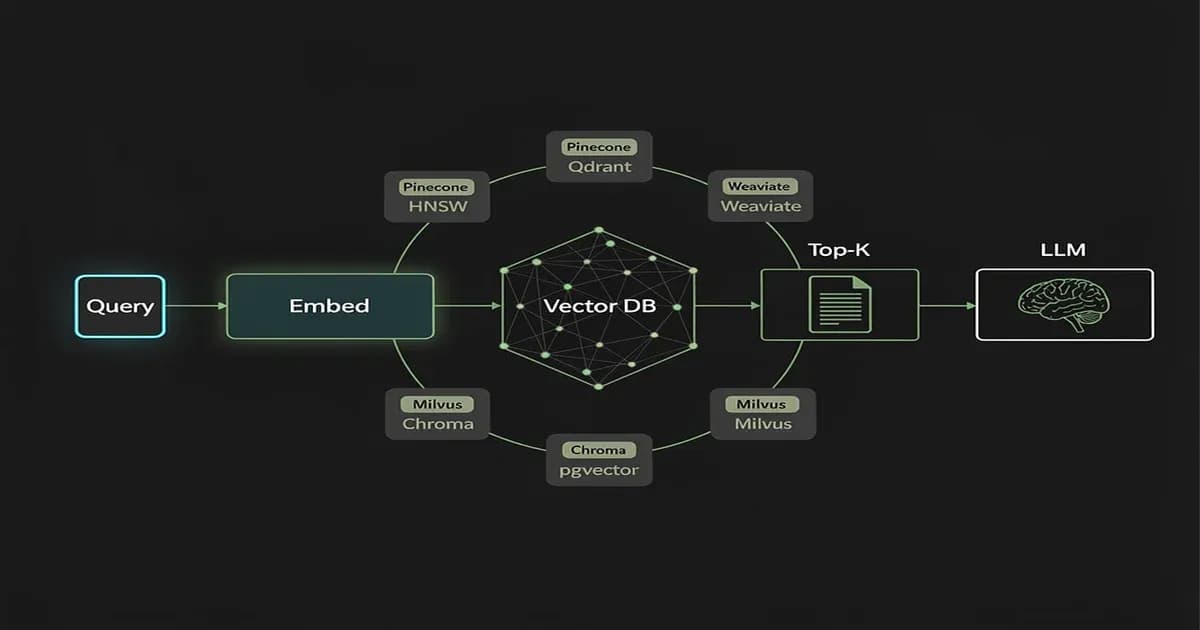
Best Vector Databases in 2026: 9 Picks, Real Pricing, and Code for Every One
There are 30+ vector databases in 2026, but only a handful matter for most teams shipping RAG, agents, or semantic search. The right pick depends more on your existing stack than on raw QPS numbers, and the gap between the cheapest and most expensive option for the same workload is roughly 10x. Here are the nine we'd actually ship today, with real pricing and runnable code for each.
Key takeaways:
- Pinecone Serverless is still the fastest path to production RAG if budget isn't the constraint.
- Qdrant offers the best open-source price-performance; Series B funded in March 2026.
- pgvector is "enough" if you already run PostgreSQL and stay under ~10M vectors.
- Weaviate, Milvus, and Chroma each win specific niches; see the decision matrix below.
What is a vector database (and what it isn't)?
A vector database is a system that stores high-dimensional embeddings and serves approximate nearest neighbor (ANN) queries at sub-100ms latency, usually via an HNSW or IVF index. It powers RAG, semantic search, and AI agent memory. Vector libraries like Faiss are not databases. They lack persistence, replication, and multi-tenancy.
Three terms get blurred constantly, so let's pin them down.
- Embedding: a numeric vector (usually 384–3072 dimensions) that represents text, an image, or audio in a way similarity can be computed.
- ANN (approximate nearest neighbor): finding the closest k vectors to a query almost exactly, trading a bit of recall for huge speedups over exact search.
- HNSW: Hierarchical Navigable Small World, the graph-based index most modern vector databases use because it balances recall and latency well.
The distinction between a library, an index, and a database matters. Faiss gives you an in-memory ANN index. It's fast, but you bring your own persistence, auth, and replication. A vector database wraps that index with storage, transactions, metadata filtering, RBAC, and a query API. If you're shipping a real product, you want the database. If you're embedding similarity search inside a single Python service, a library might be enough.
One outlier worth noting up front: pgvector is a PostgreSQL extension, not a standalone product. It still counts as a vector database for our purposes because it gives you persistence, transactions, and a SQL interface, just bolted onto Postgres. More on it below.
How we picked the 9 vector databases for 2026
After spinning up Pinecone, Qdrant, and pgvector in production over the last 18 months, and getting paged at 2am when the wrong one was chosen, three filters mattered more than benchmarks.
- Market coverage. Appears in 8+ of the top 10 SERP comparisons for "best vector database." If nobody's writing about it, you'll have nobody to learn from when it breaks.
- Production-ready in 2026. Real customers running real workloads at scale. We skipped stealth-mode startups and beta products that haven't published a single case study.
- Maintained. Commits or stable releases within the last six months. A vector database that hasn't shipped since 2024 is a liability, not an asset.
Honest bias disclosure: we use Qdrant in two of our own client projects. That doesn't make it the right answer for you, and we'll tell you exactly when it isn't. We don't take vendor sponsorship for vector-database content, which is why some of the names you'll see ranked highly on sponsored "top 10" lists elsewhere aren't on ours.
Which vector database is best for RAG in 2026?
For RAG in 2026, Pinecone Serverless is the lowest-effort path to production, Qdrant offers the best self-hosted price-performance, and pgvector is the right answer if you already run PostgreSQL. The "best vector database for RAG" depends on your scale, hosting preference, and existing stack, not on benchmark numbers.
Here's how we'd rank the top three for a typical RAG workload (1–10M chunks, OpenAI embeddings, 10–100K daily queries):
- Pinecone Serverless. You'll ship in an afternoon, the autoscaling just works, and there's no infrastructure to babysit. Pay the premium and move on.
- Qdrant. Best price-performance if you have any ops capacity. Filtering is excellent for metadata-heavy RAG, and hybrid search is native.
- pgvector. Boring, reliable, and free if you already pay for Postgres. The right answer for ~80% of RAG projects under 10M vectors.
Every major vendor on this list integrates with LangChain and LlamaIndex as a first-class retriever. That's table stakes in 2026, so don't pick based on framework support alone. Pick based on cost, scale, and your team's ops bandwidth.
If you're still figuring out the rest of the pipeline, see the broader RAG stack for chunking, reranking, and evaluation tooling. New to retrieval entirely? Walk through build your first RAG app before you commit to a database. The choice gets much easier once you've felt where the bottlenecks actually live.
One more thing: don't pick a vector database before you've nailed your chunking strategy. Bad chunks make every database look bad.
The comparison table — 9 vector databases at a glance
Eight columns, nine vendors, real numbers. This is the single table to bookmark. Every column is the answer to a question we've heard from a real client at least three times in the past year. Pricing is May 2026 reference points; everything moves quarterly, so confirm on the vendor's pricing page before signing a contract.
| Vendor | Type | Best For | Pricing Model (2026) | Self-host? | Hybrid Search | Index Algorithm | Max Scale (claimed) |
|---|---|---|---|---|---|---|---|
| Pinecone | Managed (serverless) | Fastest path to production RAG | $0 free → $20/mo Builder → usage-based | No | Yes (sparse-dense) | Proprietary | Billions |
| Qdrant | Open source + managed cloud | Best self-hosted price-performance | Free OSS / Free cloud tier / paid clusters | Yes | Yes | HNSW | Billions (340M+ verified) |
| Weaviate | Open source + managed cloud | Schema-rich apps, hybrid out of the box | Free OSS / $25/mo Serverless entry | Yes | Yes (BM25 + dense) | HNSW | Billions |
| Milvus | Open source + Zilliz Cloud | Largest-scale production deployments | Free OSS / Zilliz Cloud usage-based | Yes | Yes | HNSW, IVF, DiskANN, GPU | Tens of billions |
| Chroma | Open source (mostly local) | Prototyping, local-first dev | Free OSS / Chroma Cloud beta | Yes | Limited | HNSW | ~10M comfortable |
| pgvector | Postgres extension | Teams already on Postgres | Free (your Postgres bill) | Yes | Via pgvectorscale + extensions | HNSW (0.5.0+) | ~10–50M practical |
| MongoDB Atlas Vector Search | Managed (Atlas) | Teams already on MongoDB | Atlas pricing (search nodes) | No | Yes | HNSW | Billions |
| LanceDB | Open source (embedded) | Local-first, multimodal, edge | Free OSS / LanceDB Cloud | Yes | Yes | IVF-PQ | Billions (claimed) |
| Vertex AI Vector Search 2.0 | Managed (GCP) | Teams all-in on Google Cloud | GCP usage-based | No | Yes | ScaNN | Billions |
The 9 vector databases, ranked and explained
1. Pinecone, best for the fastest path to production RAG
Pinecone is the managed-vector-database default for teams who want zero infra and have a budget to match. Serverless went GA in 2025 and is now the recommended product for most new projects.
Why it stands out:
- Zero operational overhead. No clusters to size, no replicas to manage, just an API key.
- Serverless autoscaling handles bursty workloads without manual sharding.
- Sparse-dense hybrid search shipped natively, no second index to wire up.
Pricing (May 2026): Free Starter tier (~100K vectors), Builder at $20/mo with usage-based reads/writes/storage on top, Enterprise contracts above that. Per the Pinecone docs, a typical 10M-vector RAG workload lands in the $700–$900/mo range. Small-print details matter.
from pinecone import Pinecone

pc = Pinecone(api_key="YOUR_KEY")
index = pc.Index("rag-index")
index.upsert([
    {"id": "doc1", "values": [0.1, 0.2, 0.3], "metadata": {"source": "blog"}}
])
results = index.query(vector=[0.1, 0.2, 0.3], top_k=5, include_metadata=True)
Not for: teams with strict data-residency requirements, anyone who needs full data control, or budgets under $20/mo at non-trivial scale.
2. Qdrant, best for self-hosted price-performance
Qdrant is the open-source vector database we ship most often. The Rust core is fast, the filtering is genuinely excellent, and the Series B $50M raise in March 2026 put serious money behind the cloud product.
Why it stands out:
- Filtering performance: payload filters are first-class, not bolted on as an afterthought.
- Excellent docs and a sane Python client that doesn't fight you.
- Free OSS, free cloud tier, predictable paid clusters when you outgrow it.
Pricing (May 2026): Free open source (Apache 2.0), free Qdrant Cloud tier (1GB cluster), paid clusters from ~$25/mo for a 4GB starter up to dedicated clusters with replication. Self-hosted on a Hetzner ax52 runs $60–$120/mo all-in for 10M vectors. See the Qdrant docs for the current Python client API.
from qdrant_client import QdrantClient
from qdrant_client.models import PointStruct, VectorParams, Distance

client = QdrantClient(url="http://localhost:6333")
client.create_collection("rag", vectors_config=VectorParams(size=3, distance=Distance.COSINE))
client.upsert("rag", points=[PointStruct(id=1, vector=[0.1, 0.2, 0.3], payload={"source": "blog"})])
hits = client.query_points("rag", query=[0.1, 0.2, 0.3], limit=5).points
For a direct shootout against the obvious open-source alternatives, we wrote a separate head-to-head deep-dive.
Not for: teams with zero ops bandwidth who want truly zero infra (use Pinecone Serverless instead).
3. Weaviate, best for schema-rich apps with native hybrid search
Weaviate is what you reach for when your RAG app needs more than "blob of text plus metadata." The schema-first model and BM25 + dense hybrid search out of the box make it strong for structured knowledge bases.
Why it stands out:
- True hybrid search (BM25 + dense vectors with fusion) without a second system.
- Schema and module system let you wire embeddings + reranking inline.
- Multi-tenancy is first-class, handy if you serve embeddings per customer.
Pricing (May 2026): Free open source. Cloud restructured in October 2025: Serverless from $25/mo entry, Enterprise tiers above. The Weaviate docs document the v4 Python client.
import weaviate

client = weaviate.connect_to_local()
docs = client.collections.get("Docs")
docs.data.insert(properties={"text": "sample"}, vector=[0.1, 0.2, 0.3])
results = docs.query.near_vector(near_vector=[0.1, 0.2, 0.3], limit=5)
Not for: bare-minimum projects, you'll pay (in mental overhead and dollars) for schema features you don't need.
4. Milvus, best for the largest-scale production deployments
Milvus is the answer when you're past the "billion vectors" line and starting to think about tens of billions. The DiskANN and GPU index options matter at that scale, and Zilliz Cloud runs the managed product.
Why it stands out:
- Multiple index algorithms (HNSW, IVF, DiskANN, GPU): pick per workload.
- Operationally battle-tested. A Reddit case study via MarkTechPost put it at 340M+ vectors in production.
- Zilliz Cloud removes most of the ops pain if you don't want to run Milvus yourself.
Pricing (May 2026): Free open source. Zilliz Cloud is usage-based with free dev clusters and pay-as-you-go production. The Milvus docs cover pymilvus and DiskANN config.
from pymilvus import MilvusClient

client = MilvusClient("milvus_demo.db")
client.create_collection(collection_name="rag", dimension=3)
client.insert("rag", [{"id": 1, "vector": [0.1, 0.2, 0.3], "source": "blog"}])
results = client.search("rag", data=[[0.1, 0.2, 0.3]], limit=5)
Not for: small projects under ~10M vectors. Milvus is overkill, and the ops cost will exceed any performance benefit.
5. Chroma, best for prototyping and local-first dev
Chroma is the easiest vector database in the world to spin up. pip install chromadb, two lines of Python, and you're querying. That's its superpower and its limitation.
Why it stands out:
- Local-first by default. No server to run while prototyping.
- Apache 2.0 OSS, Chroma Cloud now in beta for managed hosting.
- Wonderful for tutorials, demos, and "let me try RAG this weekend" projects.
Pricing (May 2026): Free open source. Chroma Cloud beta pricing not finalized at time of writing. See the Chroma docs for current client API.
import chromadb

client = chromadb.PersistentClient(path="./chroma_db")
collection = client.get_or_create_collection("rag")
collection.add(ids=["doc1"], embeddings=[[0.1, 0.2, 0.3]], metadatas=[{"source": "blog"}])
results = collection.query(query_embeddings=[[0.1, 0.2, 0.3]], n_results=5)
Not for: production at >10M vectors, strict multi-tenant isolation, or anything where p99 latency is a hard requirement.
6. pgvector, best for teams already on PostgreSQL
pgvector is the boring, correct choice for a huge slice of RAG projects. It's a Postgres extension that adds a vector column type and ANN indexes, and since pgvector 0.5.0, it ships HNSW alongside IVFFlat. Pair it with pgvectorscale for streaming index updates and you get most of what dedicated vector databases offer.
Why it stands out:
- Runs anywhere Postgres runs: Supabase, Neon, AWS RDS, your laptop.
- One database for your app data and embeddings: no sync, no consistency headaches.
- SQL means joins, transactions, and existing access control just work.
Pricing (May 2026): Free. You pay for Postgres compute on whatever platform you use. Supabase free tier handles small projects, Neon scales-to-zero between queries, RDS bills by instance.
CREATE EXTENSION vector;
CREATE TABLE docs (
  id bigserial PRIMARY KEY,
  embedding vector(1536),
  content text
);
INSERT INTO docs (embedding, content) VALUES ('[0.1,0.2,0.3]', 'sample text');
SELECT content FROM docs ORDER BY embedding <=> '[0.1,0.2,0.3]' LIMIT 5;
Not for: workloads above ~50M vectors with hard p99 < 50ms requirements. You'll feel the pain, and a dedicated vector engine will be cheaper to operate at that point.
7. MongoDB Atlas Vector Search, best for teams already on MongoDB
MongoDB Atlas Vector Search is to MongoDB what pgvector is to Postgres: the obvious answer if your operational database is already MongoDB. Dedicated search nodes mean vector queries don't compete with your transactional workload.
Why it stands out:
- One platform for documents, search, and vectors. No sync to maintain.
- Dedicated search nodes isolate vector workloads from primary OLTP.
- Atlas operational tooling (backups, monitoring, scaling) extends to vector indexes.
Pricing (May 2026): Standard Atlas pricing plus per-hour cost for search nodes. Free tier (M0) supports small vector indexes for prototyping.
from pymongo import MongoClient

client = MongoClient("YOUR_ATLAS_URI")
coll = client["rag"]["docs"]
coll.insert_one({"text": "sample", "embedding": [0.1, 0.2, 0.3]})
results = coll.aggregate([
    {"$vectorSearch": {"index": "vec_idx", "path": "embedding", "queryVector": [0.1, 0.2, 0.3], "numCandidates": 100, "limit": 5}}
])
Not for: teams not already on MongoDB. There's no reason to start.
8. LanceDB, best for local-first, multimodal, and edge
LanceDB is the embedded vector database. Think SQLite-for-vectors: it runs in-process, stores data as Lance files on disk or S3, and handles multimodal data (images, text, audio) in one schema.
Why it stands out:
- Embedded mode means no server to deploy. Great for desktop apps and edge.
- Multimodal from day one; the Lance file format handles tensors cleanly.
- Object-storage backend works on S3, GCS, R2: pay-per-byte instead of per-instance.
Pricing (May 2026): Free open source. LanceDB Cloud is the managed offering, usage-based pricing.
import lancedb

db = lancedb.connect("./lance_db")
table = db.create_table("rag", data=[{"id": 1, "vector": [0.1, 0.2, 0.3], "text": "sample"}])
results = table.search([0.1, 0.2, 0.3]).limit(5).to_pandas()
Not for: teams that need a managed cloud SLA today. LanceDB Cloud is younger than Pinecone or Qdrant Cloud, and the operational track record is shorter.
9. Vertex AI Vector Search 2.0 — best for teams all-in on Google Cloud
Vertex AI Vector Search 2.0 launched in May 2026 as Google's refresh of the old Matching Engine, fully managed and built on the ScaNN algorithm Google uses internally. If your stack lives in GCP, this is the path of least resistance.
Why it stands out:
- ScaNN under the hood: the same algorithm Google Search uses for embeddings.
- Tight integration with Vertex AI embeddings, Cloud Storage, and IAM.
- Fully managed, autoscaling, billed via GCP. No separate vendor relationship.
Pricing (May 2026): GCP usage-based: index storage + query QPS. A 10M-vector workload typically lands $500–$800/mo, comparable to Pinecone Serverless.
from google.cloud import aiplatform

aiplatform.init(project="your-project", location="us-central1")
index = aiplatform.MatchingEngineIndex("projects/.../indexes/...")
endpoint = aiplatform.MatchingEngineIndexEndpoint("projects/.../indexEndpoints/...")
response = endpoint.match(deployed_index_id="rag", queries=[[0.1, 0.2, 0.3]], num_neighbors=5)
Not for: teams not on Google Cloud. The lock-in isn't worth it if you're multi-cloud or AWS-first.
Honorable mention: Faiss
Faiss is a vector library, not a database. It gives you an in-memory ANN index: no persistence, no replication, no auth, no metadata filtering beyond what you bolt on yourself. Use Faiss when you're embedding a search index inside a Python service and your data is small. For everything else, pick a real vector database from the list above.
Pick the right vector database for your stack (decision matrix)
The truthful answer to "which vector database should we use?" is "whatever fits your existing stack with the least friction." Skip the benchmark wars. Start with where your data already lives, then check the scale you expect in 18 months, then worry about features.
| If you're on/building... | Pick first | Pick second | Why |
|---|---|---|---|
| PostgreSQL already | pgvector | Qdrant | Zero new infra; switch only when you hit pgvector's scale wall |
| AWS, no Postgres | Pinecone Serverless | OpenSearch + k-NN | Managed wins on AWS; OpenSearch if you want hybrid |
| Azure | Azure AI Search | Pinecone | Native Azure integration cuts auth/billing pain |
| Google Cloud | Vertex AI Vector Search 2.0 | Pinecone | GCP-native managed; ScaNN under the hood |
| MongoDB already | MongoDB Atlas Vector Search | pgvector (if migrating) | Single database to operate |
| LangChain / LlamaIndex apps | Qdrant | Pinecone | First-class integrations, hybrid search |
| n8n / Open WebUI / local | Chroma | Qdrant (self-host) | Easiest local setup; both have one-line installs |
| AI agents (long-term memory) | Qdrant | Pinecone | Best filtering + scale for agent memory tooling |
| Local-first / multimodal | LanceDB | Chroma | Embedded mode; image + text in one schema |
How to read it: pick the row that matches your current stack, take the first column's recommendation, and stop optimizing. If you're truly unsure, prototype with Chroma locally (it'll take an afternoon) and migrate to Pinecone or Qdrant once you know the shape of your queries and your real scale. Premature optimization on vector database choice has cost more teams than the wrong choice itself.
How much does a vector database actually cost?
For 10 million 1536-dimensional OpenAI embeddings with 100K daily queries, expect roughly $700–$900/month on Pinecone Serverless, $250–$400/month on Qdrant Cloud, or $60–$120/month on self-hosted Qdrant on a Hetzner ax52. Your real bill swings hard with query volume, replication, and metadata size.
Here's the same workload across three setups:
| Setup | Vectors | Queries/day | Estimated monthly cost (May 2026) | Notes |
|---|---|---|---|---|
| Pinecone Serverless | 10M (1536-dim) | 100K | $700–$900 | Read + write + storage usage-based |
| Qdrant Cloud (managed) | 10M (1536-dim) | 100K | $250–$400 | 2-replica cluster, scale tier |
| Self-hosted Qdrant on Hetzner ax52 | 10M (1536-dim) | 100K | $60–$120 | Hardware + bandwidth; you operate it |
Why is the gap real? You're paying for three different things. On Pinecone, you pay for the SLA and the team running it; you don't think about capacity or replicas. On Qdrant Cloud, you pay less because Qdrant's infra costs are lower and you're closer to the metal, but you still get backups, upgrades, and a status page. On self-hosted, you pay almost nothing for hardware, and you pay yourself when the disk fills up at 2am.
We've watched a Pinecone bill jump from $80 to $800 in one month after a client added a second region without changing query volume. Replication isn't free. The hidden costs nobody discusses: egress (especially across regions), replication multipliers, metadata size (a 5KB JSON payload per vector adds up at 10M rows), and the embedding API calls themselves (your OpenAI bill for text-embedding-3-large will often exceed your vector database bill).
These are May 2026 estimates from published pricing pages. Confirm on each vendor's pricing page before committing, vendor pricing changes quarterly, and our numbers will drift.
Hybrid search, when keyword + vector beats vector alone
Hybrid search combines a sparse keyword index (BM25 or SPLADE) with a dense vector index, fusing scores with Reciprocal Rank Fusion or weighted sums. It outperforms pure vector retrieval on RAG accuracy by 5–15 percentage points in most public benchmarks, especially on exact-match queries like product codes, names, and error strings.
Pure vector search is bad at exact matches. Ask "what's the error code for E1042?" and a dense retriever will return semantically related errors, not E1042 itself. BM25 will pin the exact token. Combine the two and you get the best of both.
Vendors with native hybrid in 2026: Qdrant, Weaviate, Milvus, and Vespa (worth a mention even though we didn't rank it). Pinecone added sparse-dense hybrid in 2024 and the API is solid. pgvector users typically combine it with Postgres full-text search and fuse scores in SQL.
from qdrant_client import QdrantClient
from qdrant_client.models import Prefetch, FusionQuery, Fusion

client = QdrantClient(url="http://localhost:6333")
results = client.query_points(
    collection_name="rag",
    prefetch=[
        Prefetch(query=[0.1, 0.2, 0.3], using="dense", limit=20),
        Prefetch(query={"indices": [42, 73], "values": [0.8, 0.6]}, using="sparse", limit=20),
    ],
    query=FusionQuery(fusion=Fusion.RRF),
    limit=5,
)
If your retrieval quality feels "kind of off" despite good embeddings, hybrid search is the highest-use fix, and it pairs well with a smart chunking strategy. Don't skip either.
What VectorDBBench and ann-benchmarks actually tell us
VectorDBBench and ann-benchmarks measure QPS, recall@k, and p99 latency across vector databases on standardized datasets like MS-MARCO and LAION. Qdrant and Milvus lead on self-hosted throughput; Pinecone Serverless leads on managed simplicity. Benchmarks are directional. Your workload's filter complexity matters more than headline QPS.
A few concrete numbers from public benchmarks. Per Qdrant's published benchmarks, Qdrant lands around 600 QPS at recall@10 = 0.95 on the 1M-vector deep-image-96 dataset. Milvus with HNSW reaches comparable QPS on the same dataset; the gap narrows or widens depending on filter selectivity. On ann-benchmarks, the older ScaNN and HNSWlib libraries still hold their own, reminding everyone that algorithm quality matters more than vendor marketing.
Benchmarks are directional. Your filter selectivity and metadata size will swing real-world latency more than any vendor's headline QPS.
The point isn't that benchmarks are useless. They're a sanity check. Run your own with your actual filter patterns, your actual vector dimensions, and your actual recall target before you commit. While you're at it, set up how to measure retrieval quality. Recall@k tells you nothing about whether your RAG answers are correct.
Migrating off Pinecone (and other lock-in conversations)
Migrating from Pinecone to Qdrant or Weaviate is a 1–3 day project for most teams: re-index your embeddings (or copy them via the existing API), update your client library, and replay traffic. Schema-rich vendors like Weaviate add slight upfront mapping work. The hard part is rarely the code.
Three reasons teams migrate in 2026: pricing (the bill outgrew the convenience), data residency (EU customers, regulated industries), and hybrid-search needs (Pinecone hybrid works but is less ergonomic than Qdrant's or Weaviate's).
The playbook is the same shape every time: export your embeddings from the source, re-index into the destination, dual-write new vectors for a week, cut over reads, then decommission the old index. Dual-write is the part teams skip and regret. It's your rollback button if recall drops.
Honest counterpoint: if your app already works on Pinecone and budget isn't a blocker, migration is rarely worth it. The opportunity cost of a 3-day migration is usually higher than the savings unless you're spending $5K+/month.
When NOT to use a dedicated vector database
You'll see this advice almost nowhere because it doesn't sell vector databases, but a lot of teams reach for one when they don't need one.
- Under 100K vectors. In-memory NumPy or Faiss is genuinely fine. Loading a Numpy array and running cosine similarity in Python is sub-millisecond on a laptop.
- Already on Postgres, under 10M vectors. Just add pgvector. You'll save a database, an integration, and a monthly bill.
- Keyword search is enough. If users search for product names or exact strings, BM25 in Elasticsearch or Typesense will beat any vector search. Try it first.
- Prototyping locally. Chroma or SQLite + a column of floats. Decide on the production database when you have actual production data.
You don't need a vector database. You need search. Pick the simplest thing that delivers it. If you want a deeper look at the surrounding stack, context engineering tools is the related read.
How Techsy approaches vector database selection
When we help clients pick a vector database, we run a four-question filter first, before we touch a single benchmark.
- What's your current data stack? If you're on Postgres or MongoDB, the answer is usually their native vector option. Don't add a database unless it pays for itself.
- What scale will you hit in 18 months? Not today's scale. The scale that triggers the rebuild. If it's under 10M vectors, pgvector or Chroma is probably enough.
- Is hosting flexibility a hard requirement? Data residency, air-gapped deployments, or strict cost ceilings push you toward self-hosted Qdrant or Milvus, not Pinecone.
- What's your team's ops bandwidth? Zero ops capacity + budget = Pinecone. Some ops capacity + budget pressure = Qdrant Cloud. Lots of ops capacity = self-hosted Qdrant.
In practice, we use Qdrant in two client projects, pgvector in three, and we shipped one client on Pinecone as a fast prototype that we later migrated to Qdrant when their scale arrived. The first decision isn't always the last one.
If you're choosing between two and you're stuck, get a free consultation. We'll help you skip a six-month rebuild.
Frequently asked questions
What is the best vector database for RAG in 2026?
For most teams: Pinecone Serverless (fastest to ship) or Qdrant (best self-hosted price-performance). If you already run Postgres, pgvector handles RAG up to ~10M vectors comfortably. The "best" depends on hosting preference, scale, and your existing stack, not on raw benchmark numbers or vendor marketing claims.
What is the difference between a vector database and a vector search engine?
A vector database stores embeddings plus metadata, transactions, and access control. Pinecone, Qdrant, and Weaviate are examples. A vector search engine (or library) like Faiss provides only the ANN index; you bring persistence, auth, and replication yourself. Production systems need the database; embedded use-cases can sometimes get away with the search engine alone.
Do I need a dedicated vector database, or is pgvector enough for production?
pgvector is enough for production up to roughly 10M vectors with relaxed p99 latency requirements (sub-200ms). Beyond that, or if you need hybrid search, multi-tenancy, or sub-50ms p99, switch to Qdrant, Pinecone, or Weaviate. Many teams ship on pgvector first and migrate when actual scale arrives.
What is the cheapest vector database in 2026?
Self-hosted Qdrant on a single VPS (Hetzner ax52 around $60–$120/month) handles 10M vectors comfortably. Chroma is free for local prototyping. pgvector adds zero cost if you already pay for Postgres. Pinecone's free tier covers small projects, and Weaviate's $25/mo entry is the cheapest managed cloud option for hosted workloads.
What is the best free vector database?
Qdrant (open source, Apache 2.0, with a free cloud tier) and Chroma (open source, Apache 2.0) are the two strongest free picks for 2026. pgvector is also free if you already run Postgres. Milvus is free open source but operationally heavier. Skip it for small projects where Qdrant or Chroma will be simpler.
Is Pinecone or Qdrant better?
Pinecone wins on developer experience and zero-ops onboarding. You ship in an hour. Qdrant wins on price (often 3–5× cheaper at scale), self-hosting, and filtering performance. Pick Pinecone if speed-to-production matters more than long-term cost; pick Qdrant if budget control or data residency is a hard requirement.
What is the difference between a vector database and a traditional database?
A traditional database (PostgreSQL, MongoDB) finds rows by exact match or range. A vector database finds rows by similarity: given an embedding, return the closest k vectors. The underlying index (HNSW, IVF) is fundamentally different. Some traditional databases add vector capability via extensions like pgvector; others ship dedicated vector engines.
How do I choose a vector database?
Start with your existing stack: on Postgres, try pgvector. On AWS without Postgres, try Pinecone. On Google Cloud, try Vertex AI Vector Search 2.0. Then filter on scale (under 10M vectors, most options work) and hosting (managed or self-host). Prototype with Chroma locally if you're still deciding.
What is the best open-source vector database in 2026?
Qdrant leads for most production workloads with fast HNSW, excellent filtering, and a Series B funded in March 2026. Weaviate is a strong second when you need schema and hybrid search out of the box. Milvus wins at the largest scales. Chroma wins for local development. pgvector wins if you're already on Postgres.
The Techsy editorial team has shipped RAG systems on Pinecone, Qdrant, and pgvector across client projects in 2024–2026. We don't take vendor sponsorship for vector-database content; every pick above is one we'd put on a client's roadmap with our own name attached.