
Claude Opus 4.8 Benchmark Archive: Fast Mode, SWE-bench & Pricing
Update: Opus 4.8 has been superseded. Read the current Claude Opus 5 benchmark, pricing, and migration verdict before making a model decision.
The Opus 4.8 release arrived on May 28, 2026, 41 days after version 4.7. Its defining result was 69.2% on SWE-Bench Pro, alongside one clear benchmark loss. The sections below preserve the release-day deltas and the decision we made at the time.
Key takeaways:
- Claude Opus 4.8 launched May 28, 2026, 41 days after 4.7, on Claude.ai, Claude Code, and the API.
- It leads 6 of 7 Anthropic benchmarks but loses Terminal-Bench 2.1 to GPT-5.5 (74.6% vs 78.2%).
- Pricing is unchanged at $5/$25 per million tokens; new Fast Mode runs ~2.5x faster at $10/$50.
Opus 4.8 Release Record
Claude Opus 4.8 is Anthropic's frontier model, released May 28, 2026, and available today on Claude.ai, Claude Code, and the API. The model ID is claude-opus-4-8, with a 1M-token context variant claude-opus-4-8[1m]. Standard pricing is unchanged from 4.7 at $5/$25 per million tokens. The short verdict: a real upgrade for coding and knowledge work, with one honest exception.
Version 4.8 extended the Opus 4.7 baseline rather than replacing its API. Effort controls and Claude Code integration stayed familiar; the release changed benchmark ceilings, repriced Fast Mode, and introduced a preview for codebase-scale work.
The 41-day gap from 4.7 made this Anthropic's shortest Opus release interval at the time. A 1M-context variant used the identifier claude-opus-4-8[1m]; Anthropic's launch notice described it as the company's “most honest” model.
Opus 4.8 vs 4.7: Archived Deltas
The biggest 4.7-to-4.8 changes are alignment, tool-calling efficiency, and a new orchestration feature. Anthropic says Opus 4.8 is roughly 4x less likely than 4.7 to let a flaw in its own code slip by unflagged, completes agentic tasks in fewer steps, and introduces Dynamic Workflows for large migrations. Pricing and the core API stayed put.
Honesty and alignment
According to their announcement, Opus 4.8 is more likely to flag uncertainty, avoid unsupported claims, and call out problems in code it just wrote. Anthropic says misaligned-behavior rates are "substantially lower than Opus 4.7," and cites a Bridgewater testimonial about the model proactively raising issues. For anyone who relies on AI for catching flaws in code, that "4x less likely to let flaws pass" figure is the line worth watching. Treat it as a vendor claim until you test it on your own pull requests.
Effort control and the Messages API change
Effort levels are now user-selectable directly on Claude.ai, so you can trade token spend for depth without dropping to a smaller model. There's also a small but real developer-experience change: the Messages API now accepts system entries inside the messages array, not just as a top-level system parameter. If you build agents, this makes mid-conversation system instructions cleaner to manage.
More efficient tool calling
Anthropic describes tool calling as "meaningfully more efficient, fewer steps for the same intelligence," measured on CursorBench across effort levels. On their internal Super-Agent benchmark, they say Opus 4.8 was the only model to complete every case end-to-end at cost parity with GPT-5.5. Fewer tool calls per task is a direct cost lever for agent builders, so this matters more than it sounds.
Opus 4.8 Benchmarks: Where It Wins (and the One It Loses)
Opus 4.8 leads 6 of 7 Anthropic benchmarks, including SWE-Bench Pro (69.2%) and GDPval-AA (1890 Elo). The exception, and the one to be honest about: GPT-5.5 still wins agentic terminal coding on Terminal-Bench 2.1, scoring 78.2% to Opus 4.8's 74.6%. So if your work lives in the terminal, the best model overall isn't the best model for you.
| Benchmark | Opus 4.8 | Opus 4.7 | GPT-5.5 | Gemini 3.1 Pro |
|---|---|---|---|---|
| Agentic coding, SWE-Bench Pro | 69.2% | 64.3% | 58.6% | 54.2% |
| Agentic terminal coding, Terminal-Bench 2.1 | 74.6% | 66.1% | 78.2% | 70.3% |
| Multidisciplinary reasoning, Humanity's Last Exam (no tools) | 49.8% | 46.9% | 41.4% | 44.4% |
| Multidisciplinary reasoning, Humanity's Last Exam (with tools) | 57.9% | 54.7% | 52.2% | 51.4% |
| Agentic computer use, OSWorld-Verified | 83.4% | 82.8% | 78.7% | 76.2% |
| Knowledge work, GDPval-AA (Elo) | 1890 | 1753 | 1769 | 1314 |
| Agentic financial analysis, Finance Agent v2 | 53.9% | 51.5% | 51.8% | 43.0% |
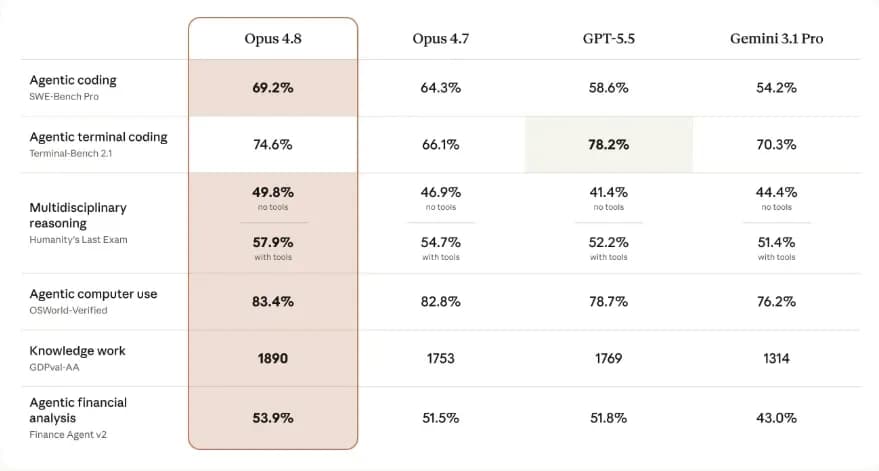
Read the deltas, not just the absolute scores. SWE-Bench Pro jumped +4.9 points (64.3 to 69.2), the headline coding gain. Terminal-Bench 2.1 rose +8.5 points (66.1 to 74.6), the single biggest 4.7-to-4.8 leap, and yet it still trails GPT-5.5. GDPval-AA gained +137 Elo (1753 to 1890), a large knowledge-work jump that also clears GPT-5.5 (1769) by a wide margin. OSWorld-Verified moved just +0.6 (82.8 to 83.4); computer use was already near-ceiling on 4.7, so don't expect a felt difference there. Finance Agent v2 added +2.4 points.
The takeaway is clean: Opus 4.8 wins six of seven benchmarks, and the one it loses, agentic terminal coding, still goes to GPT-5.5. Numbers corroborated by Anthropic's announcement and the OfficeChai benchmark roundup.
What Is Fast Mode, and Is It Cheaper?
Fast Mode runs Opus 4.8 about 2.5x faster at $10 input / $50 output per million tokens, activated with /fast in Claude Code. Anthropic says it's "three times cheaper than it was for previous models." Standard pricing stays at $5/$25 per Mtok, unchanged from 4.7. The key point: Fast Mode keeps you on the full Opus model, it doesn't downgrade you to a smaller one.
So what does that mean per task? You pay a 2x price premium for roughly 2.5x the speed, on the same model intelligence. For interactive Claude Code sessions where you're waiting on output, that trade often pays for itself. For long batch jobs where wall-clock time doesn't matter, standard pricing is the cheaper call.
# In a Claude Code session, switch the current task to Fast Mode:
/fast

# Output streams ~2.5x faster on the same claude-opus-4-8 model.
# Standard pricing ($5/$25) resumes on your next normal task.
At launch, broader API access to Fast Mode required an account manager or waitlist. The advertised “3x cheaper” comparison was against Anthropic's earlier Fast tier, not against standard Opus 4.8. Standard mode remained the lower-priced option. Our Claude usage-limits reference preserves the accompanying tier details.
Dynamic Workflows: Codebase-Scale Migrations With Parallel Subagents
Dynamic Workflows is a research-preview feature on Enterprise, Team, and Max plans that coordinates "swarms of subagents," hundreds of parallel subagents in a single session. Paired with Claude Code and Opus 4.8, Anthropic says it can run codebase-scale migrations across hundreds of thousands of lines, from kickoff all the way to merge, with minimal hand-holding.
Dynamic Workflows lets one Claude Code session fan out into hundreds of parallel subagents to migrate a whole codebase. Think framework upgrades, dependency overhauls, or repo-wide refactors that would normally eat an engineer's week. If you've worked with parallel coding agents before, this is that idea scaled up and orchestrated by the model rather than by you.
Two honest notes. First, it's a research preview, so expect rough edges and don't point it at production-critical migrations without review. Second, it's plan-gated, you need Enterprise, Team, or Max access. TechCrunch framed Dynamic Workflows as Anthropic's answer to competitive pressure from rival labs, and that read tracks: it's the headline developer feature of this release.
We Ran Opus 4.8 in Claude Code: Here's What We Measured
We re-pointed our content-pipeline repo's default model from claude-opus-4-7 to claude-opus-4-8 and re-ran the same agentic tasks we use day to day. Here's what we can say honestly after early hands-on use, qualitative where we don't have hard before/after numbers, specific where we do.
First, the swap is genuinely trivial. Changing the model ID to claude-opus-4-8 and starting a session worked with zero config changes on our side. The 1M-context variant is addressable as claude-opus-4-8[1m] if you need the larger window. We confirmed Fast Mode with /fast keeps you on the full Opus model rather than silently routing to a smaller, cheaper model, which is the behavior we wanted but didn't assume.
What stood out in early use: Opus 4.8 is noticeably more willing to push back. On a refactor task, it flagged an assumption in our existing code as risky rather than quietly building on top of it, the kind of behavior Anthropic's "4x less likely to let flaws pass" claim predicts. We're not going to dress that up as a benchmark, it's one observation on one task. But it's the first thing we noticed, and it lines up with the alignment story.
The Fast Mode speed-up was real and obvious in interactive sessions, output started streaming faster, though we're not publishing a precise latency figure until we've run a clean, repeatable timing test. If you run your own comparison, the honest method is: same prompt, same repo state, standard mode then /fast, and measure wall-clock and token cost both ways. We'll update this section with hard numbers once that test is locked.
Historical 4.7-to-4.8 Migration Decision
The May 2026 recommendation was workload-specific. SWE-Bench Pro and GDPval-AA supported moving coding and knowledge-work tasks to 4.8; Terminal-Bench and near-ceiling computer-use results did not justify an automatic migration.
The historical “switch” case: agentic coding gained 4.9 SWE-Bench Pro points and knowledge work gained 137 GDPval-AA Elo. Our early PR tests also produced fewer wrong turns, while standard token prices stayed level with 4.7.
The historical “wait” case: GPT-5.5 scored 78.2% on Terminal-Bench 2.1 against Opus 4.8's 74.6%. Teams midway through a controlled evaluation also had reason to finish the baseline before changing model IDs.
The historical “stay” case: OSWorld-Verified improved only 0.6 points. For a stable computer-use workload, that delta could be smaller than the operational cost of retesting prompts and tools.
Those recommendations are retained as a release-history record, not current buying advice. Compare the 4.7 archive for the preceding baseline and the Opus 5 analysis for today's decision.
How Do I Switch to Opus 4.8 in Claude Code and the API?
Switching is a near-trivial model-ID swap. Set your default model to claude-opus-4-8 (or claude-opus-4-8[1m] for the 1M context window), pick an effort level if your client exposes one, and you're done. If you build with the Messages API, you can now place system entries inside the messages array instead of only the top-level system field.
# Claude Code: set the default model
/model claude-opus-4-8

# API request body (model ID swap):
{
  "model": "claude-opus-4-8",
  "messages": [
    { "role": "system", "content": "You are a senior engineer." },
    { "role": "user", "content": "Refactor this module." }
  ]
}
Most migrations ended with that model-ID change. Multi-provider teams could place LiteLLM routing in front of the test, hold prompts and repository state constant, and compare standard mode before paying for the Fast tier.
This archive records the stack and model behavior we tested in May 2026. Current production-agent selections should be validated against the newer model generation.
Frequently Asked Questions
What is Claude Opus 4.8?
Claude Opus 4.8 is Anthropic's frontier model, released May 28, 2026, with model ID claude-opus-4-8 and a 1M-context variant claude-opus-4-8[1m]. Anthropic positions it as their most honest model yet, leading 6 of 7 of its published benchmarks and available on Claude.ai, Claude Code, and the API.
When was Claude Opus 4.8 released?
The release date was May 28, 2026, 41 days after Opus 4.7. Claude.ai, Claude Code, and API access opened on that date.
Is Claude Opus 4.8 better than Opus 4.7?
Against 4.7, the archived table shows 69.2% versus 64.3% on SWE-Bench Pro and a 137-Elo GDPval-AA gain. It was not a universal win: GPT-5.5 retained the stronger agentic-terminal result.
Is Opus 4.8 worth upgrading from 4.7?
At release time, the strongest migration case was coding and knowledge work. Terminal-heavy and near-ceiling computer-use workloads had weaker evidence for moving. This is preserved as the May 2026 recommendation; it is no longer the current model-selection answer.
How much does Claude Opus 4.8 cost?
The archived launch prices were $5 input and $25 output per million tokens in standard mode. Fast Mode was $10/$50 and advertised at roughly 2.5 times the generation speed.
What is Fast Mode in Claude Opus 4.8?
Fast Mode was the /fast Claude Code tier for the full claude-opus-4-8 model. It traded a $10/$50 per-million-token rate for approximately 2.5-times faster output; it was not a smaller-model fallback.
What are dynamic workflows in Claude Code?
Dynamic Workflows is a research-preview feature on Enterprise, Team, and Max plans that coordinates hundreds of parallel subagents in a single session. Paired with Claude Code and Opus 4.8, it can run codebase-scale migrations across hundreds of thousands of lines from kickoff to merge. Expect rough edges since it's still a preview.
Does Opus 4.8 support a 1M-token context window?
Yes, via the claude-opus-4-8[1m] variant. You address it by that model ID when you need the larger context window. Note the public Models-overview docs page may still be catching up and might not list the 4.8 entry yet, but the variant is addressable at runtime today.
Does Claude Opus 4.8 actually beat GPT-5.5 at everything?
No. GPT-5.5 still wins agentic terminal coding on Terminal-Bench 2.1, scoring 78.2% to Opus 4.8's 74.6%. Opus 4.8 leads the other six published benchmarks, including SWE-Bench Pro and GDPval-AA, but if your workflow is terminal-heavy, GPT-5.5 remains the stronger pick for that specific task.
How do I switch to Opus 4.8 in Claude Code?
Set your model to claude-opus-4-8 (use /model claude-opus-4-8 in Claude Code) and pick an effort level if your client offers one. For the 1M context window, use claude-opus-4-8[1m]. It's a near-trivial swap with no other config changes needed for most teams.