
OpenHands vs Devin vs Manus: The Honest 2026 Pick (and Why Manus Just Got Bought by Meta)
Here's the short version of OpenHands vs Devin vs Manus: there's no single winner, and one of the three isn't even an independent company anymore. Meta bought Manus (parent: Butterfly Effect) in a deal valued above $2B that closed around December 30, 2025. So your real question isn't "which is best." It's "which fits my one biggest constraint?" OpenHands by All Hands AI is the open-source pick. Devin by Cognition is the turnkey paid engineer at $20 to $500/mo. Manus builds whole apps. Pick by constraint, not hype.
These three are all autonomous coding agents, but they don't play the same game. OpenHands is open-source and self-hostable (MIT, free to run, ~72% SWE-bench Verified with Claude). Devin is Cognition's hands-off engineer (ACU-based, $20 to $500/mo). Manus is a generalist app-builder, now a Meta asset. Pick OpenHands for control, Devin for delegation, Manus for full-app generation.
Quick Verdict:
- OpenHands: open-source, self-host, free to run (pay model API only); ~72% SWE-bench Verified with Claude. Pick for control.
- Devin: Cognition's turnkey paid engineer; $20 to $500/mo, ACU-based; most hands-off autonomy. Pick to delegate.
- Manus: generalist app-builder, credit-based; acquired by Meta in Dec 2025. Pick for end-to-end app generation, with a caveat.
- No universal winner. It depends on your single biggest constraint: control, hands-off autonomy, or full-app generation.
Quick verdict: which of the three should you pick?
OpenHands, Devin, and Manus are three autonomous AI coding agents. OpenHands is open-source and self-hostable (free, MIT, ~72% SWE-bench Verified with Claude). Devin is Cognition's turnkey paid engineer ($20 to $500/mo, ACU-based). Manus is a generalist app-builder, now owned by Meta. Pick OpenHands for control, Devin for hands-off autonomy, Manus for full-app generation.
So how do you actually choose? Start from your single biggest constraint and the answer falls out:
- Pick OpenHands if you want control: self-hosting, your own model, no per-seat lock-in, and the highest open-source SWE-bench score.
- Pick Devin if you want to delegate whole tasks and barely babysit. It's the most hands-off of the three, with Jira, Linear, and Slack wired in.
- Pick Manus if you want to build a full app end-to-end (database, payments, deploy) rather than do surgical repo fixes. Just weigh the Meta-roadmap uncertainty first.
There's no universal winner here. The right autonomous coding agent is the one that fits your single biggest constraint: control, autonomy, or full-app generation. If you're after a broader shortlist (Claude Code, Cursor, Codex, Aider, OpenClaw), see the full 12-agent ranking instead. This post stays laser-focused on these three.
OpenHands vs Devin vs Manus at a glance (the comparison table)
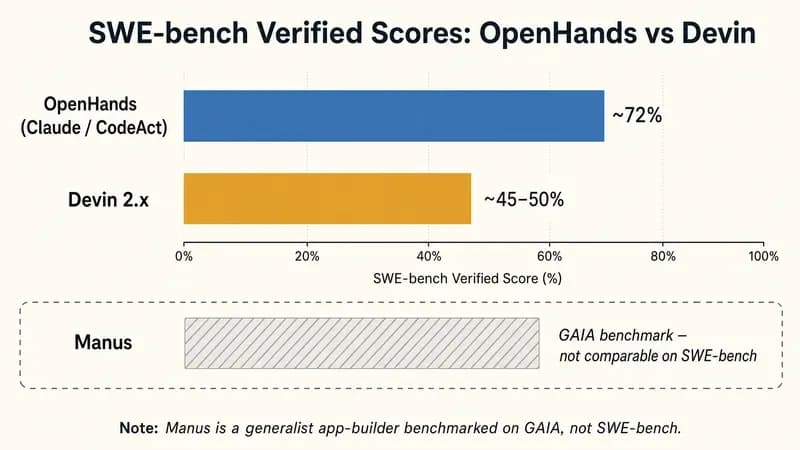
This table is the fastest way to read the three side by side. One thing to flag before you scan it: Manus benchmarks on GAIA, not SWE-bench, because it's an app-builder, not a repo-surgery tool. Forcing a SWE-bench number onto it would be dishonest, so the cell says so. Every benchmark figure below carries its evaluation variant (Verified) and the model used.
| Dimension | OpenHands | Devin | Manus |
|---|---|---|---|
| Type | Open-source agent framework | Turnkey autonomous engineer | Generalist app-builder agent |
| Company / owned by | All Hands AI | Cognition | Meta (acq. Dec 2025) |
| License | MIT (open-source) | Proprietary | Proprietary |
| Pricing model | Free to self-host (+ model API cost) | ACU-based ($20 Core / $500 Team) | Credit-based ($0 free → $200/mo) |
| SWE-bench Verified | ~72% (with Claude / CodeAct) | ~45–50% (2.x; 13.86% at 2024 launch) | Benchmarks on GAIA, not SWE-bench |
| Self-host / offline | Yes (full control) | No | No |
| Model choice (BYOM) | Yes (OpenRouter / Ollama / direct) | No (Cognition-managed) | No (Meta/managed) |
| Best shape of task | Repo surgery, bug fixes, PRs | Hands-off multi-step eng tasks | Full-app generation, browse+build |
| Human-in-the-loop | Configurable | Configurable, mostly hands-off | Configurable |
| Sandbox isolation | Yes (Docker) | Yes (managed) | Yes (managed) |
| Best for | Teams needing control + no per-seat lock-in | Teams delegating whole tasks | End-to-end app/site builds |
Numbers verified against swebench.com, devin.ai/pricing, and openhands.dev as of June 6, 2026.
OpenHands: the open-source, self-host option
OpenHands is the open-source autonomous coding agent by All Hands AI. It's MIT-licensed, free to self-host (you pay only for model API inference), and it posts ~72% SWE-bench Verified when paired with Claude under its CodeAct setup. That's the highest score among open-source agent frameworks in 2026, per the swebench.com leaderboard.
If the name feels familiar, that's because it used to be OpenDevin. All Hands AI rebranded it to OpenHands in late 2024. The project has ~70k+ GitHub stars and a real community behind it, which matters more than it sounds: with open-source agents, the issue tracker is your support line.
The headline feature is BYOM, short for bring-your-own-model. You're not locked to one provider. Run it through OpenRouter, hit an API directly, or point it at a local Ollama model for full offline operation. (Want the gory details? Here's how to run OpenHands on your own model.) You can also reach it from the terminal: the openhands CLI lets you fire off a task without touching the web UI, which is handy in CI. It slots cleanly into the broader agent frameworks ecosystem, and you can wire it up with MCP for custom tooling.
There's also OpenHands Cloud with a free tier (MiniMax model) if you don't want to host anything. The enterprise self-host path, with Kubernetes and RBAC, needs a commercial license.
Honest limits: this is not turnkey. You're signing up for a setup tax. Docker, model config, a sandbox to babysit, and you own the inference bill, which can sneak up on you when a long Claude run goes sideways. If "no infra work" is non-negotiable, OpenHands isn't your pick.
Pick OpenHands if control, self-hosting, and model choice beat convenience for you.
Devin: the turnkey autonomous engineer
Devin is Cognition's turnkey autonomous engineer. You hand it a task, it plans, codes, tests, and opens a PR with minimal hand-holding. Pricing is ACU-based (Agent Compute Unit), starting at $20/mo Core and $500/mo Team, and it plugs straight into Jira, Linear, and Slack. It's the most hands-off of the three.
What's an ACU? One Agent Compute Unit is roughly 15 minutes of active autonomous work. Core ($20/mo) comes with overage at ~$2.25/ACU and a 10-session cap. Team ($500/mo) bundles 250 ACUs at ~$2.00/ACU with unlimited concurrent sessions, which is the real reason teams pay for it: you can have Devin chewing on five tickets at once. Enterprise is custom (VPC, SSO, admin controls). All current per devin.ai/pricing.
Now, the benchmark question, because it confuses people. At its 2024 launch, Devin scored 13.86% on SWE-bench. That number still floats around blogs as if it's current. It isn't. Devin 2.x sits around ~45–50% SWE-bench Verified today (verify against swebench.com before you quote it). Cognition has been openly clear that they optimize for real-world usability over benchmark score, so the gap between Devin's headline number and the open-source leaders is partly deliberate positioning, not pure capability. If you only run async tasks, also read our take on background vs inline agents.
Honest limits: the ACU model means cost ramps with usage, and a runaway agent burns budget fast. It's less transparent than open-source options, and you can't self-host. What Cognition runs is what you get.
Pick Devin if you want to delegate whole engineering tasks and hand off the babysitting.
Manus: the generalist agent that also codes (and the Meta question)
Manus is a generalist autonomous agent that happens to code. It plans multi-step tasks, browses the live web, writes and runs code, and builds full web apps (database, Stripe, SEO) end-to-end. Pricing is credit-based, and it benchmarks on GAIA, not SWE-bench. As of late December 2025, it's a Meta asset. We unpack what the Meta deal means for your build decision below.
That GAIA-vs-SWE-bench detail is the whole story with Manus. SWE-bench measures repo surgery: can the agent fix a real bug in an existing codebase and pass the tests? GAIA measures generalist task completion: can the agent plan, browse, and execute a multi-step job? Manus is built for the second thing. Asking how it does on SWE-bench is like asking a general contractor to perform dental work. Wrong tool, wrong test.
On credits: the free tier is $0 with 300 daily refresh credits. Standard is $20/mo (~4,000 credits), Customizable $40/mo (~8,000), Extended $200/mo (~40,000), and Team starts at $20/seat. Credits scale with task complexity. A ~25-minute site build runs roughly 360 credits, so the bigger the job, the faster they drain. One caveat: pricing may have shifted post-Meta. Treat the roadmap as Meta's to change.
Honest limits: Manus is not a repo-surgery tool. If your job is "fix this failing test in our monorepo," it's the wrong shape. Credits burn fast on complex builds. And the big one: its independent roadmap and pricing are now uncertain, because they're Meta's call, not a scrappy startup's.
Pick Manus if you want to build a full app or site end-to-end, and you can stomach the post-acquisition uncertainty.
How OpenHands, Devin, and Manus actually feel in day-to-day use
Put OpenHands (self-hosted, BYO Claude) and Devin on the same kind of job, fix a failing test and open a clean PR, and the gap that matters isn't accuracy. It's how much babysitting each one needs.
OpenHands, once it's configured, is fast and transparent. You watch it reason, you see every shell command, and when it goes wrong you know exactly where. The cost is the config: you start Docker, wire up the Claude key, and you're watching the inference meter. For a one-line test fix, that's overhead. For a team that runs dozens of these a week and wants full visibility, the overhead pays for itself.
Devin is the opposite trade. You write a ticket, you walk away, you come back to a PR. Less to watch, less to debug when it stumbles, and the ACU clock is ticking the whole time. For a simple fix it can feel like swatting a fly with a forklift; for a gnarly multi-file task it's exactly the autonomy you're paying for.
Manus is a different shape of tool entirely, and that's the asymmetry the whole comparison hinges on. Point it at "build and deploy a small app" rather than "fix a repo bug" and it ships a working app with a database, the kind of end-to-end build where OpenHands or Devin tend to over-engineer. Flip the task to surgical repo work and Manus is the wrong fit. The lesson isn't "X is best." It's that the task shape decides the tool before any benchmark does.
What does the Meta acquisition mean for Manus users?
Meta acquired Manus (parent company Butterfly Effect) in a deal valued above $2B, struck in roughly 10 days and closed around December 29–30, 2025. Meta states there's no continuing Chinese ownership, and Manus is set to stop operating in China. This is the fact no competitor comparison article mentions, so here's the practical read.
The timeline: Butterfly Effect was founded in Beijing in 2022 and relocated to Singapore in mid-2025 before the deal. The acquisition was reported by CNBC, TechCrunch, and Bloomberg, with the China-exit detail covered by Fortune.
So can you still build on Manus in 2026? As of mid-2026, yes. But here's the part to take seriously before you commit a workflow to it: Manus didn't disappear, it became a Meta asset, which means its roadmap and pricing are now Meta's call, not an independent startup's. Big-company acquisitions go three ways: the product gets folded into a platform, rebranded, or quietly sunset. None of those are great if you've built a business process around the standalone tool. Weigh that lock-in risk against the convenience.
When should you NOT use each one? (and how to roll back a bad agent PR)
The honest "don't use this" list: don't use OpenHands if you have zero appetite for infra setup. Don't use Devin if your usage is occasional, because the ACU burn doesn't pay off. Don't use Manus for surgical repo bug fixes, or if acquisition uncertainty is a dealbreaker for a core workflow.
A few specific failure modes worth knowing. OpenHands can stall on a misconfigured sandbox or an unexpected dependency, and because you self-host, you're the one debugging it at 11pm. Devin can confidently produce a plausible-but-wrong PR and quietly spend ACUs doing it, so review every diff. Manus can over-build (you asked for a form, you got a full app with auth you didn't request), and complex builds drain credits fast.
The smartest safety move with any agent? Treat its output like a junior dev's first PR. Always run agents on a dedicated branch, never straight to main, and keep human-in-the-loop review gates on by default. If a run goes bad, rolling back is one command:
git revert <bad-commit> # or: git checkout main && git branch -D agent/feature-xPair that with branch protection so no agent can merge without a human approval. Boring, yes. It's also the difference between an agent that helps and one that ships a Friday-night regression nobody catches until Monday.
Decision matrix: pick this if…
Stop comparing feature lists and start from your single biggest constraint. Find your constraint in the left column and the pick falls out. This is the payoff: one honest mapping instead of three marketing pages.
| Your biggest constraint | Pick | Why |
|---|---|---|
| Data control / no per-seat lock-in / offline | OpenHands | MIT, self-host, BYOM: you own the stack and the bill |
| Hands-off delegation of whole eng tasks | Devin | Most autonomous; ACU model scales with usage |
| Build a full app/site end-to-end (DB, Stripe, deploy) | Manus | App-builder shape, but weigh the Meta-roadmap uncertainty |
| Tightest budget / experimenting | OpenHands free or Manus free tier | $0 entry; pay only when you scale |
| Highest measured code-fix accuracy on a benchmark | OpenHands w/ Claude | ~72% SWE-bench Verified, top open-source |
| Need vendor SLAs + enterprise SSO/VPC | Devin Enterprise | Managed, turnkey, contractual support |
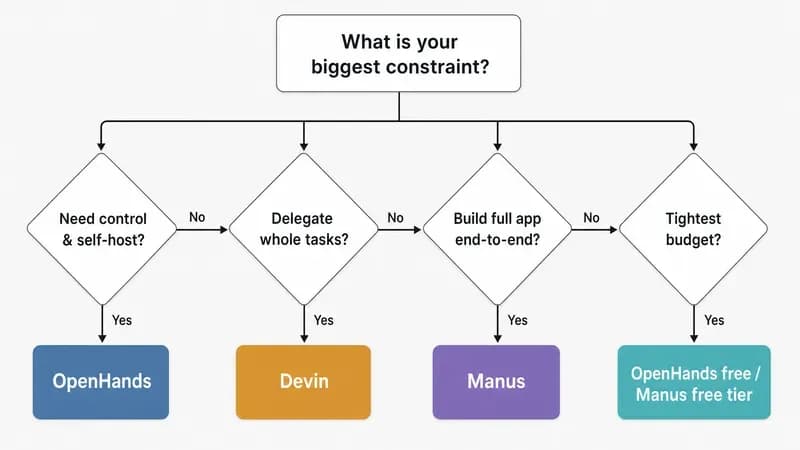
If two constraints tie, weight the one you can't change. You can always swap models or upgrade a plan later. You can't easily un-pick a self-host commitment or a vendor lock-in once a team's workflow depends on it.
How Techsy chooses autonomous agents for client work
When we pick an autonomous coding agent for a client project, we don't start with the leaderboard. We start with one question: does this client need control, delegation, or app generation? In our experience, regulated clients and teams allergic to per-seat lock-in land on OpenHands self-hosted. Teams that want to hand off whole tickets and not think about it land on Devin. Founders shipping a v1 fast lean toward an app-builder like Manus, with the acquisition caveat spelled out.
The pattern we've seen across client work: the benchmark gap matters less than the task shape and the team's tolerance for setup. If you'd like a second opinion on which fits your stack, get a free consultation and we'll walk through it.
Frequently Asked Questions
Is OpenHands really as good as Devin?
It depends on what you measure. On SWE-bench Verified, OpenHands with Claude scores higher (~72% vs Devin's ~45–50%). But Devin wins on hands-off autonomy and built-in Jira/Linear/Slack integrations. If you value raw benchmark accuracy and control, OpenHands edges it. If you value zero setup and delegation, Devin does.
Is Manus still usable after the Meta acquisition? Can you still build on it?
As of mid-2026, yes, Manus is still usable and you can build on it. But Meta acquired it in December 2025, so its roadmap and pricing are now Meta's call. Acquired products can be folded in, rebranded, or sunset. Weigh that lock-in risk before you commit a core workflow to it.
Which is cheaper: OpenHands, Devin, or Manus?
OpenHands is free to self-host, though you pay for model inference. Manus has a $0 free tier with 300 daily credits. Devin starts at $20/mo. The cheapest option at scale depends on your usage shape: heavy repo work favors OpenHands, occasional tasks favor a free tier, and team delegation can justify Devin's $500/mo Team plan.
Can OpenHands run fully offline / self-hosted?
Yes. OpenHands is MIT-licensed and self-hostable, and you can point it at a local model through Ollama for fully offline operation. That's its core differentiator over Devin and Manus, neither of which can self-host. You trade convenience for control and data privacy.
What SWE-bench score does Devin have vs OpenHands?
OpenHands scores ~72% SWE-bench Verified with Claude (CodeAct). Devin 2.x sits around ~45–50% SWE-bench Verified. Note: the famous 13.86% figure for Devin is the OLD 2024 launch number, not current. Cognition prioritizes real-world usability over benchmark optimization, so always check swebench.com for the live figure.
Is Devin worth $500/month?
For teams delegating whole engineering tasks with unlimited concurrent sessions, yes. The $500/mo Team plan bundles 250 ACUs and lets multiple agents run in parallel. For occasional or solo use, it's overkill. Core ($20/mo) or self-hosted OpenHands will cost you far less for light workloads.
Does Manus do SWE-bench-style repo surgery?
No. Manus is a generalist app-builder benchmarked on GAIA, not SWE-bench. It's better at planning, browsing, and building full apps end-to-end than at surgical bug fixes in an existing codebase. For repo surgery, OpenHands or Devin is the right shape of tool.
Is OpenHands the same as OpenDevin?
Yes. OpenDevin rebranded to OpenHands under All Hands AI in late 2024. Same project, same lineage, new name. If you find older tutorials referencing OpenDevin, they apply to OpenHands, though the CLI and config have evolved since the rename.
What about Claude Code, Cursor, or Aider?
Those are excellent agents, but they're a different lane than this three-way comparison. Claude Code and Aider are more inline/assistant-shaped, and Cursor is an editor. For a full shortlist with all of them ranked, see the full 12-agent ranking.
Which should a solo developer pick?
Usually OpenHands (free to self-host) or a free/low tier of Manus or Devin. If your work is repo surgery and bug fixes, OpenHands gives you the best accuracy for $0 plus inference. If you're building apps end-to-end, Manus's free tier is a better fit. Match the tool to your task shape.
The bottom line
There's no universal winner among OpenHands, Devin, and Manus. The right autonomous coding agent is the one that fits your single biggest constraint.
- OpenHands: pick for control. Open-source, self-host, BYOM, top open-source SWE-bench (~72% with Claude).
- Devin: pick to delegate. Turnkey, ACU-based ($20 to $500/mo), most hands-off autonomy.
- Manus: pick for full-app builds. Credit-based generalist, GAIA-benchmarked, now a Meta asset (factor in the roadmap uncertainty).
- Always run agents on a branch with human review gates, never straight to main.
Still not sure which fits your team's stack and risk tolerance? Get a free consultation and we'll help you choose.