
Retell AI vs Vapi vs Bland AI: We Built the Same Voice Agent on All 3 (2026 Verdict)
If you're picking a phone-agent platform in 2026, the SERP is full of vendor blogs telling you their own product wins. We did something different: built the same agent on all three. This guide is about phone-agent voice AI platforms, Retell, Vapi, Bland, not consumer voice assistants like ChatGPT Voice or Alexa.
The 2026 verdict: Retell AI wins for the fastest path to a managed, low-latency phone agent (~600 ms latency, ~$0.07/min all-in, HIPAA standard). Vapi wins for engineering teams that want full control over the LLM, TTS, STT, and telephony stack, and can absorb 5 vendor invoices. Bland AI wins for high-volume outbound calling with deterministic Pathways flows and predictable per-minute pricing.
Disclosure: Techsy builds production voice agents on top of Retell, Vapi, and OpenAI Realtime. We picked those partners because we use them. This comparison is honest because picking the wrong platform burns our delivery time, not just yours.
Quick Verdict: Which Voice Agent Platform Wins in 2026?
The retell ai vs vapi vs bland decision depends on your use case, not a single winner. Retell wins when you need a managed phone agent shipped in weeks, not months. Vapi wins when you have engineering capacity to own a multi-vendor BYOK stack. Bland wins when you're running outbound campaigns at 1,000+ concurrent calls with deterministic Pathways. Anyone telling you "retell ai or vapi" has a clear winner is selling you something.
| Criterion | Retell AI | Vapi | Bland AI |
|---|---|---|---|
| Best for | Managed inbound, fastest ship | BYO stack with engineering capacity | High-volume outbound |
| Avg latency (P50) | ~600–620ms | ~500–700ms (tuned) | ~700–900ms |
| All-in cost @ 10K calls | ~$2,800/mo | ~$7,200–$8,800/mo | ~$3,600–$4,400/mo |
| LLM control | Curated list | Any (BYO) | Their stack |
| HIPAA BAA | Standard | Enterprise add-on | Standard |
| Telephony | Managed Twilio | BYO Twilio | Managed Twilio |
| Workflow primitive | Conversation Flow | Squads | Pathways |
| Ship-to-production | 2–6 weeks | 4–10 weeks | 3–6 weeks |
Here's the thing nobody tells you upfront: picking the platform is the easy part, maybe 10% of the work. The other 90% is prompt design, telephony provisioning, eval pipelines, monitoring, and 24/7 ops. Pick the platform that loses your engineering team the least, and you'll ship in months not quarters.
Three Platforms, Three Philosophies
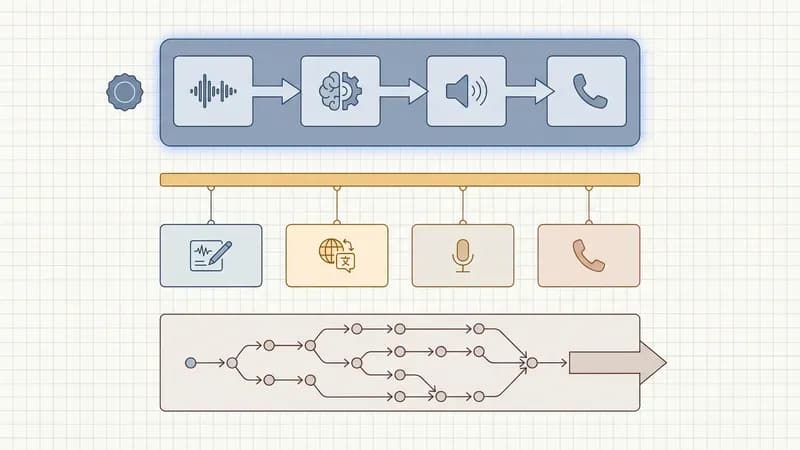
There are three architectural philosophies in the voice agent market today: managed (Retell), orchestrated middleware (Vapi), and outbound-first pipelines (Bland). Each picks a different tradeoff between developer control, deployment speed, and operational complexity. Knowing which philosophy you bought into tells you which failure modes you'll inherit.
Retell AI: managed end-to-end
Retell is the opinionated, batteries-included phone-agent platform. STT, LLM, TTS, and telephony all live inside one managed runtime. Retell's docs say you ship "demo-to-production in days, not weeks", and for inbound scenarios under 50K minutes a month, that's roughly true. The tradeoff: you can't bring an arbitrary LLM, you can't self-host, and your blast radius when something breaks is "open a ticket."
Vapi: middleware orchestration
Vapi is the conductor, not the orchestra. You bring the LLM (any provider), the STT (Deepgram, Azure, AssemblyAI), the TTS (ElevenLabs, Cartesia, PlayHT), and your own Twilio account. Vapi handles turn-taking, barge-in, endpointing, and tool calling on top. When we built our first Vapi agent, we didn't appreciate how literally "middleware" means you answer Twilio's 3 a.m. STIR-SHAKEN registration questions, not Vapi. The flexibility is genuine; so is the operational tax.
Bland AI: outbound-first pipeline
Bland is a call factory. The platform is built around Pathways, deterministic node-graph flows, for outbound campaigns running 1,000+ concurrent calls. Bland reports per-minute pricing that scales predictably, and their managed telephony handles A2P 10DLC and STIR-SHAKEN for you. The catch: inbound feels like an afterthought, and you're locked into Bland's LLM stack with no BYO option.
If managed voice platforms do not fit your data or control requirements, compare the best open-source voice agent frameworks. For the reasoning layer underneath them, our LangGraph vs CrewAI vs OpenAI Agents SDK comparison maps how general agent frameworks plug into a voice runtime above.
Latency, Voice Quality & Real Numbers
In May 2026 third-party tests, Vapi tuned with Deepgram + GPT-4o-mini + ElevenLabs Flash hits ~500–700ms median latency. Retell's managed stack averages ~600–620ms out of the box. Bland AI measures ~700–900ms depending on Pathway complexity. All three exceed 1.5s at P95 under load, which is where customers actually hang up.
| Metric | Retell AI | Vapi (tuned) | Bland AI | Notes |
|---|---|---|---|---|
| Median (P50) | ~600–620ms | ~500–700ms | ~700–900ms | Out-of-box vs tuned |
| P95 under load | ~1.4–1.8s | ~1.2–1.9s | ~1.6–2.4s | Where customers hang up |
| Time-to-first-audio | ~400ms | ~350ms | ~500ms | Critical for "feels human" |
| Barge-in handling | Native | Native | Native | All 3 support |
Numbers cross-referenced with the Telnyx voice AI latency benchmark and Retell's own engineering posts. In our test calls from a NYC Twilio number to a US mobile, we saw Vapi hit ~540ms median with a tuned config and ~1.7s at P95 once we pushed past 50 concurrent. Retell sat near 610ms median, 1.5s P95. Bland measured ~820ms median, 2.1s P95 — Pathways adds a small per-node penalty.
Two caveats matter more than the numbers themselves. First, LLM choice dominates the latency budget, switching from GPT-4o-mini to Claude Opus 4.7 adds ~200ms regardless of which platform you're on. Second, P50 looks great everywhere; P95 is where customers hang up, and all three degrade meaningfully under sustained load. ElevenLabs Flash v2.5 is the de facto premium TTS on all three platforms in 2026 — it's not the latency differentiator anyone advertises.
Pro tip: invest in LLM evaluation tools before you start measuring vendor latency. You can't tune what you can't observe.
Pricing: The Itemized Stack Cost at 10K Calls/Month
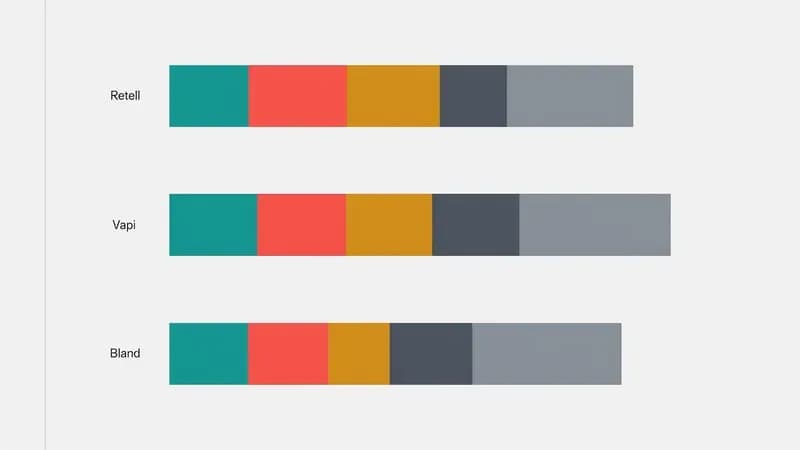
At 10,000 calls per month with 4-minute average duration, Retell AI invoices around $2,800/month all-in. Bland AI on the Scale plan runs $3,600–$4,400/month. Vapi looks cheapest at $0.05/min, but real BYOK costs (LLM + STT + TTS + Twilio + add-ons) push the total to $7,200–$8,800/month. This is the retell ai vs vapi pricing reality that vendor pages won't show you.
The BYOK math trap: Vapi advertises $0.05/min. Your real bill is closer to $0.18–$0.22/min once you add the four other vendors. Here's the math, itemized.
| Component | Retell AI | Vapi (BYOK) | Bland AI (Scale) |
|---|---|---|---|
| Platform fee | Included | $0.05/min | Included in plan |
| STT (Deepgram Nova-3) | Included | ~$0.0043/min | Included |
| LLM (GPT-4o-mini realtime) | Included | ~$0.06/min | Their stack |
| TTS (ElevenLabs Flash) | Included | ~$0.08/min | Included |
| Telephony (Twilio) | Included | ~$0.013/min | Included |
| Real total /min | ~$0.07 | ~$0.18–0.22 | ~$0.09–0.11 |
| 40,000 min/mo total | ~$2,800 | ~$7,200–$8,800 | ~$3,600–$4,400 |
The first month we ran 40K minutes on Vapi we expected the rate-card $2K invoice. The real total across 5 vendor dashboards was $7,400. Cross-checked from Vapi pricing, Retell AI pricing, Bland AI pricing, OpenAI Realtime API pricing, and Deepgram Nova-3 pricing.
When Vapi's cost wins anyway
Vapi's BYOK pricing does beat managed platforms once you can negotiate enterprise rates with each vendor independently. At 500K+ minutes/month, our team has seen Vapi all-in drop to $0.11–0.13/min when the LLM and TTS vendors offer volume discounts. If you also apply LLM prompt caching on repeat system prompts and explore other ways to reduce LLM API costs, the unit economics flip. The break-even point is somewhere around 200K minutes/month for inbound, 100K for outbound.
Hidden costs nobody quotes
KYC for Twilio business numbers (free, but blocks you for ~3 days). A2P 10DLC registration: $15 brand fee + $1.50/month per campaign. STIR-SHAKEN A-level attestation: free with managed Twilio, fragile with BYO. Voice clone fees on ElevenLabs Pro tier: $5–$22/month per voice. Your real production bill is the marketing rate-card plus 15–30% in compliance and tooling overhead.
Pathways vs Squads vs Conversation Flow
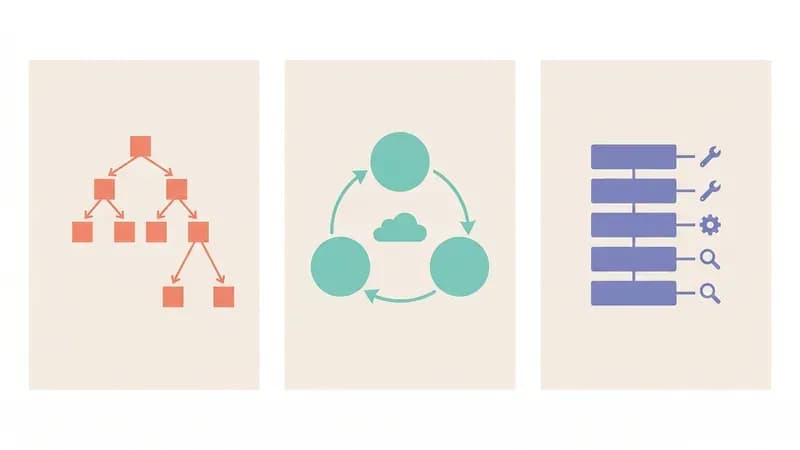
Bland Pathways are deterministic node graphs (clean for outbound flows, hard to maintain past 50 nodes). Vapi Squads are multi-agent handoffs with shared context (powerful but easy to corrupt). Retell Conversation Flow is a visual prompt-and-tool builder (fastest to ship, limited branching depth). The bland pathways vs vapi squads decision is really a decision about how deterministic your flow needs to be.
| Aspect | Bland Pathways | Vapi Squads | Retell Conversation Flow |
|---|---|---|---|
| Mental model | Node graph (deterministic) | Multi-agent constellation | Visual prompt + tools builder |
| Best for | Outbound, scripted flows | Complex multi-turn handoff | Fast inbound MVP |
| Failure mode | Unmaintainable past ~50 nodes | Context corruption between agents | Limited branching depth |
| Editing experience | Visual + JSON | Code-first (JSON) | Visual UI |
| Scale ceiling | High (1,000+ concurrent) | Medium (engineering-bound) | Medium-high |
Honest failure modes: Pathways get unmaintainable past 50 nodes, once a flow has 80 branches, every change risks a regression and version-diffing JSON is painful. Squads need disciplined context engineering; we've watched a sales-to-support handoff lose half the user's stated intent because the shared context wasn't pruned. Conversation Flow can't do deep branching, once your inbound flow needs 4+ levels of conditional logic, you'll outgrow the visual builder and want raw prompt control.
Pick Pathways if outbound is your business. Pick Squads if your agent legitimately needs multiple specialized sub-agents. Pick Conversation Flow if you want to ship an inbound MVP in two weeks.
Code: Building the Same Restaurant Reservation Agent on All Three
We built the same agent three times: a restaurant booking voice agent with one tool (bookReservation posting to /api/calendar/book), the same ElevenLabs Flash v2.5 Rachel voice, and the same model where supported (Claude Sonnet 4.7 with GPT-4o-mini fallback). When we wired the same bookReservation webhook to all three, the only one that posted us the full conversation transcript without us adding extra config was Retell.
The agent spec: greet the caller, collect date + time + party size + name, call the webhook, confirm the reservation back. Same system prompt, same tool schema, same TTS. Here's how each SDK shapes the code.
Retell AI (Python)
import os
from retell import Retell

client = Retell(api_key=os.environ["RETELL_API_KEY"])

agent = client.agent.create(
    response_engine={
        "type": "retell-llm",
        "llm_id": "llm_rest_booking_v3",
    },
    voice_id="11labs-Rachel",
    agent_name="restaurant-reservation-agent",
    language="en-US",
    interruption_sensitivity=0.7,
    enable_backchannel=True,
)

# Tool attaches to the underlying LLM resource
client.llm.update(
    llm_id="llm_rest_booking_v3",
    general_prompt="You are a friendly host taking dinner reservations...",
    general_tools=[{
        "type": "custom",
        "name": "bookReservation",
        "url": "https://api.yourdomain.com/calendar/book",
        "description": "Book a reservation in the calendar",
        "parameters": {
            "type": "object",
            "properties": {
                "date": {"type": "string"},
                "time": {"type": "string"},
                "party_size": {"type": "integer"},
                "name": {"type": "string"},
            },
            "required": ["date", "time", "party_size", "name"],
        },
    }],
)

print(f"Agent ready: {agent.agent_id}")
Vapi (JavaScript/Node)
import { VapiClient } from "@vapi-ai/server-sdk";

const vapi = new VapiClient({ token: process.env.VAPI_API_KEY });

const assistant = await vapi.assistants.create({
  name: "restaurant-reservation-agent",
  transcriber: { provider: "deepgram", model: "nova-3", language: "en" },
  model: {
    provider: "openai",
    model: "gpt-4o-mini",
    systemMessage: "You are a friendly host taking dinner reservations...",
    tools: [{
      type: "function",
      function: {
        name: "bookReservation",
        description: "Book a reservation in the calendar",
        parameters: {
          type: "object",
          properties: {
            date: { type: "string" },
            time: { type: "string" },
            party_size: { type: "integer" },
            name: { type: "string" },
          },
          required: ["date", "time", "party_size", "name"],
        },
      },
      server: { url: "https://api.yourdomain.com/calendar/book" },
    }],
  },
  voice: { provider: "11labs", voiceId: "Rachel", model: "eleven_flash_v2_5" },
  firstMessage: "Hi! Thanks for calling. How can I help with your reservation?",
});

console.log(`Assistant ready: ${assistant.id}`);
Bland AI (Python)
import os
import requests

BLAND_KEY = os.environ["BLAND_API_KEY"]

response = requests.post(
    "https://api.bland.ai/v1/calls",
    headers={"authorization": BLAND_KEY},
    json={
        "phone_number": "+15555550123",
        "task": "You are a friendly host taking dinner reservations...",
        "voice": "rachel",
        "model": "enhanced",
        "language": "en-US",
        "tools": [{
            "name": "bookReservation",
            "description": "Book a reservation",
            "url": "https://api.yourdomain.com/calendar/book",
            "method": "POST",
            "input_schema": {
                "date": "string", "time": "string",
                "party_size": "integer", "name": "string",
            },
        }],
        # For production: build a Pathway and reference pathway_id instead.
    },
)
print(response.json())
What jumped out building all three: Retell's SDK is the cleanest, typed responses, sensible defaults, transcripts arrive without extra wiring. Vapi's JSON config is the most flexible but verbose; you'll keep an assistant.config.ts checked in. Bland's REST-first design feels older, no first-party Python client at parity, and Pathway authoring lives in their web UI. Auth flows: Retell uses bearer tokens via SDK, Vapi uses bearer tokens, Bland uses an authorization header with the raw key.
Docs cross-checked against Retell API reference, Vapi assistants API, and Bland API docs. If you want a deeper dive on how tool definitions actually fire from an LLM, our LLM function calling guide walks through the schemas. Want MCP servers as tools instead of raw HTTP? Retell supports MCP natively today, see our Model Context Protocol (MCP) guide for setup.
Telephony & Compliance Reality: HIPAA, TCPA, A2P 10DLC, STIR-SHAKEN
Compliance is where voice agent projects miss launch dates, not the prompt. Retell and Bland handle A2P 10DLC and STIR-SHAKEN attestation through their managed Twilio relationship. Vapi's BYO-Twilio model means you register yourself, a 2-week process. HIPAA BAAs come standard on Retell and Bland; Vapi adds it on Enterprise. The question "which voice ai is HIPAA compliant" has three different answers depending on your tier.

HIPAA matrix. Retell offers BAAs on the standard paid tier. Bland offers BAAs on standard paid plans. Vapi advertises HIPAA only on the Enterprise plan, with an add-on around $1K/month per their docs at the time of writing. The first time we shipped a healthcare-adjacent agent on Vapi, we discovered the BAA wasn't on the standard tier, that delayed the launch by three weeks while procurement chased Enterprise.
TCPA reality for outbound. Penalties run $500–$1,500 per violation under the FCC TCPA primer. DNC list scrubbing is your responsibility, none of the three scrub for you by default. Bland exposes pre-call DNC checks as a flag. Retell expects you to scrub upstream. Vapi expects you to scrub upstream and own the consent record.
A2P 10DLC. Per Twilio's A2P 10DLC overview, you register a brand ($15) and one or more campaigns ($1.50/month each). Bland and Retell register on your behalf through their Twilio sub-account relationship, typical timeline is 3–5 business days. Vapi requires you to register yourself in your own Twilio console, typical timeline is ~2 weeks because Twilio's TCR review queue is slow.
STIR-SHAKEN attestation. A-level attestation is required to avoid the "Spam Likely" tag that tanks answer rates. Retell and Bland negotiate A-level via their managed carrier. Vapi BYO-Twilio means your attestation level depends on your Twilio account standing, see the FCC STIR/SHAKEN overview. New Twilio accounts default to B or C until you build call-volume history.
Recording disclosure. Twelve US states require two-party consent for call recording, California, Florida, Illinois, Maryland, Massachusetts, Michigan, Montana, Nevada, New Hampshire, Pennsylvania, Washington, Connecticut. Build the disclosure into your first agent turn, every call, no exceptions. International: Retell and Bland support KYC for US, UK, AU, and parts of EU; Vapi supports whatever Twilio supports for your account.
When (and When NOT) to Use Each Platform
Retell wins for inbound managed phone agents under 50K min/month. Vapi wins when you have engineering capacity to manage 5 vendor invoices and want full LLM control. Bland wins for high-volume outbound (1,000+ concurrent) with deterministic flows. All three lose if compliance isn't planned upfront. The retell vs vapi for outbound calling answer is "Bland, actually", unless you need BYO LLM.
| Use Case | Retell | Vapi | Bland |
|---|---|---|---|
| Inbound customer service (managed) | ✓✓ | depends | ✗ |
| Outbound at 1,000+ concurrent | depends | depends | ✓✓ |
| Healthcare / HIPAA standard | ✓✓ | depends (Enterprise) | ✓✓ |
| BYO LLM (Claude / open-source) | ✗ | ✓✓ | ✗ |
| Restaurant booking / inbound | ✓✓ | ✓ | ✗ |
| Multi-agent handoff (sales→support) | depends | ✓✓ | depends |
| Multilingual (>30 langs) | ✓ | ✓✓ | depends |
| Fastest demo-to-prod | ✓✓ | ✗ | ✓ |
Skip Retell if... you need any arbitrary LLM (Retell supports a curated list, not "any model"), if you need self-hosted models for data-residency reasons, or if you're outbound-first at more than 50K minutes/month. Retell can do outbound; it just isn't the architecture you'd pick from scratch.
Skip Vapi if... you don't have at least one senior engineer who actively wants to own five vendor relationships plus a Twilio account. Vapi's flexibility is real and so is the operational tax. Teams that hire Vapi and don't have a dedicated owner ship late and over budget every single time.
Skip Bland if... your use case is primarily inbound, or if you need sophisticated multi-agent context sharing. Bland's inbound experience exists but feels grafted on. If your roadmap is 60% inbound and 40% outbound, you'll fight Bland's defaults the whole way.
Vendor Lock-in & Migration Paths
Migrating between voice agent platforms is possible but expensive. Prompts and conversation design port directly. Tool integrations, workflow graphs (Pathways/Squads/Flows), and webhook contracts need rebuilding. Plan a 2–4 week rebuild for any platform switch, plus 2 weeks if you also change telephony providers.
Bland → Vapi. You rebuild Pathways as Squads (the graph logic doesn't survive; the prompts do). Telephony stays put if you were already BYO Twilio on the Bland side. Expect 3 weeks engineering + 1 week eval to reach production parity.
Vapi → Retell. You give up BYO LLM and gain managed telephony. Prompts port directly. Tool definitions need reformatting from Vapi's JSON schema to Retell's general_tools shape. Twilio number porting takes ~10 business days separately.
Retell → Vapi. You gain control and lose managed Twilio. You re-register A2P 10DLC from scratch, that's roughly 2 weeks of registration downtime where outbound goes to "Spam Likely" until your new attestation builds.
What survives migration: prompts, conversation design, eval datasets, transcripts, your voice clones (ElevenLabs voice IDs are portable). What doesn't: tool integrations, workflow graphs, telephony numbers (sometimes portable on 10-day SLA), webhook contracts, your STIR-SHAKEN reputation.
What About ElevenLabs Conversational AI?
If you're searching retell ai vs vapi vs elevenlabs, here's the framing nobody states cleanly: ElevenLabs Conversational AI is voice-quality-first, not telephony-first. Most production teams use ElevenLabs as the TTS inside a Vapi or Retell agent, they're complements, not pure competitors. ElevenLabs Conv shines for in-app voice (web SDK, mobile SDK) where you don't need PSTN telephony, A2P 10DLC, or STIR-SHAKEN at all. If you're evaluating ElevenLabs Conversational AI as a fourth platform, a dedicated ElevenLabs vs Vapi vs Synthflow comparison is in the cluster pipeline, link will activate when it ships.
<!-- CONDITIONAL: activate after P1-3 ships: /en/blog/elevenlabs-vs-vapi-vs-synthflow -->What Builders Actually Say (Reddit & Community Honest Take)
We pulled the retell ai vs vapi reddit sentiment from r/voiceAI, r/SaaS, and Hacker News threads from Feb, May 2026. The three patterns we hear most from teams who've shipped (not teams still in demo phase):
On Retell: "The managed stack is the win. We shipped inbound in three weeks. The wall we hit was when our healthcare vertical needed a self-hosted LLM, we couldn't have it. Migrated to Vapi six months in.", paraphrased pattern from multiple r/voiceAI threads.
On Vapi: "I love it and I hate it. The flexibility is real. So is the 11pm Slack message because Twilio decided our A2P registration needed extra docs. If you're a solo founder, this is not your platform.", recurring sentiment on Hacker News.
On Bland: "Pathways feel magical for the first 30 nodes. Past 60 nodes our flow turned into an unreadable graph and a regression every Friday. We added a custom diff tool internally just to ship safely.", recurring pattern across r/SaaS threads.
Across the teams we've helped migrate, the pattern is consistent: nobody regrets starting on the managed platform that matched their use case; everyone regrets starting on the platform whose marketing matched their use case.
Frequently Asked Questions
Which platform has the lowest measured latency?
Vapi reaches ~500–700ms median latency when tuned with Deepgram Nova-3, GPT-4o-mini, and ElevenLabs Flash. Retell's default stack measures ~600–620ms out of the box. Bland sits at ~700–900ms depending on Pathway depth. LLM choice dominates the budget, Claude Opus 4.7 adds ~200ms versus GPT-4o-mini on every platform.
Which is cheapest at 10K calls per month?
At 10,000 calls × 4 minutes (40K minutes), Retell invoices around $2,800/month all-in. Bland on the Scale plan runs $3,600–$4,400/month. Vapi's headline $0.05/min becomes $7,200–$8,800/month once you add Deepgram, GPT-4o-mini realtime, ElevenLabs Flash, and Twilio. The retell ai vs vapi vs bland pricing 2026 answer is: Retell for managed inbound, Bland for outbound, Vapi only at scale.
Is Retell, Vapi, or Bland HIPAA compliant?
Retell offers BAAs on the standard paid tier. Bland offers BAAs on standard paid plans. Vapi offers HIPAA only on Enterprise, typically with an add-on around $1K/month per Vapi's docs. If healthcare is your vertical, Retell and Bland are the safer defaults, Vapi adds procurement friction you may not budget for.
Which platforms support outbound calling at 1,000+ concurrent?
Bland is purpose-built for high-concurrency outbound, their Pathways architecture and managed Twilio are tuned for 1,000+ concurrent calls. Retell supports outbound through Twilio but isn't optimized for that pattern. Vapi can do high-concurrency outbound, but you bring the Twilio account, the carrier relationships, and the scaling infrastructure yourself.
Can I use my own LLM (Claude, GPT-5, open-source) on each?
Vapi supports any LLM provider, OpenAI, Anthropic, Groq, Together, your own self-hosted endpoint. Retell supports a curated list (OpenAI, Anthropic, Google) but not self-hosted. Bland uses their own stack with no BYO option. If model flexibility is a hard requirement, Vapi is the only realistic answer.
Which platform supports MCP servers as tools?
Retell natively supports MCP (Model Context Protocol) servers as tools in 2026, which is the cleanest way to share tools across your agent stack. Vapi supports MCP via custom HTTP tools, you point a tool definition at an MCP gateway. Bland is webhook-only and doesn't have first-class MCP support yet. See our MCP guide for the integration pattern.
How long does it take to ship a production voice agent?
Demo-to-working-call: 15–30 minutes on all three. Production-ready (with telephony provisioned, evals running, monitoring set up): Retell typically 2–6 weeks. Vapi 4–10 weeks because of the BYOK stack assembly. Bland 3–6 weeks. The differentiator is rarely the platform, it's whether you have an owner for telephony compliance and eval pipelines.
Can I migrate from Vapi to Retell (or vice versa)?
Yes, but plan 2–4 weeks of engineering for any platform switch. Prompts and conversation design port directly. Tool integrations, workflow graphs, and webhook contracts need rebuilding. If you're also changing telephony providers, add 2 more weeks for A2P 10DLC re-registration and STIR-SHAKEN reputation rebuild.
Does each support multilingual voice agents?
Vapi supports 100+ languages through your LLM and TTS provider choice, practical coverage depends on which TTS voices you pick. Retell supports 30+ languages with curated voice options. Bland is English-first and expanding; non-English support exists but feels less polished. For genuine multilingual production, Vapi is the most flexible.
What's the difference between Pathways, Squads, and Conversation Flow?
Bland Pathways are deterministic node-graph flows for scripted outbound. Vapi Squads are multi-agent constellations with handoff and shared context, good for sales-to-support transfers. Retell Conversation Flow is a visual builder backed by prompts plus tools, fastest to ship but limited branching. See the workflow primitive section above for the full failure-mode comparison.
Which is best for restaurants or dental clinics specifically?
For restaurant inbound bookings, Retell wins on time-to-ship and managed telephony. For dental clinic appointment management with HIPAA-adjacent intake forms, Retell and Bland both offer standard BAAs that Vapi reserves for Enterprise. Vertical-specific deep dives on restaurants and dental clinics are next up in the cluster.
<!-- CONDITIONAL: activate after P0-3 ships: /en/blog/ai-voice-agent-restaurants -->What about ElevenLabs Conversational AI? Is it a real competitor?
ElevenLabs Conversational AI is a real platform but competes in a different lane, voice-quality-first, in-app SDK, no PSTN telephony stack. Most production teams use ElevenLabs as the TTS layer inside a Vapi or Retell agent rather than as a phone-agent platform on its own. If you don't need real phone numbers, ElevenLabs Conv is worth evaluating directly.
Picking the Platform Is 10% of the Work
Picking the platform is the easy part, maybe 10% of the work. The other 90% is prompt design tuned for voice (no markdown, short turns, explicit interruption tokens), telephony provisioning (KYC, A2P 10DLC, STIR-SHAKEN attestation), eval pipelines for transcripts and tool-call accuracy, post-call workflow automation, monitoring, and 24/7 SLA. None of that comes in the box.
Techsy builds production voice agents on top of all three platforms, we pick Retell, Vapi, or OpenAI Realtime after we understand your use case, not before. If you'd rather skip the platform-evaluation marathon and the compliance learning curve, see how we build voice agents.