Claude Cowork Alternative: Why Regulated Enterprises Build Their Own AI Coworker Stack (2026)
If you've read our full Cowork guide and your gut says it can't touch your most sensitive workflows, you're probably right. Claude Cowork is a brilliant fit for the work it was designed for, and a poor fit for the regulated, custom, sovereignty-bound work that fills enterprise calendars. Here's the honest analysis, the reference architecture, and the TCO math.
Where Claude Cowork Genuinely Excels
Cowork is the right answer when your work is on non-sensitive data, your team is between 5 and 500 people, and you'd rather move in two weeks than two quarters. Anthropic has nailed the AI-coworker UX for that audience, and the four vertical bundles shipped in the last six weeks prove they're investing in it as a long-term product, not a side bet.
Three Cowork sweet spots are well-documented in our cluster:
- Marketing operations, content briefs, audience research, multi-channel orchestration. Cowork's plugin marketplace and scheduling primitives map cleanly onto how marketing teams actually work. See our marketing-ops deep dive for the workflow patterns.
- Legal teams, contract triage, redline review, jurisdictional research. The Legal bundle Anthropic shipped on May 12 was the first vertical and is still the most polished. We walked through the use cases in our legal-team analysis.
- Small and mid-market business, invoicing, customer follow-ups, lightweight reporting. The SMB bundle (May 13) is genuinely good for companies under ~250 employees who don't have a CISO breathing down their neck. Our SMB review gets into specifics.
Anthropic also confirmed Financial Services is the next vertical, and the Managed Agents stack announced at Code w/ Claude on May 11 raises the ceiling on what Cowork's plugin marketplace can do. None of that is in doubt.
Cowork is the right answer for most companies most of the time. This post is about the rest, the regulated, sovereignty-bound, proprietary-IP-heavy minority where Cowork is the wrong tool, even if it's a great product.
The 8 Enterprise Scenarios Where Cowork Hits Its Limit
Eight workflows separate "Cowork is fine" from "Cowork is impossible": GDPR data-residency requirements, healthcare PHI, defense/government classified, M&A deal-room confidentiality, regulated finance under SEC/FINRA, proprietary IP protection, custom MCP-server breadth beyond Anthropic's 20-ish ships, and agent-orchestration patterns Anthropic hasn't designed for. Every one of these is a yes/no gate, not a preference.
| Scenario | Why Cowork falls short | What self-hosted gives you |
|---|---|---|
| GDPR data residency | Cowork Enterprise offers EU data residency but not full single-region pinning for all sub-processors and model paths. Cross-border telemetry is hard to audit. | Region-pinned inference (Bedrock EU, Vertex EU, on-prem) plus full DLP at every layer; sub-processor list is your own. |
| Healthcare PHI | Anthropic's BAA covers the model endpoint, not the customer's downstream tool calls or third-party plugins from the marketplace. Plugin sprawl breaks HIPAA scope. | Full PHI segregation via tenant-isolated infra, every MCP server audited against your BAA, prompts and responses logged with retention controls you set. |
| Defense / govt classified | ITAR, IL5/IL6, and equivalents require sovereign-cloud or on-prem deployment. Cowork is SaaS. | vLLM or self-hosted Llama 3.3 on GovCloud, IL5-accredited or on-prem hardware. Anthropic's closed-weight models cannot run here. |
| M&A deal-room confidentiality | Prompts that describe deal terms can never leave the deal-room VPC. Cowork's marketplace plugins and global memory features are structurally incompatible. | Hermetic per-deal stack on ephemeral infrastructure that's nuked when the deal closes. Zero shared memory across deals. |
| Regulated finance (SEC, FINRA) | SEC's 2025 AI Disclosure Rule treats prompt content used in trading or investment decisions as a regulated record. Cowork doesn't expose immutable prompt audit logs. | WORM-storage audit logs at the gateway layer, prompt-level cryptographic hashing, MAR Article 14 surveillance hooks. |
| Proprietary IP protection | Prompts, custom tools, and training data sit in Anthropic's infrastructure under their commercial terms. Fine for most; fatal for IP-sensitive consumer brands and biotech. | All prompts, tools, and fine-tunes live on infrastructure you control. Nothing about your operations leaks to a third party. |
| Custom MCP-server breadth | Anthropic ships roughly 20 first-party MCP servers and curates the marketplace. Enterprises typically need 100–300 internal integrations (Snowflake, Workday, internal data lake, legacy SAP). | You build the MCP servers you need on the Model Context Protocol spec. No marketplace gatekeeper, no waiting for an Anthropic vendor partnership. |
| Agent orchestration beyond schedules | Cowork's scheduling primitives are great for "run this every Monday." They're not built for multi-agent supervision graphs, deterministic guardrails, or human-in-the-loop approval gates. | LangGraph or CrewAI gives you full graph supervision, conditional routing, retry policies, and structured handoffs. |
If you read that table and two or more rows describe your business, you're already past the Cowork-is-fine line. Keep reading.
The Self-Hosted Coworker Reference Architecture
A production self-hosted AI coworker stack has seven layers: inference, gateway, memory, agent orchestration, tools (MCP servers), RBAC/audit, and UI. Each layer has two or three real options in 2026, and the stack is composable enough that you can swap any one of them without rewriting the others. Here's what each layer does, what we use most often, and what to watch out for.
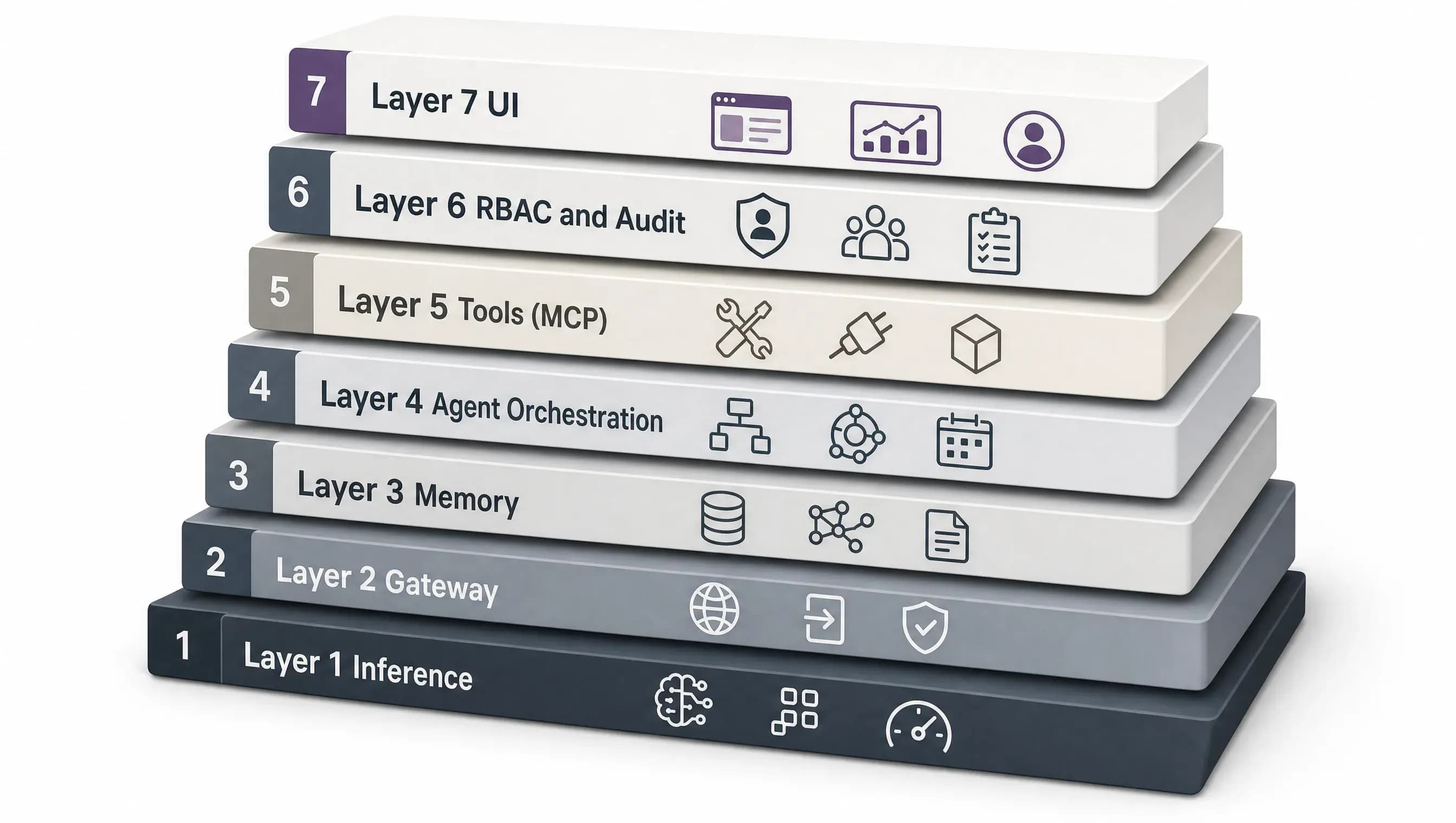
Layer 1 — Inference (the model)
This is where the LLM actually runs. You have four practical paths:
- Anthropic API direct, fastest, lowest engineering overhead, but you're back in Anthropic's data path. Fine if your concern is custom orchestration but not data residency.
- OpenRouter, single API across 100+ models. Great for development and model-comparison testing, less great for enterprise audit.
- Bedrock or Vertex AI, cloud-native private endpoints with region pinning. Anthropic Claude is available on both. This is the most common enterprise compromise: you get Claude-class quality with cloud-native compliance.
- On-prem inference, vLLM on H100/H200 hardware running open-weight models. Llama 3.3 70B, DeepSeek V3, Qwen 3, or Mistral Large. The only path for IL5/IL6 and the most expensive in capex.
Anthropic does not ship Claude model weights, so true on-prem with Claude is impossible. If you must be on-prem, you're picking from open-weight models, and the quality gap to Claude Opus 4.7 has narrowed significantly in the last 18 months but isn't closed.
Layer 2 — LLM Gateway
The gateway sits between every application and every model. Its job is failover, cost routing, audit logging, rate limiting, and (critically) abstracting model choice so you can swap inference paths without touching application code.
Production options:
- LiteLLM, open-source, self-hostable, OpenAI-compatible API across 100+ providers. Free.
- Portkey, managed gateway with built-in observability dashboards. Good for teams that don't want to operate LiteLLM themselves.
- Helicone, observability-first; pairs well with LiteLLM rather than replacing it.
This layer is non-negotiable in production. Skipping it means hardcoding model choice into your application, and then re-deploying every time Anthropic ships a new model or your security team demands a regional failover.
Layer 3 — Memory and Retrieval
Three sub-systems live here:
- Vector store, Pinecone (managed, fastest path) or Qdrant (self-hostable, the right call for on-prem requirements). Weaviate and pgvector are also valid; Qdrant has the cleanest enterprise story right now.
- Structured memory, Postgres for anything that benefits from SQL. Most "agent memory" is actually relational, not semantic.
- Short-term context, Redis or DynamoDB for session state, recent-conversation cache, and intermediate agent results.
Get this layer right and your agents feel like they remember things. Get it wrong and every conversation starts from zero, which is fine for a chatbot and fatal for a coworker.
Layer 4 — Agent Orchestration
This is where Cowork's scheduling primitives stop being enough. Options:
- LangGraph, graph-based multi-agent supervision. Best for workflows with conditional routing, retries, and human-in-the-loop approval.
- CrewAI, role-based agent crews. Cleaner abstraction for "research analyst + writer + reviewer" patterns.
- Custom DAG, for teams with strong distributed-systems backgrounds; gives you complete control at the cost of building everything yourself.
For most enterprises we ship LangGraph because the graph model makes the audit story easier, every transition is logged, every decision is inspectable. (And the Anthropic Agent SDK $500 credit we cover here often subsidises the first three months of Layer 4 development.)
Layer 5 — Tools (MCP servers)
Every internal integration becomes an MCP server. Salesforce, Snowflake, Jira, Confluence, Workday, your data lake, your internal HR API. The Model Context Protocol spec is now stable and shipping in every major agent framework. You write one server per data source; the agent layer discovers them at runtime.
This is the layer where Cowork's plugin marketplace breaks down for enterprises. Anthropic curates the marketplace, slowly, and on their schedule. A self-hosted MCP layer lets you ship a server for a legacy SAP module in a week, not a quarter. We typically build 15–40 MCP servers per enterprise engagement.
Layer 6 — RBAC + Audit Logging
Here's where the regulators decide whether your stack ships. The components:
- Policy engine, Open Policy Agent (OPA) or AWS Cedar. Every tool call and every model call passes through policy evaluation. Per-user, per-role, per-data-class.
- Audit pipeline, every prompt, every response, every tool call, every model selected, every cost incurred, logged with full retention. We use OpenTelemetry traces flowing into a regulated-cloud SIEM or a long-term S3 archive with WORM compliance.
- PII/PHI detection, Presidio or a custom DLP pipeline at the gateway. Redact before logging; never let raw PHI hit your audit store.
This layer is invisible to end users and is the reason enterprises actually pay for the build. It is also the layer Cowork can't give you, structurally, because the audit boundary doesn't include their infrastructure.
Layer 7 — UI
The desktop-app advantage Cowork has at Layer 7 mostly disappears for enterprises, because most enterprise users live inside Slack, Microsoft Teams, or a custom web portal anyway. Practical UI options:
- Slack or Teams bot, fastest path to adoption inside existing workflows.
- Custom web app, Next.js or your existing internal portal, with an embedded agent surface.
- Custom desktop app, Electron is still the practical answer if you want the Cowork-style "third tab" experience. Most enterprises don't need it.
Pick whichever surface your users already live in. The model lock-in argument here is the inverse of Cowork's: instead of forcing users into a new app, your stack meets them where they are.
That's a 7-layer stack, not a weekend project. The next two sections quantify what it costs and how long it takes.
5-Year TCO, Cowork Seats vs. Self-Hosted Stack
At 200 seats, Cowork Enterprise wins on cost. At 1,000+ seats over five years, the self-hosted build collapses to roughly $2/seat/day all-in, and crosses Cowork's TCO somewhere between 600 and 800 seats. That crossover only matters, though, if no other gate (data residency, custom orchestration, IP) has already forced the build. For most regulated enterprises, the TCO comparison is a sanity check, not a decision driver.
"5-Year TCO: Cowork Enterprise vs. Self-Hosted (200 seats)"
Data table
| "Sourcing Option" | "5-Year Total" |
|---|---|
| "Cowork (200 seats × $60/mo)" | 720 |
| "Self-Hosted (200 seats, build + 4yr ops)" | 1850 |
| "Self-Hosted (1,000 seats, amortised)" | 2150 |
The assumptions behind those numbers, because TCO posts that hide assumptions are useless:
- Cowork Enterprise, $60/seat/month list price for the Enterprise tier with EU residency and BAA add-on, ×200 seats × 60 months = $720K. No marketplace add-ons priced in.
- Self-Hosted 200 seats, Year 1 build cost $850K (six-engineer team for two quarters, infra capex, vector store, observability stack), plus Years 2–5 ops at $250K/year (two-engineer ops team, model usage, infra opex). Total: $1.85M.
- Self-Hosted 1,000 seats, same Year 1 build ($850K), Years 2–5 ops scale to $325K/year (model usage grows with users; engineering stays roughly flat). Total: $2.15M, or roughly $2.15/seat/day averaged over five years.
The interesting line is the third one. Engineering cost on a self-hosted stack is mostly fixed, two engineers can maintain a stack that serves 100 seats or 10,000. Model usage scales with users but compresses as you batch and cache. The TCO crossover with Cowork is real, but it happens at scale most enterprises only reach if they push the platform across many divisions.
If you're at 50 seats and your data is non-regulated, Cowork wins on every axis. If you're at 5,000 seats and you have a CISO, the self-hosted build pays for itself before Year 3. The math reverses around 600–800 seats, and most enterprise pilots are in that range or above.
Time-to-Value, The Curve That Surprises CFOs
Cowork is usable in week one and plateaus at month two. Self-hosted ramps slowly through Q1, breaks past Cowork around month six, and keeps going. The CFO question isn't "which is faster", it's "which curve matches our risk profile and our planning horizon."
"Time-to-Value: Cowork vs. Self-Hosted (12 months)"
Data table
| "Months" | "Cowork" | "Self-Hosted" |
|---|---|---|
| "M1" | 70 | 5 |
| "M2" | 80 | 15 |
| "M3" | 80 | 35 |
| "M4" | 80 | 55 |
| "M5" | 80 | 70 |
| "M6" | 80 | 80 |
| "M9" | 80 | 92 |
| "M12" | 80 | 100 |
Three things this chart undersells:
-
Cowork's Month-1 score is high because it's a product, not a project. Anthropic shipped the UX and the integrations; you adopt them. The 30-point gap at Month 1 is real, and it matters when you're trying to demonstrate AI ROI to a board that's been hearing about it for two years.
-
The self-hosted curve isn't linear because the work isn't linear. Months 1–2 are architecture, vendor selection, and Layer 1–2 plumbing. Months 3–4 are the first real agent ships on the stack. Months 5–6 are when the marginal cost of agent number 5 drops to a fraction of agent number one's. That's the inflection, and the reason platform-building feels frustratingly slow for the first 90 days.
-
The Cowork plateau is real, not a slander. Cowork is excellent at what Anthropic ships for it. It's not designed to extend past that envelope, and the marketplace exists precisely so they don't have to keep extending it themselves.
We walked the same shape of curve in our build-vs-buy analysis for AI voice agents, the principles transfer. If your business case lives or dies on Month 3 results, buy. If it lives on Month 12 outcomes, build.
The Build-Your-Own Decision Matrix
Score these seven questions 0, 5, or 10. If you score above 25, build your own. Between 15 and 25, pilot Cowork and revisit. Under 15, stay on Cowork. The matrix is the single highest-signal piece of this post; if you bookmark anything, bookmark the table.
| # | Question | 0 (No) | 5 (Sometimes) | 10 (Yes) |
|---|---|---|---|---|
| 1 | Does any of our AI workload touch data that can't leave our VPC? | 0 | 5 | 10 |
| 2 | Are we in a regulated industry (healthcare, finance, defense, govt)? | 0 | 5 | 10 |
| 3 | Do we have proprietary IP/prompts/tooling we don't want to share with a vendor? | 0 | 5 | 10 |
| 4 | Will we have >25 daily AI users within 12 months? | 0 | 5 | 10 |
| 5 | Do we need MCP servers Anthropic doesn't ship? | 0 | 5 | 10 |
| 6 | Are we projecting >$200K/yr in Cowork seat spend? | 0 | 5 | 10 |
| 7 | Do we need agent orchestration beyond Cowork's scheduling primitives? | 0 | 5 | 10 |
We've run this matrix across 30+ AI integration projects over the last 18 months. The share of organizations scoring above 25 went from roughly 30% in late 2024 to about 55% in May 2026 — driven mostly by GDPR enforcement and the SEC's 2025 AI Disclosure Rule. The shift isn't ideological; it's regulatory.
A pattern worth noting: scores tend to cluster at the extremes. Companies either score 5–15 (Cowork is obviously right) or 35–70 (self-hosted is obviously right). The 15–25 middle band is rarer than it looks, and usually represents companies on the verge of crossing a regulatory line they don't yet realise they're approaching.
When Cowork Still Wins, Even at Enterprise Scale
Even inside enterprises that score 50+ on the matrix, Cowork still wins for three patterns: the non-regulated marketing team, the 90-day prototype-then-buy, and the bolt-on for mature internal AI platforms. Self-hosting everything is as wrong as buying everything; the skill is routing each workflow to the right stack.
The three patterns:
-
The non-regulated marketing team inside a regulated enterprise. A pharma company can't put PHI on Cowork, but its brand marketing team isn't touching PHI, they're writing campaign briefs and analysing channel performance. Cowork is fine there. Routing low-sensitivity work to Cowork and high-sensitivity work to the internal stack is the obvious-but-rarely-implemented architecture, and we cover the marketing-manager replacement question in detail elsewhere.
-
Prototype-then-buy patterns. Use Cowork for 60–90 days to prove the workflow works on real data and real users. If ROI shows up, then build. If it doesn't, you've spent $20K on Cowork seats instead of $200K on a build that solves a problem you didn't have. The 90-day Cowork pilot is the highest-quality requirements-gathering exercise in enterprise AI.
-
Mature enterprises with internal AI platforms already. If you've already built the 7-layer stack for high-sensitivity work, bolting Cowork onto the low-sensitivity surface is fast, cheap, and reduces the "shadow IT" risk of teams adopting AI tooling on their own.
Cowork's small-business sweet spot applies inside enterprises too, for any sub-team that operates like a small business, Cowork is structurally the right tool, regardless of the parent company's regulatory profile.
Self-hosted is the right answer for sensitive workloads. Cowork is the right answer for everything else. The skill is knowing which is which, and not pretending it's binary.
How Techsy Builds Enterprise AI Integrations
We've shipped 30+ AI integration projects since 2024 across regulated finance, healthcare-adjacent, defense-adjacent, and IP-sensitive consumer brands. The methodology hasn't changed much because the architecture hasn't changed much, it's the same seven layers, customised per regulatory profile.
The four-phase methodology:
-
Phase 1 — Architecture and TCO workshop (2 weeks, fixed-fee). We score the decision matrix with your team, draft the 7-layer architecture for your constraints, and build the honest TCO model. You walk out with a working artifact regardless of whether you hire us for Phase 2.
-
Phase 2 — Reference build (8–12 weeks). One production agent on the full 7-layer stack, typically the highest-value, lowest-political-risk workflow we identified in Phase 1. Production-ready, not a demo. We use the Anthropic Agent SDK and the $500 credit we cover here to subsidise the early Layer 4 work where applicable.
-
Phase 3 — Platform expansion (3–6 months). Agents 2 through N on the same stack. This is where the marginal cost of each new agent collapses, usually 30–60% of the cost of Phase 2's reference build. The 7-layer stack becomes a platform.
-
Phase 4 — Hand-off and operate (ongoing). Your team owns the stack. We stay on retainer for model upgrades, new MCP servers, and quarterly architecture reviews.
The stack we ship by default in 2026: Anthropic Claude Opus 4.7 + LangGraph + Pinecone (or Qdrant for full on-prem) + LiteLLM gateway + vLLM for on-prem inference paths, behind OPA-policy RBAC and OpenTelemetry observability. Every component is swappable; nothing is bespoke for the sake of being bespoke. The agentic AI deployment platform we use wraps this stack into a deployable surface, and our agent development practice covers the engineering model in depth.
If you'd like to score the matrix together and see what your 7-layer architecture would look like, book a free 30-minute architecture call with our team. No prerequisites, no slides, we walk through your constraints and sketch the stack live.
Watching the Product We're Respectfully Critiquing
Anthropic shipped a genuinely good product. The next thirteen minutes are worth your time, it's the clearest articulation of what Cowork is for, from the team that built it.
Watch it before you commit to either path. If after watching you think Cowork solves your problem, buy Cowork. If you find yourself thinking "this is great, but...", the second half of this post is for you. We're not anti-Cowork. We're anti-buying-the-wrong-tool-for-your-regulatory-profile.
Migration Path, From Cowork Pilot to Self-Hosted Production
The most common pattern we see in 2026 isn't Cowork-or-self-hosted. It's Cowork-then-self-hosted, with a clean migration plan. Here's the four-stage path we recommend:
- Months 0–3 — Cowork pilot. Prove the workflow on real users with real data (low-sensitivity workflows only). Document what works, what fails, what you wish was different.
- Months 3–4 — Architecture decision. Score the matrix with the data from Phase 1. If you score above 25, commit to the build. Don't shut down Cowork yet.
- Months 4–10 — Parallel build. Build the 7-layer stack in parallel with continued Cowork use. The non-sensitive workflows stay on Cowork; the build targets the regulated workflows.
- Months 10–12 — Cut over by workflow, not by department. Sensitive workflows migrate to self-hosted first; non-sensitive workflows can stay on Cowork indefinitely if the routing makes sense.
The cut-over rule is the one most teams get wrong. Migrating by department creates a forced-march political problem; migrating by workflow type lets each team adopt the right tool for the work in front of them. The decision matrix scores per-workflow, not per-department, for the same reason.
We've also seen the inverse pattern, self-hosted-then-Cowork, at enterprises that built early and now want to give their non-regulated teams a fast surface. The vs-ChatGPT-Agents comparison is the right reference if you're stuck choosing between Cowork and a competing buy-side product after committing to a hybrid architecture.
FAQ
Isn't building your own way more expensive?
Not always, and rarely simply. At 200 seats Cowork wins on cost over five years. Between 600 and 800 seats the curves cross, and at 1,000+ seats self-hosted is cheaper. More importantly: if you score 25+ on the decision matrix, the cost comparison is academic, regulatory or sovereignty requirements have already made the decision for you.
How long does a self-hosted enterprise agent stack take to ship?
8–12 weeks for the first production agent on the full 7-layer stack, 3–6 months for the platform (agents 2 through N), and ongoing for the model-upgrade treadmill. Cowork ships in 1–2 weeks. Most enterprises trade the 8-week delta for sovereignty and customisation; the ones that don't aren't enterprises that needed to build.
Can we start with Cowork and migrate later?
Yes, this is the most common pattern we see in 2026. Use Cowork for Months 0–3 to prove the workflow, build the 7-layer stack in parallel for Months 4–10, then cut over by workflow type rather than by department. The migration is harder than starting on self-hosted from day one but much faster than building blindly.
What about Claude Enterprise's Trust Center?
Anthropic's Trust Center covers SOC 2 Type II, ISO 27001, EU data residency on Enterprise, and BAA for healthcare. It's a strong story for what it covers. It does not cover ITAR, IL5/IL6 sovereign-cloud requirements, M&A deal-room hermetic isolation, or workflows where the prompt content itself is classified or regulated. Trust Center is necessary for some scenarios and structurally insufficient for others.
Is on-prem deployment of Anthropic models allowed?
No. Anthropic does not ship Claude model weights, so true on-prem inference of Claude is impossible in 2026. On-prem self-hosting requires open-weight alternatives, Llama 3.3, DeepSeek V3, Qwen 3, or Mistral Large running on vLLM. Bedrock and Vertex offer private-endpoint options that some regulators accept as the practical equivalent of on-prem; check with your compliance team before assuming.
What's the ongoing maintenance cost over time?
Roughly $250K/year for a 2-engineer ops team plus model usage and infrastructure at 200-seat scale. That figure rises to about $325K/year at 1,000 seats, most of the cost is fixed engineering, not variable infrastructure. Model usage scales with users but compresses as you batch, cache, and route smaller queries to cheaper models via the gateway layer.
Who owns the prompts and tooling we develop?
You do, fully, on a self-hosted stack. On Cowork, prompts are stored in Anthropic's infrastructure under their commercial terms, fine for most companies, a dealbreaker for proprietary-IP industries (consumer brands, biotech, regulated finance). The ownership story is one of the underrated reasons mature enterprises self-host.
Do you support hybrid, some workflows on Cowork, others self-hosted?
Yes, and we recommend it more often than pure self-hosted. Route low-sensitivity workflows to Cowork and high-sensitivity to your internal stack. A LiteLLM gateway can fan out by workflow type with simple routing rules, and your audit and policy layers can treat the two surfaces uniformly.
How do you handle the model-upgrade treadmill on a self-hosted stack?
The LiteLLM gateway abstracts model choice. When Anthropic ships a new model, you point one config at it. When an open-weight model leapfrogs the closed-source incumbent on a specific task, you redirect that compute-heavy workload to vLLM without touching application code. The 7-layer architecture is explicitly designed to protect you from model lock-in, which Cowork, by design, cannot do.
Closing
Cowork is a great product for the work it's built for, and it's not the right answer for regulated enterprises with sovereignty, IP, or custom-orchestration constraints. The 7-layer self-hosted reference architecture in this post is the same one we've shipped 30+ times since 2024; the decision matrix is the artifact we walk every client through in Phase 1. Read the full Cowork guide if you haven't, then come back here when you're ready to talk architecture.
If you'd like a working version of the decision matrix and a draft 7-layer architecture for your constraints, reach out, we'll sketch it live and you walk out with the artifact whether or not we work together after.