AI Agent Development Services in 2026: Real Costs, Stack, and When Not to Hire
Updated April 22, 2026. Techsy builds AI agents for clients, including LangGraph workflow agents, OpenAI Agents SDK prototypes, and MCP-integrated enterprise systems. This guide is written from the builder's side of the table, not the buyer's. Reviewed by our engineering team.
Most guides to AI agent development services are vendor sales pages dressed up as buyer guides. This one isn't. You'll get real 2026 cost ranges, the stack we actually ship with, and five situations where hiring an agency is the wrong call, even when the agency would say yes.
What AI Agent Development Actually Involves
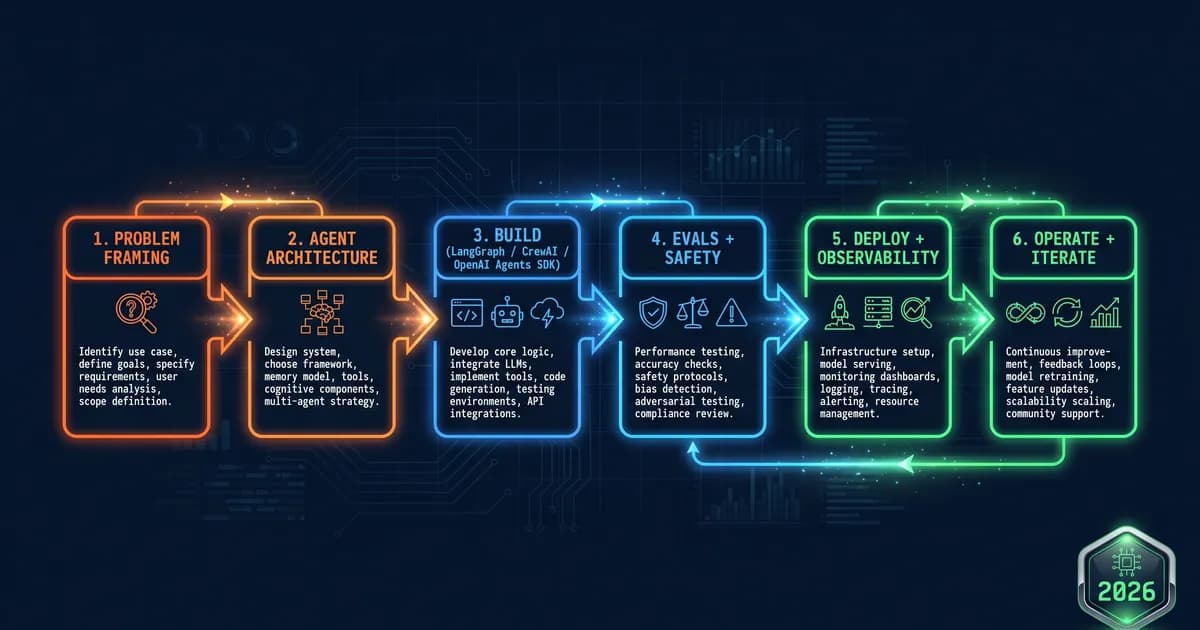
AI agent development is the practice of building LLM-powered systems that pursue goals autonomously by planning, calling tools, using memory, and self-correcting, not just replying to prompts. A custom AI agent development engagement typically covers six stages: discovery, architecture, build, evals, deploy, and operate. The end product is production software, not a demo.
The line between a chatbot and an agent gets blurred constantly, so let's draw it clearly. A chatbot reacts: you send a message, it replies. An agent pursues a goal: you give it an outcome, and it plans steps, invokes tools, reads from memory, checks its own work, and loops until the goal is met (or it fails loudly enough for a human to step in). Anthropic's Building Effective Agents write-up is still the clearest practitioner framing we've read on this distinction.
What makes something an "agent" vs a chatbot
After shipping agent systems into production across a handful of verticals, these are the five defining traits we look for:
- Autonomy: it decides the next step without a human prompt for every action
- Tool use: it calls APIs, databases, and services, not just the model
- Memory: short-term (context), semantic (vector store), and episodic (history)
- Planning: it decomposes a goal into ordered subtasks
- Self-correction: it can detect failure and retry or escalate
If your "agent" is missing three of these, you've got a chatbot with a better system prompt. Read our broader piece on business AI agent use cases if you want use-case inspiration before spec'ing a build.
The 6-stage development lifecycle
Every serious agent engagement moves through the same phases, roughly in order:
- Discovery: problem framing, data audit, success metrics
- Architecture: planner, tool schema, agent memory model
- Build: prompts, tool wiring, orchestration
- Evals: golden dataset, LLM-as-judge, failure taxonomy
- Deploy: observability, guardrails, rate limits, secrets
- Operate: monitoring, iteration, cost tuning
One more framing: custom AI agent development vs platform agents (Zapier Agents, Relevance AI, Dust). Platforms are great when your use case is generic and integrations are few. Custom wins the moment you have compliance needs, proprietary workflows, or three-plus systems to integrate. More on that decision in a minute.
When You Should Hire an AI Agent Development Agency
Hire an AI agent development agency when you need production reliability and your team hasn't shipped an agent before, when you have three or more enterprise integrations tangled with auth, when you need a voice agent, when you're in a regulated industry, or when you need to ship in under 90 days without a senior AI engineer on payroll. Otherwise, keep it in-house.
Concretely, here are the five scenarios where an agency earns its fee:
- You need production-grade reliability. Evals, observability, guardrails, uptime. If your team has built prototypes but never shipped an agent people depend on, the hardening work is where projects die.
- You have 3+ enterprise integrations with auth complexity. CRM, ERP, ticketing, identity. Each one is a rabbit hole. An experienced vendor has pre-built patterns for OAuth, SSO, and service accounts across the common suspects.
- You need a voice agent. Call-center, SDR, or IVR deployments are a specialist domain (latency budgets, barge-in, ASR tuning, telephony). For this subset specifically, we'd point you at a specialist AI SDR agency or an enterprise voice agents partner over a general agency.
- You're in a regulated industry. HIPAA, SOX, GDPR, or data residency constraints change the architecture. You want a vendor who's done the security review before.
- You need to ship in under 90 days without a senior AI engineer on staff. Hiring a senior agent engineer in 2026 is a 4-6 month exercise. An agency is the fast path.
If you're an enterprise buyer, a few things shift regardless of which scenario you're in: procurement wants SOC 2, security wants threat modeling, IT wants SSO and SCIM, and legal wants a DPA before the kickoff call. Gartner flagged agentic AI as a top strategic technology trend for 2026 precisely because these enterprise integration patterns are now maturing into real deployments (see Gartner's 2026 trends). If your scope is cross-functional workflow automation, our piece on enterprise AI workflow automation covers the deployment patterns we see working.
One practical note on AI voice agent development: call-center is currently the highest-ROI agent deployment we see. A well-built voice agent deflects 30-60% of tier-1 calls. If that's your use case, budget for it seriously. Voice adds 40-60% to a comparable text-agent spend.
When You Should NOT Hire an AI Agent Development Agency
Skip the agency if your problem definition is fuzzy, nobody internally owns the project, you can't name a success metric as a number, your underlying workflow is being redesigned this quarter, or the project exists because the board asked "what's our AI story?" In all five cases, the cheapest thing you can do is delay 60 days and fix the prerequisite. The most expensive thing is to hire anyway.
Here are the five disqualifiers in detail. If any of them apply to you right now, no vendor (us included) will save the project.
- Unclear problem definition. If you can't write a one-sentence success criterion ("the agent resolves at least 40% of returns tickets end-to-end without human intervention"), no vendor can deliver it. The demo will look fine and the production result will be a shrug. Nail the problem before the RFP.
- No single internal owner. Agent projects touch data, systems, operations, security, and compliance. If there's no named person inside your company who owns the outcome and has authority to unblock all five of those groups, the project stalls the week after handoff. Every vendor has watched this play out.
- No measurable success criteria. If "working" isn't defined as a number (hallucination rate, tool-call accuracy, deflection percentage, response latency, resolution rate), you can't evaluate what anyone ships. You'll argue about vibes in Slack until somebody gets fired. MIT Sloan Management Review's ongoing coverage of enterprise AI outcomes puts the failure rate somewhere north of 80%, a pattern BCG's 2024 AI at work research also tracks, and fuzzy success criteria are the single biggest contributor.
- Workflows in flux. If the underlying human process is being redesigned right now (new tooling, new team structure, new SOP), building an agent on top of it is building on sand. Wait for the dust to settle, then automate the stable version. Three months of patience saves nine months of rework.
- "AI as anxiety response" rather than strategy. If the project exists because the board asked "what's our AI story?" and someone panicked, the outcome will be a demo-ware kiosk, not a system that does work. You can tell this project from its symptoms: a budget with no owner, a deadline pegged to the next board meeting, and the word "transformational" on the one-pager. Say this out loud. Your future self will thank you.
If any of these apply, the cheapest path is to delay by 60 days and fix the prerequisite. Hiring a vendor anyway to "get moving" is how six-figure checks get written for systems nobody uses.
The Real 2026 Stack: Frameworks, Memory, Tools, Observability
The 2026 agent stack has four layers: a framework for orchestration (LangGraph, CrewAI, or OpenAI Agents SDK), tool integration via Model Context Protocol (MCP), a memory architecture combining context windows and vector stores, and an evals + observability layer (Langfuse, LangSmith, Arize Phoenix). If a vendor can't name their choice at each layer and explain why, they haven't shipped one.
Framework: LangGraph vs CrewAI vs OpenAI Agents SDK
The honest short version of our framework opinion:
| Framework | Best for | When we skip it |
|---|---|---|
| LangGraph | Complex branching, multi-step workflows, fine-grained state control | Simple 1-2 tool agents where graph ceremony slows us down |
| CrewAI | Role-based multi-agent systems (research → writer → editor) | Anything that needs strict state machines or heavy guardrails |
| OpenAI Agents SDK | Fast prototypes, teams already on OpenAI, Realtime voice | Multi-vendor model strategies or self-hosted open models |
In our experience, we reach for LangGraph when workflows have real branching and we need to checkpoint state between steps, the official LangGraph docs are the canonical reference. We reach for OpenAI Agents SDK when speed-to-ship matters more than portability; the OpenAI Agents SDK docs cover handoffs, tools, and tracing in detail. CrewAI fits best when you're genuinely building an agentic AI crew, a research team, a content pipeline, and the role metaphor maps to the work. Worth a look: AutoGen and Pydantic AI, the latter being our pick when type-safe structured output is a non-negotiable. Our deeper piece that compares LangGraph, CrewAI, and OpenAI Agents SDK walks through decision criteria in detail.
Here's what a tiny LangGraph agent loop looks like in practice, with plan, act, and reflect nodes:
from langgraph.graph import StateGraph, END
from typing import TypedDict

class State(TypedDict):
    goal: str
    scratch: list
    done: bool

def plan(s): return {"scratch": s["scratch"] + [llm_plan(s["goal"])]}
def act(s):  return {"scratch": s["scratch"] + [call_tools(s["scratch"][-1])]}
def reflect(s):
    ok = llm_check(s["goal"], s["scratch"])
    return {"done": ok}

g = StateGraph(State)
g.add_node("plan", plan); g.add_node("act", act); g.add_node("reflect", reflect)
g.set_entry_point("plan")
g.add_edge("plan", "act"); g.add_edge("act", "reflect")
g.add_conditional_edges("reflect", lambda s: END if s["done"] else "plan")
agent = g.compile()
Fifteen lines, but every production agent we ship looks like a more-guarded version of this shape.
Tool integration: Model Context Protocol (MCP)
Model Context Protocol is the open standard Anthropic introduced in late 2024 for connecting LLMs to tools, data, and services. OpenAI and Google adopted it through 2025, and by April 2026 it's the default way serious teams wire up agent tooling. Why does it matter? You can swap tool providers, or the underlying model, without rewriting your agent. The Anthropic MCP docs are the canonical reference. If you're building anything non-trivial, skip proprietary tool schemas and go MCP-native. For lower-level choices, our function calling libraries post has the comparison.
Memory architecture
Agent memory splits into three layers in production:
- Working memory: the context window itself, managed with context engineering patterns
- Semantic memory: vector stores (Pinecone, pgvector, Qdrant) for RAG-style retrieval
- Episodic memory: conversation history, tool-call logs, prior decisions (Letta, Zep, LangMem)
Most agent projects underestimate how quickly episodic memory becomes the limiting factor. Once an agent runs for days against a real user, the state of "what did we decide on Tuesday" matters more than the vector search. Pick tooling for the long game.
Evaluation and observability
This is where almost every vendor goes silent, and where senior engineers decide if you know what you're doing. In our stack: Langfuse or LangSmith for tracing, Arize Phoenix or Braintrust for eval pipelines, and Ragas when the agent has a heavy RAG component. The basics of an eval suite are a golden dataset, LLM-as-judge grading, tool-call accuracy tracking, and a hallucination detector. The Langfuse docs are a good starting point. For a broader view, see our agent observability guide and our primer on how to evaluate agent reliability. If you find yourself asking "how do I add this to an existing app?" our how to add AI features post covers the retrofit path.
How Much Does AI Agent Development Cost?
AI agent development cost in 2026 typically falls into three tiers: $15K-$40K for a simple workflow agent shipping in 4-6 weeks, $40K-$120K for a custom multi-step agent with memory and integrations shipping in 8-14 weeks, and $120K-$400K+ for an enterprise multi-agent system with compliance and SLAs shipping in 4-9 months. Ongoing operations run $500-$15K/month depending on tier.
The ranges below track what we see across client engagements and public vendor pricing bands from firms like EffectiveSoft and Appinventiv. Cost is driven by four things: how many integrations, custom vs platform, compliance requirements, and how much ongoing operation you'll pay for.
| Tier | Scope | Price range | Timeline | Ongoing |
|---|---|---|---|---|
| Simple workflow agent | Single LLM, 1-2 tools, session memory | $15K-$40K | 4-6 weeks | $500-$2K/mo |
| Custom multi-step agent | Multi-step reasoning, memory, 3-6 integrations, evals | $40K-$120K | 8-14 weeks | $2K-$6K/mo |
| Enterprise multi-agent system | Orchestration, SSO, compliance, SLAs, on-call | $120K-$400K+ | 4-9 months | $6K-$15K/mo |
Ongoing ops costs are where most buyers get surprised. The monthly spend breaks down into LLM API spend (often the biggest line, and worth reading our notes on how to reduce LLM API costs), observability tooling, eval and monitoring time, and on-call coverage when the agent is customer-facing.
A note on geography, because AI agent development India is a search term that won't go away: US/EU senior agencies typically charge 1.5-2.5x nearshore rates, and offshore shops often come in at 0.4-0.6x. The spread reflects seniority of the AI engineers, familiarity with US/EU compliance regimes, and synchronous timezone overlap with your team during incidents. If US/EU delivery matters, filter for onshore or nearshore early, geography changes everything about response time during a production incident.
"Ongoing monthly ops cost by tier (midpoint)"
Data table
| "Monthly cost ($)" | "Monthly ops" |
|---|---|
| "Simple workflow agent" | 1250 |
| "Custom multi-step agent" | 4000 |
| "Enterprise multi-agent system" | 10500 |
Timeline: What 30 / 60 / 90 Days Actually Look Like
A realistic first 90 days looks like this: discovery and a vertical-slice prototype by Day 30, an internal alpha with real tools and an eval suite by Day 60, and a production deploy with observability and guardrails by Day 90. Anything faster is cutting evals. Anything slower suggests scope creep, unclear data access, or security review blockers the vendor didn't flag early enough.
Days 1-30, discovery and prototype. Problem framing, data audit, architecture proposal, and a working demo agent against a narrow scope. You should see a runnable prototype and a written eval plan by end of month one. If you don't, the engagement is already off-track.
Days 31-60, scope expansion and evals. The agent integrates real tools and APIs, a proper eval suite is in place, and the team is iterating on specific failure modes. An alpha release to internal users lands here. This is the messiest month; most of the hard problems surface between Day 35 and Day 50.
Days 61-90, hardening and production. Guardrails, observability, rate limiting, secrets management, and the production deploy. Handoff documentation or the ongoing ops kickoff happens in the final two weeks.
What derails the 90-day track? In order of frequency: unresolved data access (you promised the API would be ready; it isn't), security review cycles (your infosec team hasn't budgeted time), and scope creep ("can it also handle this one other thing?"). Name the owner of each of those three risks on Day 1.
How to Evaluate an AI Agent Development Agency
The fastest way to separate real agencies from PowerPoint agencies is to ask eight specific technical questions on the discovery call. Vague answers on these are disqualifying. A real vendor has shipped enough production agents to have opinions, and the receipts to back them up.
If you are building the shortlist itself, our AI agent development companies comparison applies these criteria to named vendors before the discovery call.
Here's the list we'd hand any buyer running a vendor shortlist:
- "Show me your agent eval suite. What metrics do you track and at what thresholds?" If they don't have one, they don't know whether their past agents worked.
- "Which framework will you use (LangGraph, CrewAI, OpenAI Agents SDK, or custom) and why for my specific use case?" A vendor who answers "whichever one fits best" without naming any hasn't made the choice before.
- "What's your hallucination mitigation strategy in production?" The right answer involves constrained outputs, tool verification, LLM-as-judge checks, and human escalation, not "we use GPT-5."
- "How do you handle tool-call failures and retries?" Exponential backoff, circuit breakers, and graceful degradation should all come up.
- "Who owns the code, models, prompts, and eval datasets when we offboard?" The honest answer is you do. If they hedge, walk.
- "Show me a production agent you've shipped, not a demo. What eval pass rate does it run at?" Demos are easy. Production metrics are not.
- "What's your observability stack? Langfuse, LangSmith, or Arize?" See our comparison of LLM evaluation tools and AI observability platforms for what good answers sound like.
- "How do you handle compliance (SOC 2, HIPAA, GDPR) in the architecture itself, not just the vendor contract?" Data routing, PII redaction, logging scope, and retention should all be concrete.
Red flags in the answers: vague timelines, no eval suite, no ownership transparency, "we use GPT-4" as a complete stack answer, and case studies without numbers. At Techsy we encourage every prospect to ask us these same questions, especially #5 and #6, because those two separate real agencies from slide decks fastest.
Red Flags: Signs an Agency Will Over-Promise
The pattern of a vendor who hasn't shipped production agents is remarkably consistent. If you see two or more of these six red flags on a first call, the risk-adjusted expected outcome is a burned budget and a demo-ware prototype. Move on.
- "100% accuracy" or "zero hallucinations" claims. Impossible at the current state of LLMs. Run, don't walk. Published hallucination benchmarks in the Stanford HAI AI Index put the best models in the 2-8% hallucination range even on narrow tasks.
- No eval suite shown. If they can't measure their own agents, they can't tell you whether your agent will work.
- Vague framework answers. "We use the best tools for the job" with no specifics means they haven't made the call before.
- No honest-limits conversation. "We can do anything" is code for "we haven't hit production."
- Case studies without metrics. Logos and "delighted" testimonials aren't evidence. Eval pass rates and deflection numbers are.
- No named tech lead for your project. If they won't tell you which engineer will own your build, you're getting the B-team once the contract is signed.
How Techsy Approaches AI Agent Development
At Techsy, our AI agent consulting and build engagements follow the same six-stage flow we described up top: discovery, architecture and eval plan, build, ship with observability, then operate and iterate. We reach for LangGraph when workflows need complex branching, OpenAI Agents SDK when speed-to-ship wins, and Pydantic AI when structured output has to stay type-safe end to end. Langfuse is our default for tracing and evals.
On stack opinions: we run MCP-native for tool integration, default to pgvector for semantic memory unless scale forces otherwise, and treat evals as a Day 1 deliverable, not a Phase 2 nice-to-have. For enterprise AI agent development scopes with SSO, SOC 2, or data residency constraints, we bring the deployment patterns from our enterprise agent deployment engagements. For product teams building custom AI agent development into an existing app, we start smaller and instrument aggressively.
What we specifically don't do: we don't take on projects where any of the five disqualifiers in the "when NOT to hire" section apply. If your problem definition is fuzzy, your workflow is in flux, or there's no single owner internally, we'll tell you to delay 60 days and fix the prerequisite first. That's cheaper for you and better for our success rate.
If you're past the disqualifiers and want a working architecture, get a free AI agent architecture review. 30 minutes, no slide deck.
Frequently Asked Questions
What is AI agent development? AI agent development is the practice of building LLM-powered systems that pursue goals autonomously through planning, tool use, memory, and self-correction. Unlike chatbots, agents take actions against real systems, calling APIs, reading databases, and looping until a goal is met or they escalate to a human. See our business AI agent use cases primer for examples.
How much does AI agent development cost in 2026? A simple workflow agent runs $15K-$40K. A custom multi-step agent with memory and integrations runs $40K-$120K. An enterprise multi-agent system with compliance and SLAs runs $120K-$400K+. Ongoing operations add $500-$15K/month depending on tier, LLM API spend, and on-call coverage needs.
How long does AI agent development take? A simple workflow agent ships in 4-6 weeks. A custom multi-step agent takes 8-14 weeks. An enterprise system runs 4-9 months. A realistic 90-day track delivers a prototype by Day 30, an internal alpha by Day 60, and a production deploy with observability by Day 90.
What is an AI agent development company? An AI agent development company is a services firm that designs, builds, and deploys autonomous LLM-powered systems for clients. Good ones cover the full lifecycle: discovery, architecture, build, evals, deploy, and operate. The best ones will also tell you when not to hire them, which is the single clearest quality signal.
How do you choose an AI agent development company? Ask for their eval suite with specific metrics and thresholds, their framework choice for your use case with reasoning, a production agent they've shipped with pass rates, their observability stack, and who owns the code when you offboard. Vague answers on any of these five are disqualifying.
Can AI agents integrate with CRM, ERP, and existing systems? Yes. Agents integrate with Salesforce, HubSpot, SAP, NetSuite, ServiceNow, Zendesk, and most major enterprise systems through OAuth, API keys, or service accounts, increasingly standardized via Model Context Protocol. Integration complexity scales with auth requirements and data volume, not system count alone.
What's the difference between an AI agent and a chatbot? A chatbot reacts: you send a message, it replies. An AI agent pursues a goal: it plans, calls tools, uses memory, and self-corrects across multiple steps without being prompted for each action. A chatbot answers; an agent does work. The practical test: can it take actions against real systems on your behalf?
Do I need custom development or can I use a platform like Zapier Agents? Use a platform when your use case is generic, you have fewer than two integrations, and you don't need compliance features. Go custom when you have three-plus integrations, regulated data, proprietary workflows, or a differentiated user experience. Platforms are faster to start; custom pays off long-term on integration depth and ownership.
Which framework should I use, LangGraph, CrewAI, or OpenAI Agents SDK? LangGraph fits complex branching workflows with fine-grained state control. CrewAI fits role-based multi-agent systems like research-writer-editor pipelines. OpenAI Agents SDK fits fast prototypes and teams already committed to OpenAI's stack. Our full LangGraph vs CrewAI vs OpenAI Agents SDK comparison walks through the decision criteria in detail.
What's the difference between agentic AI and RAG? RAG (retrieval-augmented generation) fetches relevant documents into the LLM's context to improve answers. Agentic AI uses RAG as one tool among many, alongside APIs, databases, and other agents. RAG answers questions; agentic AI takes actions. Most production agents combine both: RAG for knowledge, tools for actions, memory for state across turns.
The Short Version
2026 is the year agentic AI moves from pilots to production. The vendors who'll deliver in that shift are the ones who can name their stack, show you their evals, and tell you when not to hire them. Frameworks matter, honest pricing matters, and knowing when to delay a project by 60 days matters more than either.
If you're past the disqualifiers and want the builder's take on your specific use case, get a free AI agent architecture review. We'd tell you that even if we weren't writing this.