
9 Best AI Agent Development Companies (2026): Ranked & Compared
The best AI agent development companies in 2026 all share one trait: they ship agents that survive real users, not just a polished demo. Gartner expects 40% of enterprise apps to ship with task-specific AI agents by the end of 2026, up from under 5% in 2025 (Gartner, Aug 2025). Hundreds of firms now claim this work; few do it well. Below are the 9 that stand out, ranked by tech stack, cost, and buyer fit, starting with how we build production agents at Techsy.
Quick answer
- For an end-to-end production build (custom agents, integrations, and voice) for startups and SMBs: Techsy.
- For enterprise multi-agent systems in regulated industries: LeewayHertz and Neurons Lab.
- For fast, low-risk startup pilots: Markovate and SoluLab.
- Expect roughly $20K (proof of concept) to $500K+ (enterprise rollout); add 30-40% for LLM usage, hosting, and maintenance.
- Vet on: production track record, a named stack (LangGraph / OpenAI Agents SDK / MCP), eval methodology, and IP/data ownership.
Do you need an AI agent platform or a development partner?
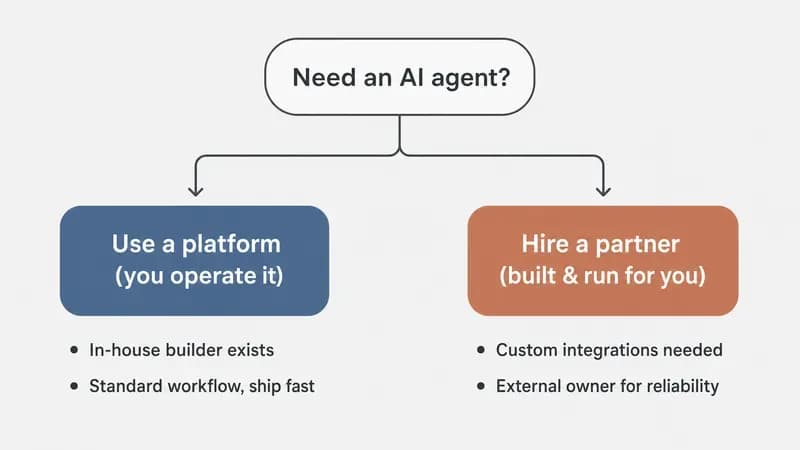
A platform is a self-serve no-code tool you operate yourself: Zapier, Make, Lindy, Flowise, Microsoft Copilot Studio. A development partner (an AI agent development agency) is a company that designs, builds, integrates, and runs a custom agent for you. Confusing the two is the most expensive mistake buyers make on this whole search.
Here's the clean split:
| When to use it | What it means |
|---|---|
| Choose a platform if… | You have an in-house builder, your workflow is fairly standard, and you want to ship something this week without a contract. |
| Choose a partner if… | The agent has to wire into your CRM/ERP, handle edge cases reliably, and someone other than you needs to own its uptime. |
This shortlist is strictly build-for-you companies, which is why Lindy, Zapier, and Make aren't on it. They're tools, not vendors. A platform is something you operate; an agency is someone who builds and runs it for you, and treating them as interchangeable is how budgets vanish.
If you're still fuzzy on what the work involves, our breakdown of what AI agent development actually involves covers the scope before you start shopping, and our AI agent development solution page shows how we run that scope in practice. The same logic applies whether you want a custom AI agent development company or a marketing-focused vertical specialist: decide the platform-vs-partner question first.
How do you choose an AI agent development company?
You choose an AI agent development company on production track record, a named technical stack, a written eval methodology, and clear IP ownership, not on a slick deck. Demos prove nothing; ask to see one agent that has been live for six months with a measurable outcome. Vagueness about the stack is the loudest red flag there is.
Here's the 10-point selection framework we'd hand any buyer:
- Platform or partner? Decide first. A self-serve platform if you have an in-house builder, an agency if you need it built and operated.
- Production track record. Demand at least one agent live in production 6+ months with a measurable outcome. Demos don't count.
- Named stack. They should volunteer LangGraph, the OpenAI Agents SDK, CrewAI, or MCP, plus an eval framework and observability. These are the agent frameworks a good vendor should name.
- Integration depth. Can they wire into your CRM, ERP, or data warehouse, not just call an LLM API? This is where AI integration work actually lives.
- Evals and guardrails. How do they measure reliability and prevent failure modes? No eval story, no deal.
- IP and data ownership. You own the code, prompts, and data. Get it in writing.
- Engagement model fit. Fixed-price, time-and-materials, dedicated team, or platform subscription, matched to your risk tolerance.
- TCO honesty. Add 30-40% to any quote for LLM usage, hosting, and 15-30%/yr maintenance.
- Vertical and domain fit. A healthcare-regulated agent is a different animal from an e-commerce search agent.
- Onshore / nearshore / offshore. Time-zone overlap and communication cadence matter more than the hourly rate. Plenty of strong AI agent development companies in the USA charge a premium that a nearshore team in the same time zone can undercut without losing quality.
If a vendor won't name their stack or their eval method, that's not a trade secret, it's a red flag. The modern baseline is documented and public: the OpenAI Agents SDK docs and LangGraph both publish how production agents should be orchestrated and evaluated, and any serious shop can point to where they fit. Getting agents deploying agents to production reliably, not just running on a laptop, is the real test.
The 9 best AI agent development companies (2026), compared
The 9 best AI agent development companies below are ranked by who they actually fit. Techsy leads for end-to-end production builds aimed at startups and SMBs; enterprise multi-agent programs map to LeewayHertz and Neurons Lab; fast startup pilots map to Markovate and SoluLab; data-heavy integration work maps to RTS Labs and Azumo. Read the table, then the detail.
| Company | Best for | Ideal client | Pricing model | Stack signal |
|---|---|---|---|---|
| Techsy | End-to-end production agents: custom, integration, voice | Startups & SMBs | Fixed-price / dedicated team | LangGraph, OpenAI Agents SDK, MCP |
| LeewayHertz | Enterprise multi-agent systems | Large/regulated enterprise | Fixed-price + dedicated team | Multi-agent / LLM orchestration |
| Markovate | Fast, low-risk pilots | SaaS, healthcare, logistics startups | Fixed-price MVP | Custom agent + automation |
| SoluLab | Full-lifecycle builds | Startups to enterprise | T&M / dedicated team | Broad custom AI stack |
| Azumo | Nearshore engineering | US firms wanting time-zone overlap | Dedicated team | AI/ML eng + DevOps for AI stacks |
| Intuz | Multimodal production agents | Mid-market | Fixed-price / T&M | LangGraph, CrewAI, AutoGen, n8n |
| RTS Labs | Data + integration glue | Mid-market / enterprise | Consultancy / T&M | Data engineering + integration |
| Neurons Lab | Science-led applied AI | Regulated enterprise | Consultancy / fixed-price | Applied AI, governance |
| Master of Code Global | Conversational AI at scale | Contact-center enterprises | Dedicated team | Conversational AI + agents |
Cross-check any of these on Clutch.co, which carries verified third-party B2B reviews, a useful sanity check on any ranking. And if you're a Fortune 500 with an existing GSI relationship, the giants (Accenture, IBM watsonx, Microsoft Copilot Studio, Cognizant, Infosys) belong on your list too; they're not ranked here because they're not where most startup and mid-market buyers should start.
Which AI agent development company is right for you? (the shortlist)
1. Techsy
Techsy builds custom AI agents, AI integrations, and voice agents for startups and SMBs, and we run the full stack most of the companies below split between them. The agents we ship are built on LangGraph, the OpenAI Agents SDK, and MCP for tool access, with an eval suite that runs before launch, not after something breaks. Where many shops stop at one layer, data, conversation, or deployment, we cover AI agent development, AI integration into your CRM and ERP, and production voice agents end to end. The voice work is the clearest proof: we've shipped production voice agents and published the real economics in what AI voice agents cost and a production voice agent we shipped.
Where we focus: hands-on, senior-built production agents for teams that want one partner from scope to running system, with you owning the code, prompts, and data. If you're a Fortune 500 running a six-figure global rollout through an existing GSI, that's LeewayHertz or Accenture territory, and we'll say so on the first call.
2. LeewayHertz
LeewayHertz is the default for enterprise AI agent development and multi-agent systems in regulated industries. They lean on LLM orchestration and deep enterprise integration, and report blue-chip clients including names like Coca-Cola, P&G, and Siemens on their case-study pages. If you're running a six-figure global program with compliance baked in, they have the breadth to handle it.
Pick someone else if… you're a startup shipping a first MVP. LeewayHertz tends to run premium, and an enterprise-grade engagement is heavy for a proof of concept you might still pivot.
3. Markovate
Markovate is built for speed and business-value-first pilots. They're known for shipping focused agents (their "LegalAlly" build is a good example), dashboards, and process automation. SaaS, healthcare, and logistics teams that want a low-risk pilot with a measurable outcome in weeks, not quarters, tend to fit well here.
Pick someone else if… you're standing up a very large multi-agent enterprise program; Markovate's sweet spot is lower-complexity automation, not sprawling orchestration.
4. SoluLab
SoluLab covers the full lifecycle, from startup MVP through enterprise rollout, with a broad custom AI stack. If you want one partner to take a custom AI agent from discovery to production and then keep iterating, their end-to-end delivery is the draw.
Pick someone else if… your problem demands deep vertical specialization. SoluLab's generalist breadth is a strength for range, but a domain-specialist shop may out-perform on a tightly regulated or niche use case.
5. Azumo
Azumo is a nearshore engineering partner for US companies that want time-zone overlap plus product-grade engineering and DevOps for their AI stack. They're strong when you already know roughly what you want built and need reliable hands and platform stability to ship it.
Pick someone else if… you need a strategy-and-consulting partner to define the problem first. Azumo is engineering-led; if you want heavy advisory and roadmap work up front, a consultancy-style shop fits better.
6. Intuz
Intuz builds multimodal production agents and names a genuinely modern stack: LangGraph, CrewAI, AutoGen, and n8n. Their work spans sales, support, HR, and supply-chain use cases, so mid-market teams wanting multimodal agents in production have plenty to look at.
Pick someone else if… you want a narrow specialist. The service menu is broad, so vet hard for proof in your specific vertical rather than assuming the breadth covers your case.
7. RTS Labs
RTS Labs is an AI and data-engineering consultancy whose real strength is the unglamorous glue: data pipelines and system integration around the agent. If your agent lives or dies on clean data flowing from messy internal systems, this is the kind of partner you want.
Pick someone else if… you have a small, agent-only scope. Consultancy pricing and a data-heavy approach can be more than a lightweight single-agent build needs.
8. Neurons Lab
Neurons Lab is a science-led applied-AI consultancy with real R&D depth and a governance focus, aimed at regulated and enterprise buyers. For agentic systems where reliability, compliance, and explainability are non-negotiable, their rigor earns its keep.
Pick someone else if… you just need a simple bot. The premium, enterprise-oriented engagement is overkill for a straightforward automation, and you'll pay for depth you won't use.
9. Master of Code Global
Master of Code Global comes from a conversational-AI heritage and builds custom conversational and agent experiences at contact-center scale. Enterprises wanting bespoke chat and voice experiences across high volume get a partner who has done it before.
Pick someone else if… you need pure backend autonomous agents. Their center of gravity is conversational-first, so deep non-conversational automation is less of a fit.
A quick note on how we vet our own builds, since it's the same bar we'd hold any vendor to: we won't ship an agent without an eval suite and a named owner for the prompts after launch. Vertical specialists count too: our write-up on a vertical-specialist (sales) agency example shows how a single-vertical focus changes the math.
What does it cost? AI agent pricing and engagement models
AI agent development typically runs from roughly $20K for a proof of concept to $500K+ for an enterprise rollout, with most production pilots landing in the $40K-$120K range. Then add 30-40% on top of any quote for LLM usage, hosting, and ongoing maintenance, the number that surprises buyers most. How you're billed matters as much as the headline figure.
| Engagement model | What it is | Best for | Risk profile |
|---|---|---|---|
| Fixed-price | Scoped deliverable, set fee | Well-defined POC/MVP | Budget certainty; scope-change friction |
| Time & materials | Hourly/sprint billing | Evolving requirements | Flexibility; less budget predictability |
| Dedicated team | Embedded engineers, monthly | Ongoing build + operate | Continuity; higher commitment |
| Platform subscription | Self-serve tool license | You already have a builder | Low upfront; you operate it yourself |
In practice the tiers look like this: a proof of concept ($20K-$40K) validates whether the agent can do the job at all; a pilot ($40K-$120K) puts it in front of real users with guardrails; production ($120K-$300K) hardens it with monitoring, integrations, and eval gates; and an enterprise rollout ($300K-$500K+) adds governance, multi-team support, and SLAs. For a full breakdown of AI agent development costs, including where the LLM bill actually goes, that post does the deep math. Whatever model you pick, insist the maintenance and usage costs are quoted upfront, a quote without them isn't a real quote.
Should you build AI agents in-house or hire a company?
Hire a company when you lack in-house agentic or ML engineers, you want speed, and you need someone accountable for reliability in production. Build in-house when agents are core to your product, you have the team to maintain evals long-term, and the domain knowledge can't easily transfer to an outside vendor.
The honest trade is about ownership and time. Hiring an agency buys you a working agent in weeks; building in-house buys you a team that owns it. Pick based on whether agents are your product or your plumbing. If they're plumbing (internal automation, a support bot, an ops agent), outsourcing is usually the faster, cheaper call. If the agent is the thing customers pay for, you probably want that capability in-house eventually, even if you start with a partner to learn the patterns.
There's also a middle path plenty of teams take: hire an agency to ship the first version and run it, then bring maintenance in-house once your team understands the stack. Our take on when it doesn't make sense to hire an agency walks through the cases where DIY genuinely wins. Don't let anyone, including us, talk you into a build you could rent for a fraction of the cost.
A 10-point checklist before you sign with any vendor
Run any AI agent development company through these ten checks before you sign. Each is a yes/no. If a vendor stalls on more than two, keep looking. This list is the single fastest way to separate a real production shop from a demo factory.
- At least one agent live in production 6+ months, with a named outcome
- They volunteer their stack (LangGraph / OpenAI Agents SDK / CrewAI / MCP)
- A written eval and guardrail methodology
- You own the code, prompts, and data (in the contract)
- Real integration into your CRM/ERP/data warehouse, not just an LLM API call
- Clear who owns and maintains the prompts post-launch
- An exit and handover plan (no vendor lock-in)
- TCO quoted with +30-40% for usage, hosting, and maintenance
- SOC 2 or the compliance your industry requires
- Fixed-price vs T&M stated upfront, matched to your risk tolerance
Frequently asked questions
How much does it cost to hire an AI agent development company?
Most engagements run from about $20K for a proof of concept to $500K+ for an enterprise rollout, with production pilots commonly in the $40K-$120K range. Add 30-40% on top for LLM usage, hosting, and ongoing maintenance. That recurring cost is the line buyers most often forget to budget for.
What's the difference between an AI agent platform and an AI agent development agency?
A platform (Zapier, Make, Lindy, Copilot Studio) is a self-serve no-code tool you operate yourself. An agency is a company that designs, builds, integrates, and runs a custom agent for you. Choose a platform if you have an in-house builder; choose an agency if you need it built and operated.
How do I choose an AI agent development company?
Prioritize four things: a production track record (one agent live 6+ months with a measurable outcome), a named technical stack like LangGraph or the OpenAI Agents SDK, a written eval methodology, and clear IP ownership. Demos and slick decks prove nothing. Vagueness about the stack is the biggest red flag.
Should I build AI agents in-house or hire an agency?
Hire when you lack agentic engineers, want speed, and need someone accountable for reliability. Build in-house when agents are core product IP and you can maintain evals long-term. A common middle path: hire an agency to ship and run version one, then move maintenance in-house once your team understands the stack.
Which AI agent development company is best for startups vs enterprises?
For startups and SMBs wanting fast, hands-on, end-to-end builds: Techsy, then Markovate and SoluLab. For enterprise multi-agent and regulated programs: LeewayHertz and Neurons Lab, or a GSI like Accenture if you already have that relationship. The right pick is mostly about scale, budget, and how much governance you actually need.
How do I vet an AI agent development vendor?
Use the 10-point checklist above: production references, a volunteered stack, a written eval method, contractual IP and data ownership, real CRM/ERP integration, prompt maintenance ownership, an exit plan, honest TCO, relevant compliance, and a stated billing model. If a vendor stalls on more than two of these, keep looking.
Who owns the code and data when I hire an AI agent company?
You should, but only if it's in the contract. A trustworthy vendor agrees in writing that you own the code, the prompts, and the data, with a clean handover at the end. If a company is cagey about IP ownership or wants to keep the prompts, treat that as a vendor-lock-in warning and negotiate it before signing.
What tech stack should a good AI agent company use?
Modern production agents are built on LangGraph or the OpenAI Agents SDK for orchestration, CrewAI or AutoGen for multi-agent setups, and MCP for tool access, plus a real eval framework and observability. A good vendor names these without being asked. The exact tools matter less than the fact that they have a defined, documented stack.
Which is the best AI agent development company in 2026?
It depends on your buyer profile. For an end-to-end production build (custom agents, AI integration, and voice) aimed at startups and SMBs, Techsy leads this list. For large regulated enterprise programs, LeewayHertz or Neurons Lab may fit better, and a GSI like Accenture suits an existing Fortune 500 relationship. Match the company to your scale, budget, and vertical.
Are AI agent development companies in the USA better than offshore or nearshore ones?
Not inherently. US-based teams offer easier time-zone overlap and contracting; nearshore teams (like Azumo) give you overlap at lower cost; offshore teams can deliver strong work at the best rates if communication cadence is managed well. Choose on time-zone overlap, integration needs, and budget, not on the flag alone.
The bottom line
Decide platform-vs-partner first. Then vet on production track record and a named stack, budget $20K to $500K+ with 30-40% on top for the real running costs, and match the company to your buyer profile. For an end-to-end production build for startups and SMBs, Techsy leads this list; for enterprise programs, LeewayHertz and Neurons Lab are strong; for fast pilots, Markovate and SoluLab. The right pick is the one that fits your situation.
Want a scoped agent build or a second opinion on a vendor shortlist? See how Techsy builds AI agents → or get a free consultation.