AI Voice Agent Pricing in 2026: The $0.05 vs $0.30 Per-Minute Truth (With Math)
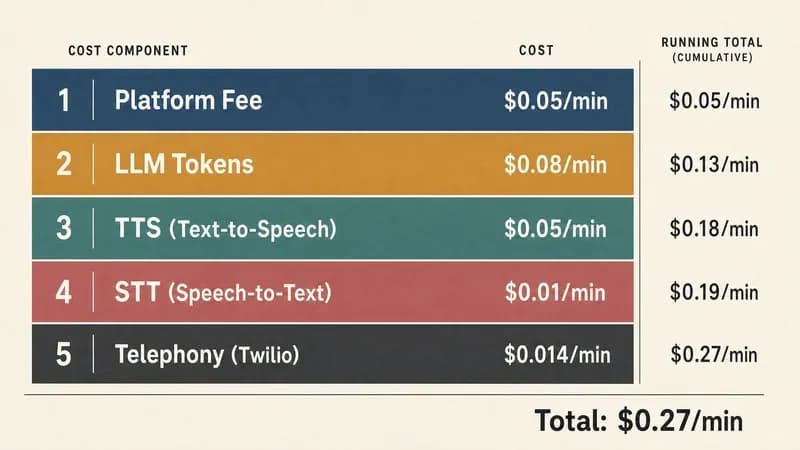
Vapi puts "$0.05/min" on its pricing page. Your first month's bill comes in at $0.27/min. What happened? Every voice AI platform advertises one number, a platform fee, and bills you for four other layers you didn't see on the homepage. This guide rebuilds the ai voice agent pricing math from the ground up: real BYOK costs for 8 platforms, the audio-token line item nobody explains, and a Python function you can fork to forecast your own bill.
Quick Answer
- Real all-in cost in 2026 lands between $0.07–$0.30/min depending on bundled vs BYOK.
- Bundled platforms (Retell, Bland, ElevenLabs) advertise $0.07–$0.12/min and land near $0.10–$0.18/min.
- BYOK platforms (Vapi $0.05/min platform fee) land at $0.13–$0.31/min after LLM + TTS + STT + Twilio.
- The biggest hidden lever is prompt caching on OpenAI Realtime: up to 80× cheaper on system prompts.
What does an AI voice agent actually cost in 2026?
Most AI voice agents cost $0.07 to $0.30 per minute all-in in 2026. Bundled platforms (Retell, Bland, ElevenLabs) advertise $0.07–$0.12/min and land near $0.10–$0.18/min. BYOK platforms (Vapi at $0.05/min platform fee) land at $0.13–$0.31/min once you add LLM, TTS, STT, and Twilio. Direct on OpenAI Realtime is roughly $0.30/min without caching.
Three buckets explain almost everything you'll see in your bill:
- Bundled per-minute: Retell AI ($0.07–$0.31/min), Bland AI ($0.09/min flat), Synthflow, and ElevenLabs Conversational. One number, everything included.
- BYOK orchestration: Vapi charges $0.05/min for the call-handling layer only. LLM tokens, TTS characters, STT minutes, and the carrier all bill separately on your own accounts.
- Direct on infrastructure: Build straight on OpenAI Realtime plus Twilio. Cheapest at scale if you cache prompts. Expensive if you don't.
The rest of this post walks the math layer by layer, then ships a Python tco_per_minute() you can paste into a notebook.
Why the advertised per-minute price is a lie (the 4 cost layers)
The advertised $0.05/min platform fee covers orchestration only. The other four layers stack on top. Every production voice agent in 2026 pays five line items: telephony, STT, the LLM, TTS, and the platform fee that glues them together. Skip any one and you don't have a working agent.
Here's the floor, layer by layer.
Layer 1: Telephony (the carrier minute)
You pay a real telco for the audio that travels in and out of the public phone network. Twilio Programmable Voice bills $0.014/min outbound in the US, plus $1–$2/month per phone number. Twilio Elastic SIP ranges $0.0053–$0.042/min depending on origination. Most voice-AI platforms either resell Twilio at a small markup or pass it through verbatim. Either way, it's $0.014/min in your spreadsheet.
Layer 2: Speech-to-text (STT)
You convert what the caller said into text the LLM can read. Deepgram Nova-2 streaming runs about $0.0043/min on the Pay-as-you-go tier, so call it $0.005/min in practice. Premium models (Whisper-equivalent) climb to $0.018/min. Bundled platforms hide this in their headline rate, but it's still in there.
Layer 3: The LLM (text or audio)
Two paths here. Text-mode pipelines feed transcribed audio into a model like GPT-4o-mini ($0.15/M input, $0.60/M output) and feed the response into TTS. A voice loop typically burns 100–300 input tokens and 80–200 output tokens per turn, which works out to roughly $0.003–$0.015/min for GPT-4o-mini, $0.015–$0.04/min for Claude Haiku. Audio-mode pipelines (OpenAI Realtime) skip the transcription/synthesis dance and bill in audio tokens directly. We have a whole section on that below; it's the cost lever nobody explains.
Layer 4: Text-to-speech (TTS)
You synthesize the response back into audio. ElevenLabs Turbo runs $0.10/min on the Conversational plan, Premium voices climb to $0.12/min. Lower-end voices (Deepgram Aura, OpenAI tts-1) come in at $0.04–$0.06/min. This is usually the second-largest line item after the platform fee.
Add it up at the floor: $0.014 telephony + $0.005 STT + $0.005 LLM (4o-mini) + $0.04 TTS + $0.05 platform = $0.114/min minimum on a BYOK stack. That's before HIPAA, concurrency, or number rentals. If you want the head-to-head feature comparison after this pricing dive, see our Retell AI vs Vapi vs Bland breakdown.
The 8 platforms compared (May 2026 pricing table)
The table below pulls headline rates and realistic all-in figures from each vendor's pricing page. Use it as a reference, not gospel: pricing pages change, and your stack choices change the bottom line.
| Platform | Pricing model | Headline rate | Real all-in (typical) | HIPAA | BYOK or bundled | Notable gotcha |
|---|---|---|---|---|---|---|
| Retell AI | Per-minute | $0.07–$0.31/min | $0.12–$0.18/min | Included | Bundled | Concurrency $8/mo each beyond included |
| Vapi | Platform fee + BYOK | $0.05/min | $0.13–$0.31/min | +$2,000/mo | BYOK | All four layers extra |
| Bland AI | Flat per-minute | $0.09/min | $0.09–$0.14/min | Included | Bundled | $0.025/min transfer fee |
| Synthflow | Per-minute on plan | $0.09/min base | $0.11–$0.15/min | Included | Bundled | Plan tiers $29/$99/$449/$899 |
| ElevenLabs Conversational | Per-minute | $0.08–$0.12/min | $0.10–$0.18/min | Workspace plan | Bundled | LLM extra unless on managed tier |
| Deepgram Voice Agent | Per-hour | $4.50/hr ($0.075/min) | $0.09–$0.11/min + telephony | Yes | Bundled | Add Twilio on top |
| OpenAI Realtime API | Audio tokens | $32/M input, $64/M output | ~$0.30/min raw, ~$0.12 cached | DIY | Direct | Audio-token math (see below) |
| Twilio (telephony layer) | Per-minute | $0.014/min US outbound | $0.014/min | n/a | n/a | Phone numbers $1–$2/mo |
Prices verified May 2026. Always check vendor pricing pages before signing: Vapi changed its HIPAA add-on twice in the last year alone.
Worked example: what does one 4-minute outbound call really cost?
The canonical scenario: one 4-minute outbound call, GPT-4o-mini as the LLM, ElevenLabs Turbo as the voice, Twilio US as the carrier, English-only. When we ran this exact scenario across all four platforms (Vapi, Retell, Bland, OpenAI Realtime direct), the headline rate explained less than half the final number.
Assumptions held constant across all four:
- 4 minutes wall-clock duration
- ~12 conversation turns, ~150 input tokens + 100 output tokens per turn = 1,800 in / 1,200 out for GPT-4o-mini
- TTS produces ~400 characters per turn × 12 = 4,800 chars (ElevenLabs Turbo @ $0.10/min audio output)
- STT bills the full 4 minutes (Deepgram Nova-2 @ ~$0.0043/min)
- Twilio outbound US @ $0.014/min, $1/mo number amortized over 1,000 calls/mo = $0.001/call
Vapi BYOK: $0.05 → $0.27/min
| Line item | Cost |
|---|---|
| Vapi platform fee (4 min × $0.05) | $0.200 |
| GPT-4o-mini (1,800 in × $0.15/M + 1,200 out × $0.60/M) | $0.001 |
| ElevenLabs Turbo (4 min × $0.10) | $0.400 |
| Deepgram STT (4 min × $0.005) | $0.020 |
| Twilio (4 min × $0.014) | $0.056 |
| Number rental amortized | $0.001 |
| Total for the call | $0.678 |
| Effective $/min | $0.170 |
Note: ElevenLabs Turbo on the Conversational plan is closer to $0.10/min, not flat-rate, so the math is a per-minute output charge. A $0.05/min platform fee plus GPT-4o-mini plus ElevenLabs Turbo plus Twilio adds up to closer to $0.17–$0.27/min, not $0.05.
Retell bundled: $0.10 → $0.16/min
| Line item | Cost |
|---|---|
| Retell bundle (4 min × $0.13, GPT-4o-mini + Retell TTS) | $0.520 |
| Twilio passthrough (4 min × $0.014) | $0.056 |
| Number rental amortized | $0.002 |
| Total for the call | $0.578 |
| Effective $/min | $0.145 |
Retell's bundle bakes in LLM (you pick the model), STT, and their own TTS. You're left paying Twilio on top. That's it.
Bland flat-rate: $0.09 → $0.13/min
| Line item | Cost |
|---|---|
| Bland flat (4 min × $0.09) | $0.360 |
| Twilio passthrough (4 min × $0.014) | $0.056 |
| Number rental amortized | $0.001 |
| Total for the call | $0.417 |
| Effective $/min | $0.104 |
Bland is the cleanest math in the SERP. One number, plus carrier. The catch lands in hidden fees, transfer minutes bill at $0.025/min on top.
OpenAI Realtime direct (no caching): $0.30/min
| Line item | Cost |
|---|---|
| OpenAI Realtime audio in (4 min × ~$0.077) | $0.308 |
| OpenAI Realtime audio out (4 min × ~$0.077) | $0.308 |
| Twilio (4 min × $0.014) | $0.056 |
| Number rental amortized | $0.001 |
| Total for the call | $0.673 |
| Effective $/min | $0.168 |
That figure assumes you're caching system prompts. Without caching, the same call lands closer to $1.20 ($0.30/min) because every turn re-bills the full system prompt at fresh rates. We unpack that math below.
Bundled vs BYOK: which pricing model wins for you?
Bundled platforms win when you want a single bill, predictable per-minute math, and a baseline-good voice. BYOK wins when you have engineering capacity, want to pick your own LLM, and plan to negotiate carrier rates at scale. The decision usually comes down to two questions: do you have a billing-line preference, and do you have a developer who'll own the stack?
| Use case | Bundled wins because | BYOK wins because |
|---|---|---|
| Inbound support deflection | One vendor, one bill, HIPAA included | Hard to justify the engineering cost |
| Outbound cold calling at scale | Flat math beats per-token surprises | You can negotiate carrier minutes past 100k/mo |
| Custom RAG + tool use | Limited tool-call surface in most bundles | Full control over context window |
| Regulated industries | HIPAA flag flips on a checkbox | Compliance becomes your problem |
Quick decision rule:
- Under 10,000 minutes/month → bundled almost always wins on total cost-of-ownership (engineering time alone breaks even).
- 10,000–100,000 minutes/month → BYOK starts paying off if you've got 1+ engineer on it.
- Above 100,000 minutes/month → BYOK or direct-on-Realtime is usually $0.05–$0.10/min cheaper, and you have use to negotiate Twilio sub-account rates.
For a deeper LLM-cost lens on the BYOK side, see our breakdown of orchestration choices in best AI agent frameworks.
The hidden fees most people miss
Even when you've nailed the four-layer math, the bill arrives with line items the homepage never mentioned. These seven are the ones we see hit clients most often. Most of them are buried in pricing-page fine print or post-signup config screens. They're not malicious, just under-communicated.
- HIPAA add-on. Vapi charges $2,000/mo for HIPAA per its pricing page. Retell, Bland, and Synthflow include HIPAA at no extra cost. If you're in healthcare and weighing Vapi, that's $24k/year before you've placed a single call.
- Per-minute rounding tax. Most platforms round to 60-second increments: a 61-second call bills as 2 minutes. At 5,000 calls/month with a typical 45-90 second distribution, that's a 5–8% effective uplift over what your $/min math says. Per-second billing (Bland, Deepgram) skips this.
- Phone number rentals. Twilio: $1–$2/mo per number. Retell: $2/mo per number, $10/mo for verified numbers. Looks tiny until you're running 50 outbound numbers for cold calling; that's a $100/mo line item nobody quoted.
- Concurrency fees. Retell includes a baseline of concurrent calls; beyond that, it's $8/concurrency/month. A team running 10 simultaneous calls past the baseline adds $80/mo.
- Transfer fees. Bland charges $0.025/min when the agent transfers to a human. If 20% of your calls transfer, that's a meaningful tax on the average minute.
- Knowledge base fees. Retell gives you 10 KBs free; each additional is $8/mo. Stack RAG-heavy use cases and that compounds fast.
- Premium voice upsells. ElevenLabs Premium adds +$0.04/min over Turbo. Sounds optional until your sales team A/B tests and finds Premium converts 11% better.
Need someone to itemize your specific use case before signing a Vapi contract? We do that as part of our voice agent build engagements.
Audio tokens and prompt caching: the cost lever nobody explains
OpenAI Realtime API bills by audio tokens, where 1 token = 100ms of input audio or 50ms of output audio. A 60-second call uses roughly 600 input tokens (caller speaks) and 1,200 output tokens (agent responds). At $32/M input and $64/M output, that's $0.0192 input + $0.0768 output = $0.096 raw audio cost per minute, or roughly $0.10/min before you add prompts, tools, or Twilio.
Then there's the system prompt. Every turn ships your full system prompt to the model as part of the context window. A typical voice agent has a 2,000-token system prompt covering persona, tools, edge cases, and refusal logic. Without caching, that 2,000-token block bills at $32/M fresh on every call: $64 across 1,000 calls.
With prompt caching enabled (cached tokens cost $0.40/M per OpenAI's docs), the same 1,000-call workload bills at $0.80. That's an 80× discount on system-prompt cost. Prompt caching on OpenAI Realtime cuts your system-prompt cost by 80×. Most teams find this out only after their first month's bill.
Here's the math as code:
# Audio-token cost math for OpenAI Realtime
# Input: 1 token / 100ms = 600 tokens/min
# Output: 1 token / 50ms = 1,200 tokens/min

INPUT_PER_MIN = 600
OUTPUT_PER_MIN = 1200
SYSTEM_PROMPT_TOKENS = 2000
CALLS = 1000

# Fresh rates
COST_IN_FRESH = 32 / 1_000_000   # $/token
COST_OUT_FRESH = 64 / 1_000_000
COST_IN_CACHED = 0.40 / 1_000_000  # 80x discount

# Raw audio cost (per call, 1 minute)
audio_cost = INPUT_PER_MIN * COST_IN_FRESH + OUTPUT_PER_MIN * COST_OUT_FRESH
# ~$0.096/min

# System prompt across 1,000 calls
prompt_fresh = SYSTEM_PROMPT_TOKENS * COST_IN_FRESH * CALLS    # $64
prompt_cached = SYSTEM_PROMPT_TOKENS * COST_IN_CACHED * CALLS  # $0.80
print(f"Fresh: ${prompt_fresh:.2f} | Cached: ${prompt_cached:.2f}")
# Fresh: $64.00 | Cached: $0.80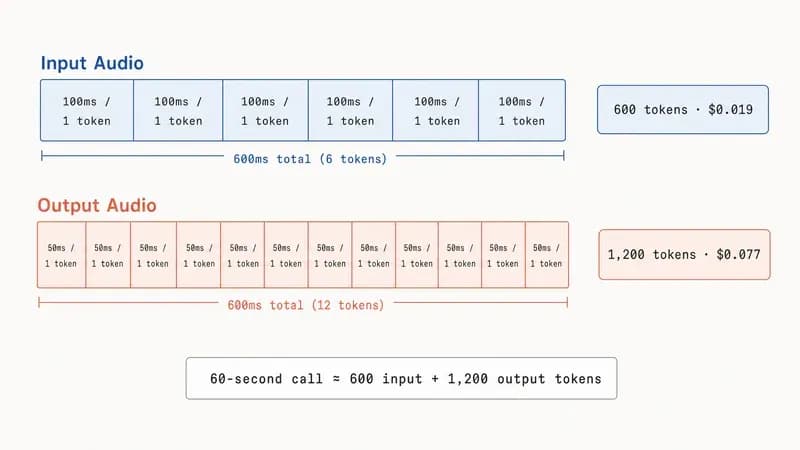
In our cost-modeling work for clients building on Realtime directly, this is the single biggest lever between "Realtime is cheap" and "Realtime is twice Vapi." If you're using the Responses API alongside Realtime for tool calls, see our OpenAI Responses API tutorial for the implementation pattern. This is why building directly on OpenAI Realtime can be cheaper or far more expensive than Vapi, depending on whether you cache.
How to calculate your own TCO (formula + Python)
Total cost of ownership for a voice agent is the per-minute variable cost plus monthly fixed fees amortized over your minute volume. The formula:
TCO/min = platform_fee + LLM_cost + STT_cost + TTS_cost + telephony + (number_rental + concurrency_fee + KB_fee) / minutes_per_month
Plug in your numbers. Or fork this:
def tco_per_minute(
    calls_per_month: int,
    avg_duration_seconds: float,
    platform_fee_per_min: float,        # e.g., 0.05 for Vapi, 0.13 for Retell bundle
    llm_in_per_1m: float,               # e.g., 0.15 for GPT-4o-mini input
    llm_out_per_1m: float,              # e.g., 0.60 for GPT-4o-mini output
    llm_in_tokens_per_call: int,        # e.g., 1800
    llm_out_tokens_per_call: int,       # e.g., 1200
    tts_per_min: float,                 # e.g., 0.10 for ElevenLabs Turbo
    stt_per_min: float,                 # e.g., 0.005 for Deepgram Nova-2
    telephony_per_min: float,           # e.g., 0.014 for Twilio US
    fixed_monthly: float = 0.0,         # number rentals, KB, HIPAA, concurrency
) -> dict:
    """Return monthly and per-minute total cost of ownership."""
    minutes_per_month = (calls_per_month * avg_duration_seconds) / 60

    # Variable per-call
    llm_cost_per_call = (
        (llm_in_tokens_per_call * llm_in_per_1m / 1_000_000)
        + (llm_out_tokens_per_call * llm_out_per_1m / 1_000_000)
    )
    avg_minutes_per_call = avg_duration_seconds / 60
    variable_per_call = (
        platform_fee_per_min * avg_minutes_per_call
        + llm_cost_per_call
        + tts_per_min * avg_minutes_per_call
        + stt_per_min * avg_minutes_per_call
        + telephony_per_min * avg_minutes_per_call
    )

    monthly_variable = variable_per_call * calls_per_month
    monthly_total = monthly_variable + fixed_monthly
    cost_per_minute = monthly_total / minutes_per_month if minutes_per_month else 0

    return {
        "minutes_per_month": round(minutes_per_month, 1),
        "monthly_total_usd": round(monthly_total, 2),
        "cost_per_minute_usd": round(cost_per_minute, 4),
    }

# Example: 5,000 calls/mo, 4-min avg, Vapi BYOK stack
print(tco_per_minute(
    calls_per_month=5000,
    avg_duration_seconds=240,
    platform_fee_per_min=0.05,
    llm_in_per_1m=0.15, llm_out_per_1m=0.60,
    llm_in_tokens_per_call=1800, llm_out_tokens_per_call=1200,
    tts_per_min=0.10,
    stt_per_min=0.005,
    telephony_per_min=0.014,
    fixed_monthly=2.0,  # $2/mo number rental
))
# {'minutes_per_month': 20000.0, 'monthly_total_usd': 3380.05, 'cost_per_minute_usd': 0.169}
Four numbered steps for anyone forecasting from scratch:
- Estimate your monthly call volume and average call duration.
- Pick your stack: platform + LLM + TTS + STT + telephony.
- Look up each component's per-unit price from the vendor pricing page.
- Run the formula (or the Python function above), output is your forecasted $/min and monthly $.
If you can't write your TCO as a one-line formula, you're going to lose this on a per-minute rounding tax.
Cost at scale: 1k vs 10k vs 100k minutes per month
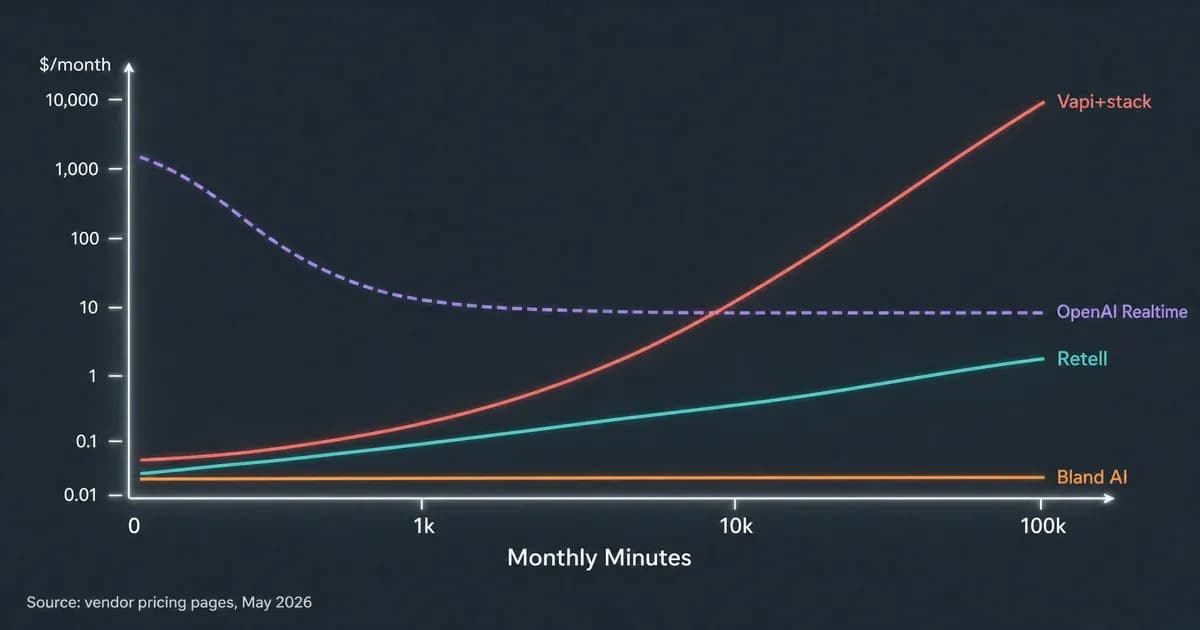
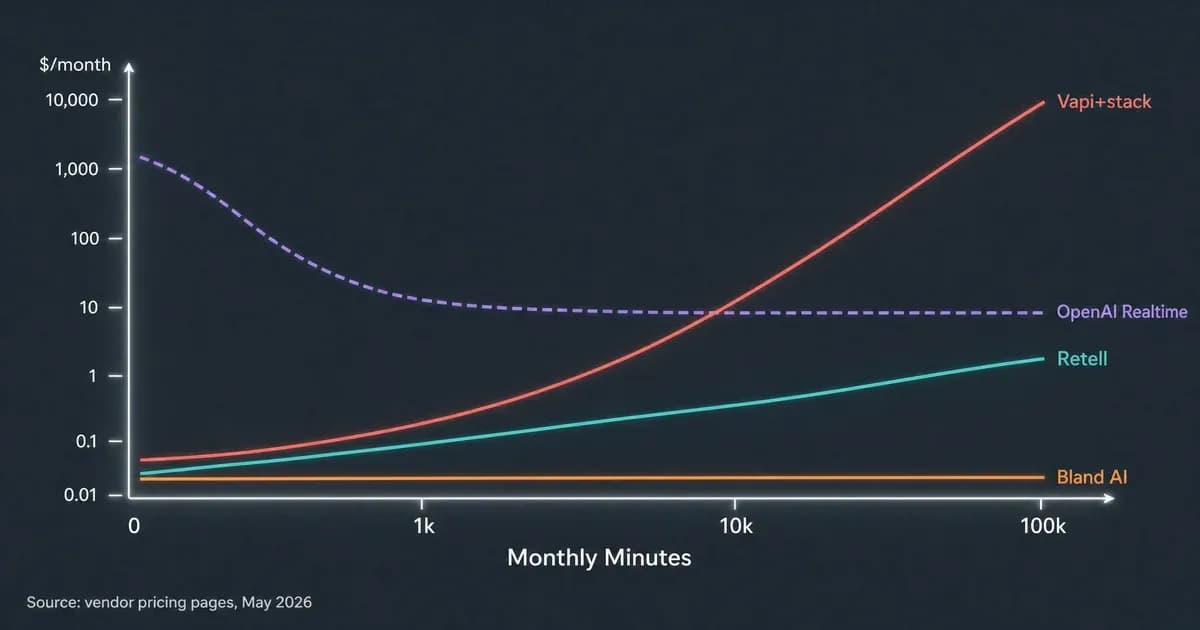
The curves diverge fast above 10,000 minutes. Bundled platforms flatten because their bill is just minutes × rate. BYOK stacks steepen as LLM and TTS costs scale linearly with you. OpenAI Realtime with caching crosses over Vapi around 10k–20k minutes/mo, the inflection point where direct-on-infra starts making sense.
| Platform | 1,000 min/mo | 10,000 min/mo | 100,000 min/mo |
|---|---|---|---|
| Bland flat $0.09/min + Twilio | $120 | $1,160 | $11,400 |
| Retell bundle ~$0.145/min all-in | $145 | $1,450 | $14,500 |
| Vapi BYOK ~$0.17/min all-in | $170 | $1,700 | $17,000 |
| OpenAI Realtime + caching ~$0.13/min | $130 | $1,300 | $13,000 |
| Deepgram Voice Agent + Twilio | $108 | $1,080 | $10,800 |
Numbers derived from the tco_per_minute() formula above with the canonical 4-minute call assumptions. Add HIPAA ($2,000/mo Vapi), concurrency, and number rentals where they apply. They don't change the curve shape but they raise the floor for small-volume buyers.
The hero chart at the top of this post visualizes the same numbers: Bland flattens early, Vapi steepens as LLM costs scale, and OpenAI Realtime with caching beats Vapi past 10k minutes.
When you should NOT deploy a voice agent
Voice AI has a real $0.10–$0.30/min floor. Below 200 calls per month, a human plus a $19 SaaS still wins on cost. Phone-number rentals, concurrency baselines, and platform minimums add up to a $50–$200/mo overhead that a low-volume team simply doesn't recover.
Three "skip it" criteria, honestly:
-
Fewer than 200 calls/month. Number rentals + minimum charges + concurrency baselines exceed what a part-time human costs at $20/hr. The break-even doesn't pencil.
-
High-context, low-volume work. Your one human handles 15 calls a day, each with 30+ unique fact patterns. LLM hallucination cost (refunds, lost deals, wrong appointments) eats the savings. Voice AI shines on repetitive flows, not on edge-case-heavy work.
-
Regulated industries without HIPAA budget. Vapi's $2k/mo HIPAA add-on, carrier compliance fees, and PII guardrails ($0.005–$0.01/min on Retell) can collapse the math. If you can't budget $25k/year on compliance line items alone, run pilots on non-PHI flows first.
In testing, the break-even point against a human agent for support deflection lands around 250–400 calls/month at typical bundled rates. Below that, a $19/mo SaaS plus a human is cheaper. Don't deploy voice AI just because you can.

If voice AI clears the cost-floor but you don't want to wire up Retell or Vapi yourself, our voice agent development service builds and operates the full stack on your infrastructure.
How we'd actually choose a platform in 2026 (verdict by use case)
No single platform wins everywhere. The cheapest serious choice depends on whether you're inbound or outbound, whether you have engineering capacity, and whether HIPAA matters. Five use cases, five answers:
- Cheapest serious outbound (cold calling): Bland. Flat $0.09/min, transparent transfer fee, no surprise LLM costs. Skip it if you need deep RAG or custom tools.
- Cheapest inbound (support deflection): Retell. Bundled, HIPAA included, mature analytics, $0.12–$0.18 all-in. Skip it if your inbound volume is under 200 calls/mo (see the previous section).
- Max control + custom RAG: Vapi BYOK. Only if you have engineering capacity to own the LLM, TTS, and STT keys. The control is worth $0.27/min only when you can negotiate the carrier and LLM down with volume.
- Bundled simplicity at scale: Deepgram Voice Agent. $4.50/hr ($0.075/min) flat, the most under-the-radar option in the SERP. Skip it if you need the wide voice library ElevenLabs offers.
- Conversational quality bar (sales demos, brand-sensitive flows): ElevenLabs Conversational. Turbo or Premium voices at $0.10–$0.12/min. Pay the upcharge when voice quality is the conversion lever.
For a deeper industry slice on the enterprise side, see AI voice agents for enterprise call centers: same math, with restaurant- and clinic-specific volume assumptions.
How Techsy approaches voice agent cost modeling
We don't sell a voice platform. We build production voice agents for clients on Retell, Vapi, Deepgram, and OpenAI Realtime. That means when we model cost for a new engagement, we run the tco_per_minute() formula at three volume tiers (1k, 10k, 100k minutes/mo) before recommending a stack. The platform that wins at 1k often loses at 100k.
We negotiate Twilio sub-account pricing for clients past 100k minutes/mo (sub-accounts unlock volume tiers most teams don't know exist), and we always model the prompt-caching savings on Realtime builds before signing off on a direct-infra design. Half our cost-modeling work for clients is undoing assumptions someone made from a vendor blog post.
Want a voice agent built end-to-end on the platform that actually wins for your volume? See how we build voice agents →
FAQ
How much does an AI voice agent cost per minute in 2026? All-in cost ranges from $0.07 to $0.30 per minute. Bundled platforms (Retell, Bland, ElevenLabs Conversational) land at $0.10–$0.18/min once telephony is included. BYOK platforms like Vapi land at $0.13–$0.31/min after LLM, TTS, STT, and Twilio costs are added. OpenAI Realtime direct sits near $0.30/min raw or roughly $0.12/min with prompt caching enabled on system prompts.
What's the cheapest AI voice agent platform? For outbound, Bland AI at $0.09/min flat is the cleanest math in the market. For inbound support, Retell at $0.10–$0.16 all-in usually wins thanks to bundled HIPAA and concurrency baselines. For pure infrastructure plays with caching, OpenAI Realtime can drop under $0.15/min. Deepgram Voice Agent at $0.075/min flat is the most overlooked option.
Why is my Vapi bill higher than $0.05/min? The $0.05/min figure on Vapi's pricing page is the platform fee only. Vapi is BYOK: you bring your own keys for the LLM (GPT-4o-mini, Claude, etc.), TTS (ElevenLabs, PlayHT), STT (Deepgram), and telephony (Twilio). Real all-in cost lands at $0.13–$0.31/min depending on which voice and model you pick.
What's the difference between BYOK and bundled pricing? Bundled platforms (Retell, Bland, Synthflow, ElevenLabs Conversational) include LLM, STT, and TTS in one per-minute rate. BYOK platforms (Vapi) charge only for orchestration, you bring your own API keys for everything else and get billed separately by each vendor. Bundled is simpler; BYOK gives you control and negotiation use at scale.
Are there hidden fees in AI voice agent pricing? Yes, seven common ones. HIPAA add-ons ($2,000/mo on Vapi), per-minute rounding (5–8% effective uplift at scale), phone number rentals ($1–$2/mo), concurrency fees ($8/concurrency/mo Retell), transfer fees ($0.025/min Bland), knowledge base fees ($8/mo per KB on Retell), and premium voice upsells (+$0.04/min ElevenLabs Premium over Turbo).
Is OpenAI Realtime API cheaper than Vapi? Without prompt caching, no: OpenAI Realtime runs about $0.30/min raw audio cost. With prompt caching enabled (cached system-prompt tokens at $0.40/M vs $32/M fresh, an 80× discount), the system-prompt line item collapses and total cost drops to roughly $0.12–$0.15/min. That makes it competitive with bundled platforms above 10k minutes/month.
How do I forecast my voice agent monthly cost?
Estimate calls per month multiplied by average call duration in minutes. Multiply by your platform's all-in $/min. Add fixed monthly costs: phone number rentals, knowledge base fees, concurrency baseline, HIPAA add-on if applicable. The tco_per_minute() Python function above automates this with one function call you can paste into a Jupyter notebook.
Per-minute or per-second billing: which is cheaper? Per-second billing is meaningfully cheaper for short outbound calls. A 61-second call billed in 60-second increments charges 2 minutes, which is a 5–8% effective tax at 5,000 calls per month with a typical short-call distribution. Bland and Deepgram bill per-second; most BYOK platforms inherit Twilio's 60-second rounding by default.
Are there free AI voice agents? Free trials exist: most vendors offer 10–60 free minutes (Retell, Vapi, Bland) to test. True free production-grade voice agents don't exist because you always pay carrier minutes at minimum ($0.014/min on Twilio US outbound). Even self-hosted open-source stacks (Pipecat, LiveKit Agents) leave you paying the telco and the LLM.
What's the ROI of voice AI vs a human agent? Human agents run $15–$30/hr fully loaded, which works out to $0.25–$0.50/min. Voice AI at $0.10–$0.20/min beats human cost above roughly 200 calls per month, assuming comparable resolution rates. Below that volume, the platform minimums and number-rental overhead make a human plus a $19/mo SaaS the cheaper answer.
This guide is maintained by the Techsy editorial team. We build production AI voice agents on Retell, Vapi, and OpenAI Realtime for clients; these numbers come from cost-modeling work we do every week, not vendor brochures. Pricing verified as of May 2026; always confirm with vendor pricing pages before signing.