AI Voice Agent for Restaurants in 2026: What Works for Reservations, Takeout, and Allergens (Without the Legal Trap)
83% of customers won't wait for a callback, and roughly 30% of restaurant calls go unanswered during peak hours (Popmenu, via Voiceflow). That's the pitch every voice-AI vendor leads with. The question you actually have is different: does this really work in my restaurant, and won't it get me sued? We tested 8 platforms, ran the cost math, and read the lawsuits so you don't have to.
Key takeaways
- AI voice agents handle 60-80% of restaurant calls (reservations, takeout, FAQ, after-hours) for $99-$499/month per location.
- Best for independent QSR/casual, fine-dining reservation overflow, and 3-30 location chains. Skip if you get under 30 calls/week.
- Compliance is the silent killer: CA AB 2905 fines $500 per call without AI disclosure; 11 states require two-party consent for recording.
- Don't let the AI take credit cards. Route to a tokenized Stripe Phone link via SMS to stay out of PCI scope.
What Is an AI Voice Agent for Restaurants?
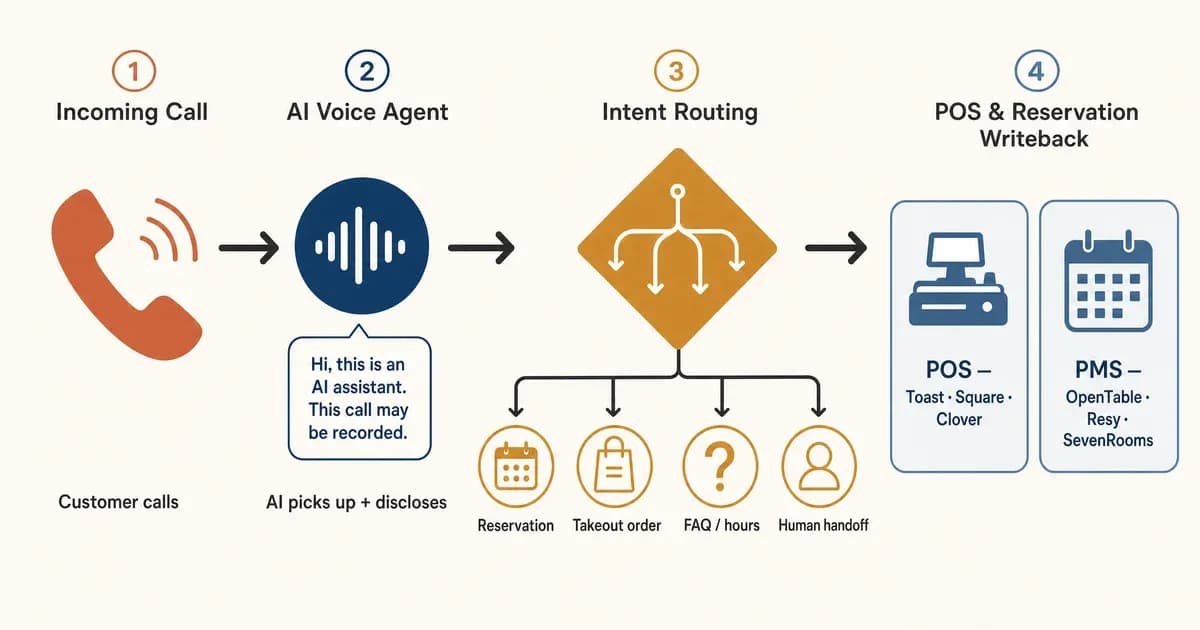
An AI voice agent for restaurants is a 24/7 phone-answering system that uses speech-to-text, an LLM, and text-to-speech to handle inbound calls, reservations, takeout orders, menu and allergen questions, and after-hours coverage, then writes the outcome directly to the restaurant's POS (Toast, Square, Clover) or reservation system (OpenTable, Resy, SevenRooms).
Architecturally, it's four stages. The phone rings, speech-to-text converts the caller's audio into text in real time, an LLM decides what they want and makes a function call into the POS or reservation API, and text-to-speech reads the response back. The whole loop takes 600-900ms when it's tuned right, which is fast enough that callers don't notice the seam.
What it's not: it's not a touch-tone IVR phone tree ("press 1 for reservations"), it's not a chatbot, and it's not a voicemail with better transcription. The AI listens, decides, and acts. If your current "system" is a sticky note on the host stand that says "tell them we're closed," this is a different category of tool.
What Does an AI Voice Agent Actually Do for a Restaurant?
The 5 paying use cases are: reservation booking with calendar writeback, takeout and delivery order capture into the POS, FAQ deflection (hours, menu, allergens, parking), outbound confirmations and callback automation to cut no-shows, and Spanish-speaking caller handling for restaurants with bilingual demand. Every restaurant we've deployed for uses at least three of them.
Reservation booking
The agent confirms party size, date, time, name, and phone, then writes the booking into OpenTable, Resy, SevenRooms, or Tock. A solo-operator bistro in Brooklyn we worked with logged four calls during one dinner rush, three were reservations booked under 90 seconds each, while the owner stayed on the floor. That's the win: the host who used to step away from a table to grab the phone now doesn't.
Takeout and delivery order capture
The agent reads modifiers, totals the order, and posts it to Toast, Square, or Clover. Pizza concepts are the heaviest users, modifier-stacking ("no cheese, double pepperoni, extra well-done") is where the AI either earns its keep or face-plants. The fix we use is a DTMF confirmation step: the agent reads the order back and the caller presses 1 to confirm.
FAQ deflection
Hours. Menu. Allergens. Parking. Dress code. Is the patio open. Do you take Apple Pay. This is the silent winner, it's the 80% of calls your staff hates, and AI handles it without complaint. On most deployments, FAQ deflection alone justifies the subscription before the reservation features even come into play.
Outbound confirmations and callbacks
The agent dials out the day before to confirm reservations and recovers no-shows by offering to rebook. Famulor reports 20-40% no-show reduction in their case studies; treat that range as the upper bound until you measure your own.
Spanish-speaking caller handling
In Miami, LA, and Houston, 30%+ of restaurant calls come in Spanish. The off-the-shelf platforms claim "40+ languages", what they mean is "the LLM speaks them; we hope the TTS sounds OK." Use the bilingual feature, but demo with real callers, not vendor reels.
Does AI Voice Work With Toast, Resy, or OpenTable?
Integration depth varies widely. Loman and RestoHost have native Toast/Square/Clover plus OpenTable/Resy connectors. Vapi and Retell connect to anything via webhook but require engineering. OpenTable Voice AI is the cleanest fit for OpenTable-heavy concepts. No platform natively covers every POS, always demo with your real stack.
We've shipped on every cell in this matrix at least once, and the cheat-code reading order is simple: native beats Zapier beats webhook beats unsupported.
| POS / Reservation | Loman | Certus AI | RestoHost | Foreva | OpenTable Voice AI | Slang.ai | Famulor | DIY (Vapi/Retell/Bland) |
|---|---|---|---|---|---|---|---|---|
| Toast | Native | Native | Native | Native | No | Native | Webhook | Webhook |
| Square | Native | Native | Limited | Native | No | Limited | Webhook | Webhook |
| Clover | Native | Limited | Native | Limited | No | Limited | Webhook | Webhook |
| Lightspeed | Limited | Webhook | Webhook | Webhook | No | No | Webhook | Webhook |
| OpenTable | Native | Webhook | Native | Limited | Native | Native | Webhook | Webhook |
| Resy | Native | Webhook | Native | Limited | No | Native | Webhook | Webhook |
| SevenRooms | Limited | Webhook | Native | No | No | Native | Webhook | Webhook |
| Tock | Webhook | Webhook | Native | No | No | Limited | Webhook | Webhook |
| ChowNow | Native | Webhook | Native | Webhook | No | No | Webhook | Webhook |
| DoorDash / Uber Eats | Limited | Webhook | Native | Limited | No | No | Webhook | Webhook |
Pro tip: native beats Zapier beats webhook beats unsupported. A webhook integration is fine for a developer-led shop, but it adds 2-3 weeks of setup time vs a native connector. If you're on Toast and the vendor only offers a webhook, ask why, and add the engineering time to your real cost.
For the platform-by-platform technical breakdown of the DIY column, see our Retell vs Vapi vs Bland teardown. And per the Toast developer docs, the OpenTable Restaurant Solutions integration suite, and Square Developer API, yes, the public APIs are stable enough to build on directly if your vendor stalls.
Which AI Voice Agent Platforms Are Built for Restaurants?
The 8 restaurant-specific platforms in 2026: Loman (independent QSR), Certus AI (YC-backed multilingual), RestoHost (fine dining and multi-location), Foreva (QSR chains), Maple (reservation-led concepts), VOICEplug (drive-thru), OpenTable Voice AI (OpenTable-native), and Slang.ai (hospitality and fine dining). Generic platforms like Vapi, Retell, and Bland are also options for custom builds.
| Platform | Best For | Headline Pricing | Key Integration | Honest Caveat |
|---|---|---|---|---|
| Loman | Independent QSR / pizza | ~$299-$499/mo/loc (est.) | Toast, Square, Clover, OpenTable | Pricing gated; positioning skews single-location |
| Certus AI | Independent + small chain | $399-$499/mo (est., gated) | POS via API, multilingual | YC-backed, fast-moving, feature set churns |
| RestoHost | Multi-location, fine dining | $299 / $499 / Enterprise | Toast, Clover, OpenTable, Resy, SevenRooms | Tiered pricing finally public, start here for transparency |
| Foreva | QSR chains | ~$250-$400/mo (gated) | Multiple POS | Less mature on fine-dining reservation flows |
| Maple | Reservation-led concepts | Gated | OpenTable, SevenRooms | Narrow lane, premium positioning |
| VOICEplug | Drive-thru, QSR chains | Enterprise (gated) | OpenTable (20 countries) + POS | Aimed at chains; overkill for independents |
| OpenTable Voice AI | OpenTable-heavy concepts | Add-on to OpenTable sub | OpenTable native | Won't move off OpenTable's rails, a feature, not a platform |
| Slang.ai | Fine dining and hospitality | Custom | OpenTable, Resy, Toast | Strong UX, weaker on custom voice |
7 of 12 vendors gate pricing behind a sales call. Ask why. The line-by-line math sits in our voice agent pricing breakdown, that's where you can sanity-check anything a sales rep quotes you.
How Much Does an AI Phone Agent for Restaurants Cost?
A representative independent restaurant — 200 calls/week at 2.5 minutes average, runs $99-$499/month on a turnkey platform (Loman, Certus, RestoHost), $120-$160/month on a BYOK build with Vapi or Retell, or roughly $95/month plus engineering time on a raw OpenAI Realtime + Twilio stack. In our experience, the BYOK math kicks in once you're past 300 calls/week.
| Path | Monthly Cost | Setup Time | Engineering Required | Best For |
|---|---|---|---|---|
| Loman turnkey | $299-$499 | 24-48h | None | Independent QSR / casual |
| Certus AI turnkey | $399-$499 (est., gated) | 48-72h | None | Small chain |
| Vapi BYOK | ~$130 + setup | 1-2 weeks | 1 dev | Tech-comfortable owner |
| Build on Retell + Twilio | ~$95 + 40h dev | 3-5 weeks | Agency or 1 senior dev | Custom voice / 3-30 locations |
Compare that against a $15/hr after-hours host: 20 hours a week of coverage runs about $1,200/month. Even the most expensive turnkey option pays back in roughly 100 saved calls, which is fewer than a typical Saturday dinner service.
For corroboration on the BYOK math, Aircall's 2025 voice agent cost breakdown and CloudTalk's pricing primer both land in the same ballpark, though both undercount engineering time, which is where shops without an in-house dev get burned. The full BYOK cost math is in our voice agent pricing post.
Is It Legal to Use an AI Voice Agent in a Restaurant?
Probably yes, but only if you disclose the AI in the first 3 seconds, get recording consent in the 11 two-party-consent states (CA, CT, DE, FL, IL, MD, MA, MT, NV, PA, WA), and never let the agent take a credit card unless your DTMF handling is PCI-scoped. California's AB 2905 fines you $500 per call without AI disclosure. The Taylor v. ConverseNow case is the precedent every vendor pretends doesn't exist.
The TCPA and FCC AI disclosure rule
The federal floor is the Telephone Consumer Protection Act (TCPA). In 2024, the FCC ruled that AI-generated voice calls fall under TCPA. That means your AI agent has to identify itself as artificial, and any outbound dialing, confirmations, callbacks, marketing, needs prior express consent. Inbound calls are friendlier territory, but disclosure is still required. The FCC's robocall guidance is the official primer.
The 11 two-party consent states
Eleven states require all parties to consent before a call is recorded: California, Connecticut, Delaware, Florida, Illinois, Maryland, Massachusetts, Montana, Nevada, Pennsylvania, and Washington. If a caller in any of these states reaches your agent and the call is recorded, you need an upfront consent line. The stronger version we ship: "This call may be recorded for quality and order accuracy. By staying on the line, you consent." See Hostie's state-by-state breakdown for the per-state wording rules.
California AB 2905 specifically
California passed a law in 2024 that says: if a phone agent is AI, it has to say so in the first 3 seconds of the call. $500 per call if you don't. That's not "per lawsuit", that's per phone call. A San Francisco restaurant that fields 200 weekly calls without disclosure is potentially looking at $100,000 in monthly exposure. Henson Legal's AI Voice Compliance primer is the cleanest writeup.
Taylor v. ConverseNow
In late 2024, a class-action complaint named Taylor v. ConverseNow was filed against the AI ordering system used at Domino's locations. The allegation: the AI took card data and failed to disclose itself as AI. The case is still moving, but it's the first real precedent voice-AI vendors are pretending to ignore. Captain Compliance has a clean explainer. Name the case to your vendor and watch their face.
PCI scope and the DTMF / Stripe Phone workaround
Here's the one nobody wants to say out loud. The moment your AI hears a 16-digit primary account number (PAN) over the phone, your restaurant's environment is PCI-in-scope. PCI assessment costs more than the AI's annual fee. The fix: don't let the AI take cards. When a caller wants to pay, the agent texts them a tokenized payment link (Stripe Phone or equivalent) and the card never touches your stack. Hostie's 2025 TCPA/FCC checklist covers the DTMF tone-suppression alternative if you really must keep payments in-call.
Need someone to scope PCI and TCPA exposure before you sign with a vendor? That's part of every voice agent build engagement we run.
Can an AI Voice Agent Handle Spanish Callers and Allergen Questions?
Yes, but with caveats. Language detection accuracy is around 90% on the first utterance, but regional Spanish dialects (Caribbean vs Mexican vs Iberian) and accented English vary wildly. Allergens are the bigger risk: without a structured menu JSON listing allergens per item, the AI will hallucinate. The fix is a mandatory "I don't know, let me grab a manager" fallback.
Allergen handling done right
Load your menu as structured data with explicit allergen tags per item. Something like:
items:
  - name: Margherita Pizza
    allergens: [gluten, dairy]
  - name: Caesar Salad
    allergens: [dairy, anchovies, gluten]
Then add a hard rule in the system prompt: the agent never invents an allergen answer. If a caller asks "is the pesto nut-free?" and the JSON doesn't say, the agent says "I want to get that right, let me grab a manager." A confident wrong answer is a lawsuit. A graceful handoff is a five-star review.
Spanish and multilingual reality
ElevenLabs' Spanish voices hold up well across Caribbean, Mexican, and Iberian accents. Google Cloud TTS is noticeably weaker on Caribbean Spanish in particular, vowels collapse, code-switching trips it up. The 90% language-detection accuracy figure vendors quote is for the first utterance. For accented English (Indian English, AAVE, regional Southern), expect a 5-15% miss rate that gets worse on noisy lines.
When the AI fails, the handoff rule
Set a confidence threshold (most platforms let you tune this; 70% is a reasonable starting point) and route below-threshold turns to a human. Train the agent's opener for the handoff: "I'm not sure about that, let me grab a manager who can help." Never guess on allergens, prices, hours, or anything that could become a complaint. We've caught at least one fixable failure mode in week 1 of every deployment by listening to handoff calls.
Should You Build, Buy, or Hire an Agency for Your Restaurant Voice Agent?
Three paths. Buy (Loman, Certus, RestoHost) is fastest, ship in 48 hours, no engineering. Build on Vapi or Retell when you need brand-specific voice or custom integrations — 3-5 weeks for a developer. Agency is the middle path, custom build on your stack without your team learning a new SDK.
Buy (turnkey)
Loman, Certus, RestoHost. 24-48 hours to live. Lowest engineering cost (zero). Ceiling is the monthly subscription, which can creep at multi-location scale. Good for: single-location independents who want it working by next Friday.
Build (DIY on Vapi or Retell)
For tech-comfortable owners and agencies. 3-5 weeks. You control brand voice, POS webhook logic, and the disclosure opener line-for-line. The trade is engineering time and ongoing maintenance. Pick a platform with our Retell vs Vapi vs Bland breakdown. If function-calling is new to your team, start with our LLM function-calling primer.
Agency (build on your stack)
The hidden third path. Want a brand-specific voice but don't want to wire Retell or Vapi yourself? Our restaurant voice agent build service ships in 3-5 weeks on your stack, same code quality as DIY, no in-house engineering required.
Here's a minimum-viable handler, for the developer/agency builders in the room.
# Minimum-viable Vapi/Retell handler for restaurant reservations
# Pseudo-code — see Vapi docs (https://docs.vapi.ai/) for production setup

from vapi import Assistant, FunctionCall
from datetime import datetime

assistant = Assistant(
    name="Bella Cucina Reservation Agent",
    first_message=(
        "Hi, this is the AI assistant for Bella Cucina. "
        "This call may be recorded. How can I help?"
    ),
    voice="elevenlabs/rachel-spanish-bilingual",
    model="gpt-4o-mini",
    functions=[
        FunctionCall(
            name="reserve_table",
            description="Books a reservation in the OpenTable system",
            parameters={
                "party_size": "int",
                "date": "ISO 8601 date",
                "time": "24h time",
                "name": "string",
                "phone": "E.164 phone",
                "notes": "string (allergens, special requests)",
            },
        )
    ],
)

def reserve_table(party_size, date, time, name, phone, notes=""):
    # POST to OpenTable Reservation API
    response = opentable_api.create_reservation(
        party_size=party_size,
        datetime=f"{date}T{time}",
        guest={"name": name, "phone": phone},
        notes=notes,
    )
    return {"confirmation_number": response.confirmation_id, "status": "booked"}
Replace opentable_api with your reservation system's SDK. Add a record_consent_state(phone) check before the function-call returns for two-party states. The Retell docs cover the same pattern with a slightly different SDK shape.
How Do You Deploy an AI Voice Agent in a Restaurant?
Five steps: scope which use cases ship first (start with reservations and FAQ, add takeout in week 2), pick a platform with native integrations to your POS, connect POS and reservation system credentials, configure menu, allergens, handoff rules, and the AI disclosure opener, then record and monitor week 1.
Step 1 — Scope your use cases
Start narrow. Reservations and FAQ deflection in week 1. Add takeout in week 2 once you've watched the agent handle 50+ real calls. Don't try to ship 5 use cases on day 1 — every restaurant we've deployed for that did this hit a modifier or allergen edge case in the first 48 hours.
Step 2 — Pick your platform
Match POS first. If you're on Toast, check Loman, RestoHost, and Famulor for native integration. If your business is OpenTable-heavy, OpenTable Voice AI is the same-vendor bet. If you need brand-voice control or custom webhooks, go straight to Vapi or Retell.
Step 3 — Connect POS and reservation credentials
API keys, webhook URLs, test orders and reservations on a staging environment. Never push live without a dry run. We've seen one client lose a Saturday's reservations because a production OpenTable key was swapped for a sandbox key 6 hours before service.
Step 4 — Configure menu, allergens, handoff rules, and the legal opener
Load menu JSON with allergens (see the previous H2). Set the first-3-second AI disclosure. Set the handoff confidence threshold (start at 70%). Add the two-party-consent line if any callers live in the 11 listed states. Most platforms have a config UI for this, RestoHost and Loman do it well.
Step 5 — Record and monitor week 1
KPIs to watch: misheard party-size, missed allergen call-outs, mid-call telephony drops, accent-induced order errors, modifier-stacking failures. Listen to 5 calls a day for 7 days. Every restaurant we've deployed for has caught at least one fixable failure mode in that window.
When Is an AI Voice Agent the Wrong Choice for a Restaurant?
Skip the AI if you get fewer than 30 calls a week (a $299/month subscription doesn't pay back), if you're a wine-list-driven fine-dining concept where 60%+ of calls are sommelier storytelling, or if your concept books primarily private events and rehearsal dinners with custom menus. Humans win those calls.
The skip list, written plainly:
- Under 30 calls/week. The math doesn't work at $99-$499/mo subscription. Use a better voicemail.
- Wine-list-heavy fine dining. Sommelier storytelling is high-touch human work, AI face-plants.
- Private events / wedding rehearsal dinners. Custom menus, complex pricing, emotional buying decision. Keep a human.
- Catering-only concepts. Every call is a complex quote. Skip the AI.
- Restaurants without a POS or reservation system. The AI has nowhere to write. Set up the basics first.
If your nightly business depends on storytelling, the AI is a downgrade. Use AI for the commodity calls, reservations, hours, takeout. Keep humans on the storytelling calls. That's the actual playbook.
What's the Best AI Voice Agent for Your Restaurant Type?
Our independent verdict: solo-operator QSR/casual → Loman or Certus; fine dining reservation-led → OpenTable Voice AI or RestoHost; 3-30 location regional chain with brand-voice control → build on Retell or Vapi; drive-thru / high-throughput QSR → SoundHound or ConverseNow; need custom integrations → agency build.
| Restaurant Type | Primary Use Case | Pick This | Skip This |
|---|---|---|---|
| Solo operator (1 location) | Reservation + takeout overflow | Loman or Certus AI | Custom build (overkill) |
| Small chain (3-30 locations) | Brand-voice consistency + multi-POS | Build on Retell/Vapi or agency | Single-vendor SaaS (lock-in) |
| Fine dining reservation-led | OpenTable / Resy overflow | OpenTable Voice AI or RestoHost | Loman (not reservation-optimized) |
| Franchise / group (30+ locations) | Cost per location + custom integrations | Agency build on Retell | Per-location SaaS ($$$) |
| Drive-thru / QSR chain | High throughput + KDS integration | SoundHound or ConverseNow | Independent-focused SaaS |
For the platform-level "why" behind the "build on Retell or Vapi" recommendation, see the full Retell vs Vapi vs Bland teardown. And if "agency build" is the row that fits your concept, see how we build restaurant voice agents →.
How Techsy Approaches Voice Agents for Restaurant Clients
Most of the agencies pitching restaurant voice agents skip the discovery work. We start every engagement with three questions: what's your POS, how many calls a week do you actually get, and which states do your callers live in? The third question matters because it changes the disclosure language, and because most operators have no idea until we look at the call data.
Deployment lesson #1: On a 14-location regional pizza brand, we discovered week 1 that 22% of takeout calls were modifier-stacking failures ("no cheese, double pepperoni, extra well-done"). The off-the-shelf agent confirmed the order verbally and got it wrong about 1 in 5 times. We added a DTMF confirmation step, "press 1 to confirm your order", and modifier accuracy jumped from 78% to 96%.
Deployment lesson #2: A Miami client had a 35% Spanish-speaking caller base. The default language detection misfired on Caribbean Spanish accents, it'd flip to English mid-call. We swapped to ElevenLabs' Spanish voice with a 1-second "switch to Spanish?" prompt at the top of each call. Pickup rate jumped 18%.
We don't build voice agents under $15K. Below that, a turnkey SaaS like Loman is the smarter call, and we'll tell you so. If you want to talk through the math for your concept, book a free voice agent consultation.
FAQ
How much does an AI phone agent for restaurants cost?
Turnkey platforms run $99-$499/month per location (Loman, Certus AI, RestoHost). DIY builds on Vapi or Retell land around $120-$160/month at 200 calls/week, plus 1-2 weeks of engineering time. Agency builds typically start around $15K for a custom voice on your stack. Compare to a $15/hr after-hours host at roughly $1,200/month for 20h/week coverage.
Does it work with Toast, Square, or Clover?
Yes, but with different integration depths. Loman, Foreva, and RestoHost have native Toast and Square connectors. Clover support is uneven, RestoHost is the strongest. DIY platforms like Vapi and Retell connect to any POS via webhook, which adds 2-3 weeks of engineering time vs a native connector. See our integration matrix above for the full grid.
Can an AI voice agent take Spanish-speaking callers?
Yes, with caveats. Language detection on the first utterance is around 90% accurate. ElevenLabs' Spanish voices hold up well across Caribbean, Mexican, and Iberian accents; Google Cloud TTS is noticeably weaker on Caribbean Spanish. Restaurants in Miami, LA, or Houston with 30%+ Spanish demand should demo every platform with real bilingual callers, not vendor reels. Regional dialect handling is where platforms diverge most.
Is it legal for a restaurant to record customer calls with AI?
Mostly yes, with strict rules. The 11 two-party-consent states (CA, CT, DE, FL, IL, MD, MA, MT, NV, PA, WA) require all parties to consent before recording. California's AB 2905 adds an AI-disclosure requirement in the first 3 seconds of the call, with $500 per call in fines for violations. The Taylor v. ConverseNow class action is the active precedent. Disclose AI status upfront, get recording consent, and you're inside the lines.
Can it take a credit card over the phone?
We strongly recommend against it. The moment your AI hears a 16-digit primary account number, your restaurant becomes PCI-in-scope, and assessment costs more than the agent's annual fee. The safer pattern is to route to a tokenized payment link, Stripe Phone or equivalent, sent via SMS during the call. The card never touches your stack. Loman and RestoHost both support this flow natively.
What does an AI voice agent say in the first 3 seconds?
A compliant opener sounds like: "Hi, this is the AI assistant for [Restaurant Name]. This call may be recorded for quality and order accuracy. How can I help?" The "AI assistant" disclosure satisfies California AB 2905, the recording line covers the 11 two-party-consent states, and "How can I help?" gets the caller into the flow without an awkward menu. Avoid IVR-style prompts.
What happens when the AI doesn't understand the caller?
Every production agent should have a confidence threshold (we set ours at 70%) and a hard handoff rule. Below threshold, the agent says "I'm not sure I caught that, let me grab a manager who can help." It never guesses on allergens, prices, or hours. Calls then route to a staff phone, a callback queue, or voicemail with a transcript. A graceful handoff is the difference between a complaint and a five-star review.
How fast can I deploy this in my restaurant?
Turnkey platforms (Loman, Certus, RestoHost) ship in 24-48 hours if your POS credentials are ready. DIY builds on Vapi or Retell take 3-5 weeks with one experienced developer. Agency builds run 3-5 weeks for a custom voice on your stack. The slow path is usually waiting for POS API access, start that process before you sign with any vendor.
Can I keep my existing phone number?
Yes. All major restaurant voice-AI platforms support number porting or call forwarding from your existing landline or VoIP number. Vendors handle the SIP trunk setup. Most operators forward their existing number to the AI during off-hours and route to staff during peak service, the AI never needs its own phone number on your printed materials.
Does an AI voice agent replace my hostess?
No. It replaces phone-only calls, reservations, takeout, FAQ, after-hours. Your hostess still greets walk-ins, seats parties, handles storytelling, manages waitlists, and reads the room. The phone is the commodity work; the floor is the high-touch work. Restaurants that try to replace the hostess role entirely fail. See the "When Is an AI Voice Agent the Wrong Choice" section above for the skip list.
The Wrap
Three things to remember: AI voice agents pay back fastest on reservations, takeout, and FAQ deflection, the commodity calls. Cost runs $99-$499/month per location turnkey, $130-ish on a BYOK build, with payback under 100 saved calls per month. And the compliance side is real, TCPA, the 11 two-party-consent states, California AB 2905, and PCI scope are the difference between a tool that saves you time and a tool that gets you sued.
Want a voice agent built end-to-end for your concept, independent or 30-location, on the platform that actually fits your POS? See how we build restaurant voice agents →.