
Claude Sonnet 5: What's New, and What It Actually Costs to Run
Claude Sonnet 5 landed today, June 30, 2026, and Anthropic priced the intro tier at $2 per million input tokens. That's where most coverage stops. The number that actually moves your bill is different: what does a full agent run cost once you add output tokens and a dozen back-and-forth turns? Anthropic says Sonnet 5 gets "close to Opus 4.8" for roughly a third of the price. So the real question isn't the spec sheet. It's whether your agent's monthly cost just dropped, and by how much.
Key takeaways:
- Claude Sonnet 5 launched June 30, 2026, replacing Sonnet 4.6 as Anthropic's mid-tier agentic model.
- Intro pricing is $2/M input and $10/M output through August 31, 2026, then $3/$15.
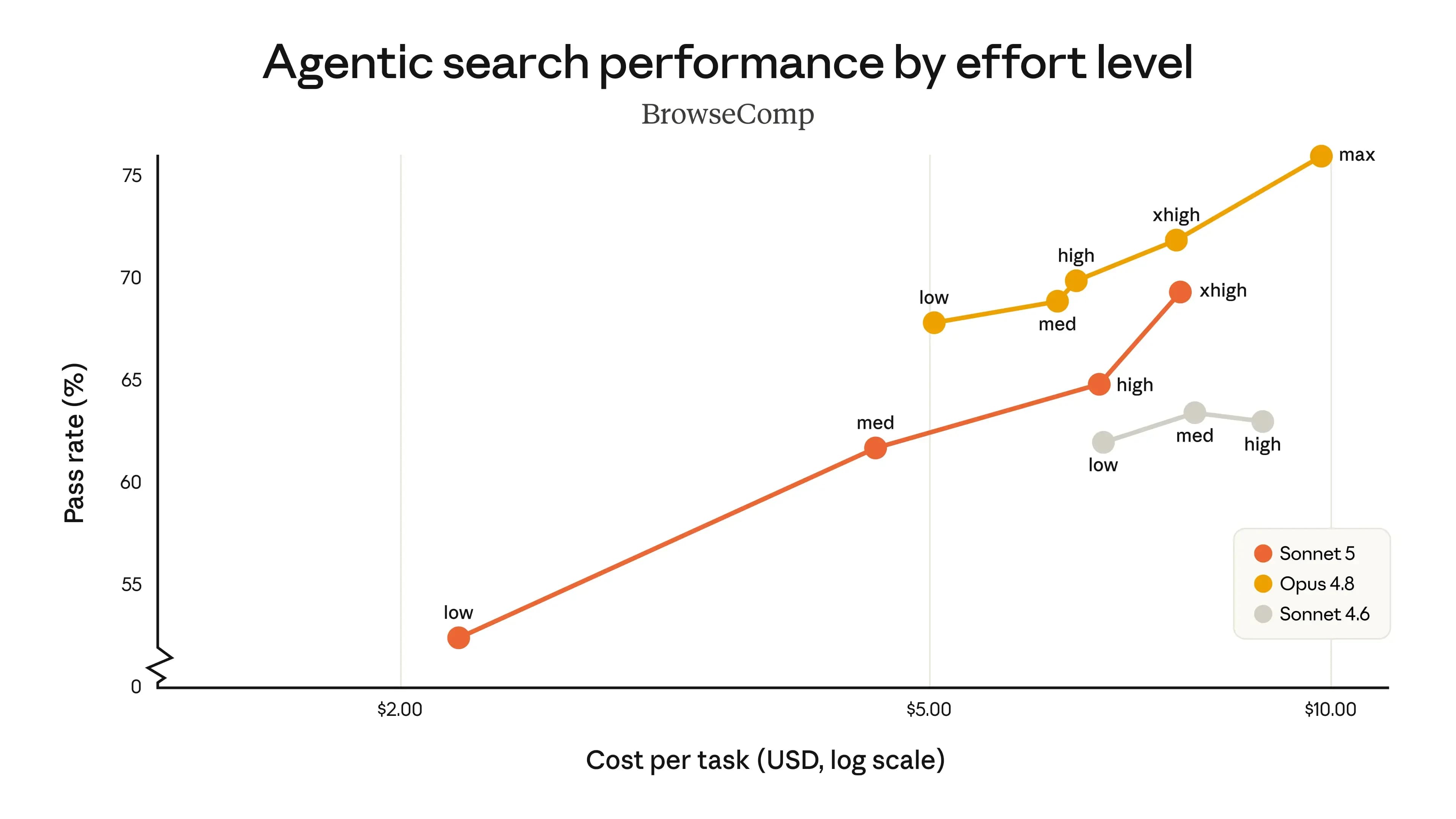
- Anthropic says performance is "close to Opus 4.8" at roughly a third of Opus's cost.
- It's the default for Claude Free and Pro, and available via the API and Claude Code as
claude-sonnet-5.
What Is Claude Sonnet 5? (the 30-second answer)
Claude Sonnet 5 is Anthropic's new mid-tier model, launched June 30, 2026, and described in its launch post as the most agentic Sonnet yet. It can make plans, use tools like browsers and terminals, and run autonomously. Intro pricing is $2/M input and $10/M output, and it's now the default for Claude Free and Pro.
Yes, it's released today, in case you've seen the "has Claude Sonnet 5 been released?" confusion floating around. You select it with the model string claude-sonnet-5 in the API or in Claude Code. Anthropic positions it as a meaningful step over Sonnet 4.6 and says quality sits close to its flagship, Opus 4.8, without the flagship price tag.
Here's the bet underneath it: Claude Sonnet 5 is Anthropic's wager that most agent work no longer needs a frontier model. If that holds, the interesting story isn't the capability jump. It's the economics.
What's New vs Sonnet 4.6 and Opus 4.8
Anthropic calls Sonnet 5 a "substantial improvement over its predecessor, Sonnet 4.6" across reasoning, tool use, coding, and knowledge work, with performance "close to that of Opus 4.8, but at lower prices." It checks its own output without being asked, and it's stronger at sustained coding, debugging, and multi-step tool use. Those are Anthropic's framings, not our measurements.
Agentic upgrades
The headline change is autonomy. Sonnet 5 is built to plan a task, pick up tools like browsers and terminals, and grind through long runs without hand-holding. As TechCrunch reports (citing Anthropic), the model is pitched as a cheaper way to keep agents running, with early customer signals from teams like Zapier and Lovable. That's the use case Anthropic is chasing: agents that loop for minutes or hours, where every turn adds tokens.
How it stacks against Opus 4.8 on paper
Here's the part that matters for budgeting. The capability gap narrowed; the price gap didn't.
| Model | Input $/M | Output $/M | Intro vs standard | Positioning |
|---|---|---|---|---|
| Claude Sonnet 5 | $2 (intro) → $3 | $10 (intro) → $15 | Intro through Aug 31, 2026 | Mid-tier, most agentic Sonnet; "close to Opus 4.8" (Anthropic) |
| Claude Sonnet 4.6 | $3 | $15 | Standard | Prior mid-tier (Feb 2026) |
| Claude Opus 4.8 | $5 ($10 Fast Mode) | $25 ($50 Fast Mode) | Standard | Flagship; hardest long-horizon reasoning |
Notice the standard Sonnet 5 price ($3/$15) is identical to Sonnet 4.6. You get a more capable model at the same sticker. And against Opus 4.8's $5/$25, Sonnet 5 standard runs at roughly 60% of the input rate and the output rate. During the intro window it's cheaper still. Anthropic hasn't published a number that says Sonnet 5 beats Opus 4.8, so don't read it that way: the official line is "close to," and we're holding to it.
How Much Does Claude Sonnet 5 Actually Cost? (token economics)
Claude Sonnet 5 costs $2/M input and $10/M output during the intro window through August 31, 2026, then steps up to $3/M input and $15/M output. That standard price matches Sonnet 4.6 for a stronger model, and it lands at roughly a third of Opus 4.8's standard rate ($5/$25). For high-volume agent work, that ratio is the whole story.
So what does "per million tokens" actually mean for you? A token is roughly three-quarters of a word. A million tokens is a lot of text, maybe 750,000 words, but agents burn through them fast because every turn re-sends context: the system prompt, prior messages, file contents, tool outputs. A single multi-file refactor can chew through hundreds of thousands of input tokens before it's done.
That intro window is a real decision point. Until August 31, you're paying $2/$10. After that, $3/$15. If you're going to test Sonnet 5 anyway, doing it now means your evals run at the discount, and you lock in habits while the math is friendliest. The flip side: don't build a budget on intro pricing you'll lose in two months.
Two platform features change the real bill more than the headline rate does. Prompt caching lets you reuse a cached context instead of paying full input price on every turn, for up to roughly 90% savings on the cached portion. Batch processing cuts costs by about 50% for non-urgent jobs you can run asynchronously. Both are documented in Anthropic's platform pricing. If your agent re-sends the same large system prompt or codebase on every turn, prompt caching is the single biggest lever you have on cost. We get into more tactics in our guide on cutting your LLM API costs.
At $2 per million input tokens, Sonnet 5 makes high-volume agent loops cheap enough to leave running. That's the shift. The question is no longer "can I afford to run this agent?" but "how many of them can I run at once?"
What a Real Sonnet 5 Agent Run Actually Costs (reproducible)
Let's put a number on it. We didn't run a lab benchmark, and we're not going to pretend we did. What follows is a transparent calculation you can reproduce with your own token counts, using Anthropic's published per-token rates. State your assumptions, do the arithmetic, and the bill falls out.
The worked calculation
Take a realistic agent task: a multi-file refactor that runs about 12 turns. Assume roughly 40K input tokens and 8K output tokens per turn (caching off), because each turn re-sends growing context. That's about 480K input tokens and 96K output tokens total. Now the math:
- Sonnet 5 intro: (0.48M × $2) + (0.096M × $10) = $0.96 + $0.96 = $1.92
- Sonnet 5 standard: (0.48M × $3) + (0.096M × $15) = $1.44 + $1.44 = $2.88
- Opus 4.8 standard: (0.48M × $5) + (0.096M × $25) = $2.40 + $2.40 = $4.80
Now turn prompt caching on. If most of that 480K input is a reused context (system prompt, file tree, prior turns) and you get close to the documented ~90% saving on the cached portion, the input side drops from about $0.96 to roughly $0.10, while output stays at $0.96.
| Scenario (12 turns, ~480K in / ~96K out, caching off unless noted) | Input cost | Output cost | Total |
|---|---|---|---|
| Sonnet 5 intro ($2/$10) | $0.96 | $0.96 | $1.92 |
| Sonnet 5 standard ($3/$15) | $1.44 | $1.44 | $2.88 |
| Opus 4.8 standard ($5/$25) | $2.40 | $2.40 | $4.80 |
| Sonnet 5 intro + prompt caching (~90% input savings) | ~$0.10 | $0.96 | ~$1.06 |
These are modeled estimates using public per-token pricing and the stated token assumptions, a calculation you can reproduce, not a benchmark we ran. Swap in your own turn count and token sizes and the structure holds. Run the numbers yourself: the same agent task costs roughly $1.92 on Sonnet 5 intro versus $4.80 on Opus 4.8 standard, and caching can pull the Sonnet 5 run down near $1.06. Across a thousand of those runs a month, that's the difference between a ~$1,900 bill and a ~$4,800 one.
Selecting the model and measuring your own cost
You don't have to trust our assumptions. Point the model at your own workload and read the real token counts back. In Claude Code, set the model with a flag or in your project settings:
# One-off
claude --model claude-sonnet-5

# Or pin it in .claude/settings.json
{
  "model": "claude-sonnet-5"
}
On the Anthropic API, the model string is the same, and every response hands you the exact token usage:
import anthropic

client = anthropic.Anthropic()

resp = client.messages.create(
    model="claude-sonnet-5",
    max_tokens=1024,
    messages=[{"role": "user", "content": "Refactor utils/parser.py for readability."}],
)

# Read the real numbers for your own cost math
print(resp.usage)
# Usage(input_tokens=..., output_tokens=..., cache_read_input_tokens=...)
Multiply input_tokens by your input rate, output_tokens by your output rate, sum across turns, and you have the true cost of that task. The cache_read_input_tokens field shows how much caching actually saved you. In our experience routing models for clients, cost-per-task is what moves the monthly bill, not the per-token sticker, and the only honest way to know it is to read the usage object on your own traffic.
Where Sonnet 5 Is the Right Pick (real use cases)
Sonnet 5 is the right call for high-volume agentic and coding work where cost-per-task decides the bill, which is most production agent work. Reach for Opus 4.8 only when a single wrong step is expensive enough to justify the premium. For everything that loops, retries, and re-sends context, the mid-tier rate compounds in your favor.
Concrete picks:
- Coding agents. Multi-file refactors, test generation, and debugging runs eat tokens across many turns, so a lower per-turn rate matters most here. See our roundup of AI coding agents for where it fits.
- Browser and terminal automation. Long autonomous runs are exactly what Anthropic built the agentic upgrades for, and exactly where cost adds up.
- Knowledge-work pipelines. Summarization, extraction, and research loops that run at scale benefit from caching plus the mid-tier rate.
- Customer-facing agents. High request volume turns a small per-task saving into a large monthly one.
Where can you run it? It's the default in Claude Code, available through the API, and rolling out across major platforms. If you're choosing tooling, our comparison of Cursor and Copilot against Claude Code covers the tradeoffs.
Is Sonnet 5 Better Than Opus 4.8, and When Is Opus Still Worth It?
No, not "better" by Anthropic's own framing. Anthropic says Sonnet 5 is "close to Opus 4.8," not ahead of it. Pick Sonnet 5 for cost-sensitive, high-volume agentic and coding work. Reach for Opus 4.8 on the hardest long-horizon reasoning, where one wrong step is expensive and the extra accuracy earns its premium.
A quick rubric:
- High-volume agent loops, cost-sensitive? Sonnet 5.
- Hardest reasoning, single-shot accuracy critical? Opus 4.8.
- Migrating from Sonnet 4.6 and watching budget? Sonnet 5 (same standard price, more capable).
- Mixed workload? Route the easy 90% to Sonnet 5 and escalate only the hard cases to Opus.
That last pattern is where an LLM gateway to route models and control cost pays off. On the competitive frame, some outlets note Sonnet 5 undercuts GPT-5.5 on price for agentic coding, and Gemini 3.1 Pro plays in the same tier. Benchmark on your own workload before you commit, because price-per-task and task-fit rarely line up the way a leaderboard suggests.
Sonnet 5 doesn't replace Opus 4.8. It replaces using Opus 4.8 for everything.
What Is Claude Sonnet 5 NOT Good For? (honest limits)
Sonnet 5 is mid-tier, so it's not the pick for frontier-grade reasoning, the longest-horizon autonomy, or maximum-accuracy single-shot tasks. For those, Opus 4.8 is still the safer bet. The whole value proposition is "close to the flagship for less," and "close" is doing real work in that sentence.
One specific limit worth knowing: Anthropic says Sonnet 5 has a "much lower ability to perform cybersecurity tasks than our current Opus models," and notes it never developed a working exploit during Firefox vulnerability testing. If security tooling is your use case, that's a deliberate design choice, not a bug, but plan around it.
And don't assume a context-window size. Anthropic's launch post doesn't state one, which brings us to the rumors.
The "Fennec" Rumors: What's Actually Confirmed (myth-bust)
Plenty of numbers circulating about Sonnet 5 didn't come from Anthropic. Here's the line between the confirmed launch and the leak narrative, with each rumor attributed to aggregator and leak pages, not the official post.
- "Fennec" codename. Unconfirmed. That identifier leaked from a Vertex AI log months earlier and historically mapped to Sonnet 4.6, not Sonnet 5. Anthropic announced no codename.
- "1M token context window." Not stated anywhere in the official launch post. Treat any specific context-window number as unverified until Anthropic publishes one.
- "82.1% / 92.4% SWE-bench." Aggregator fabrications. Cite only figures from the official post or the system card; ignore the rest.
- "April 1 release," "trained on Google TPUs," "Dev Team Mode." False or unconfirmed. The launch is June 30, 2026, and none of those features or claims appear in Anthropic's materials.
Anthropic never announced a "Fennec" codename for Sonnet 5. That identifier leaked from a Vertex AI log months earlier and pointed at a different model. If a page is quoting a precise benchmark with no link to the system card, treat it as noise.
Should You Switch From Sonnet 4.6? (migration verdict)
If you're on Sonnet 4.6, switching to Sonnet 5 is low-risk: you get a more capable model at the same standard price ($3/$15), and the intro window ($2/$10 through August 31) makes testing cheap right now. The New Stack frames it as closing the gap with Opus 4.8 while staying cheap until August, which is a fair read for developers weighing a move.
A few gotchas before you flip production traffic:
- Change the model string to
claude-sonnet-5. That's the only required code change for most setups. - Re-check any prompt or output assumptions. A more capable model can change tone, verbosity, or formatting in ways that matter downstream.
- Validate on your eval set first. Don't swap production traffic on vibes.
- Watch the August 31 price step if you're budgeting past the summer.
The verdict: at the same standard price as Sonnet 4.6 with better agentic performance, staying on 4.6 is the harder choice to justify. Switch now to catch the intro pricing, wait only if you have a frozen eval cycle, and keep Opus 4.8 reserved for the hardest tasks. If your team is routing models and wrestling with LLM cost in production, we offer a free consultation to map it out.
Frequently Asked Questions
Has Claude Sonnet 5 been released?
Yes. Anthropic launched Claude Sonnet 5 on June 30, 2026, as the default model for Claude Free and Pro, and made it available to Max, Team, and Enterprise users. You can also reach it through the Anthropic API and Claude Code using the model string claude-sonnet-5.
How much does Claude Sonnet 5 cost?
Intro pricing is $2 per million input tokens and $10 per million output tokens through August 31, 2026. After that, it moves to standard pricing of $3 per million input and $15 per million output, the same standard rate as Sonnet 4.6 for a more capable model.
Is Claude Sonnet 5 actually better than Opus 4.8?
Not by Anthropic's own description. Anthropic says Sonnet 5's performance is "close to Opus 4.8," not better. For the hardest long-horizon reasoning where a single wrong step is costly, Opus 4.8 is still the stronger pick. Sonnet 5 wins on cost-per-task, running at roughly a third of Opus's standard price.
What is the Claude Sonnet 5 context window?
Anthropic's launch post does not state a context-window size. Claims of "1M tokens" circulating on aggregator pages are unconfirmed and did not come from Anthropic. Until Anthropic publishes an official number, treat any specific context-window figure as unverified.
How do I use Claude Sonnet 5?
Set the model string to claude-sonnet-5 in the Anthropic API, or select it in Claude Code with claude --model claude-sonnet-5 or your project settings. It's also the default model for Claude Free and Pro, so no setup is needed there. Read the response usage object to track real token costs.
Is Claude Sonnet 5 codenamed "Fennec"?
There's no confirmation. "Fennec" is a leaked identifier that historically mapped to Sonnet 4.6, and Anthropic announced no codename for Sonnet 5. The identifier surfaced in a Vertex AI log months before this launch, so treat any "Fennec equals Sonnet 5" claim as an unverified rumor.
Should I switch from Sonnet 4.6 to Sonnet 5?
Likely yes. Sonnet 5 runs at the same standard price as Sonnet 4.6 ($3/$15) with better agentic performance, and the intro window makes testing cheap through August 31. Change the model string, validate on your eval set, and check behavior before swapping production traffic.
How does Sonnet 5 compare to GPT-5.5 for coding?
Sonnet 5 is Anthropic's cost-competitive agentic-coding option, and some outlets report it undercuts GPT-5.5 on price. Capability comparisons are workload-dependent, so benchmark both on your own codebase and task mix before committing. Price-per-task and task-fit rarely align the way a single leaderboard implies.
Can I run Claude Sonnet 5 on AWS Bedrock?
Anthropic makes Sonnet models available across major cloud platforms, so Bedrock and Vertex availability for claude-sonnet-5 should follow as rollout completes. Check the current platform status for your region, since same-day launches often reach the first-party API and Claude Code before every third-party platform.
How can I reduce Claude Sonnet 5 costs?
Use prompt caching for up to roughly 90% savings on reused context, and batch processing for about 50% savings on non-urgent jobs. Route only the hardest tasks to Opus 4.8 and keep high-volume work on Sonnet 5. Read the usage object to see exactly where your tokens go.