
Google's TurboQuant Just Shrank a 31GB AI Index to 4GB — Here's What It Actually Means
31GB down to 4GB. That's the number that knocked a few percent off Micron's stock in June 2026, and it's what sent half of dev Twitter into a panic about whether their RAG bills just collapsed. The math underneath is real: Google's TurboQuant (arXiv 2504.19874, accepted to ICLR 2026) compresses an LLM's memory roughly 6x down to about 3 bits per value with near-zero accuracy loss. But most write-ups got one thing wrong, and it changes how you should read the whole story.
The Google TurboQuant AI memory compression story is actually two stories wearing the same hoodie. Let's untangle them.
Key Takeaways
- TurboQuant is Google's training-free compression algorithm: ~6x KV-cache reduction to ~3 bits, near-zero accuracy loss (ICLR 2026).
- TurboVec is a separate third-party Rust library that implements TurboQuant. Google did not release it.
- The viral "31GB → 4GB, beats FAISS" demo is TurboVec's, not raw TurboQuant.
- The real developer win is cheaper long-context inference and smaller RAG indexes, but the official Google release is a paper, not a product.
What Is Google's TurboQuant, in Plain English?
TurboQuant is Google Research's training-free, data-oblivious vector-quantization algorithm. It compresses an LLM's KV cache about 6x, down to roughly 3 bits per value, with near-zero accuracy loss. It's published in arXiv 2504.19874 and accepted to ICLR 2026. "Training-free" means it works on existing models off the shelf, no fine-tuning required.
So what's actually getting compressed? Two things, mainly.
First, the KV cache. When a model reads your conversation, it stores a running summary of everything so far, called the key-value cache. Think of it as the model's short-term memory. The longer your context window, the more of this memory it holds, and the more GPU RAM it eats. A 128k-token chat can balloon the KV cache into many gigabytes. That's why long-context serving gets expensive fast, and why prompt caching to cut API costs became a thing in the first place.
Second, vector indexes. The embeddings that power semantic search and RAG are big arrays of floating-point numbers. Store millions of them at full precision and you're looking at tens of gigabytes of RAM.
TurboQuant shrinks both. Here's the cool part: it doesn't need any of your data to do it. Most quantization schemes study a sample of your vectors first, then build a codebook tuned to them. TurboQuant skips that. It's data-oblivious, meaning it hits its compression ratio without ever looking at your distribution.
TurboQuant's real trick isn't the compression ratio. It's that it needs zero training data to hit it.
That's the genuine unlock. You can point it at a model you already run and get the savings immediately.
TurboQuant vs TurboVec: The Confusion Everyone's Getting Wrong
TurboQuant is Google's compression algorithm (arXiv 2504.19874, ICLR 2026). TurboVec is a separate third-party Rust and Python library (RyanCodrai/turbovec) that implements TurboQuant for vector search. Google did not release TurboVec. The viral "31GB → 4GB, beats FAISS" result belongs to TurboVec, not raw TurboQuant. If you remember one thing from this post, remember that.
Here's where it got messy. When the 31GB→4GB benchmark went viral in early June 2026, a few outlets (including Tech Startups) ran headlines saying Google had "released TurboVec." That's not what happened. Check the source: TurboVec lives at RyanCodrai/turbovec on GitHub and PyPI. It's an open-source library built by a developer named Ryan Codrai. MarkTechPost got the framing right, describing it as "a Rust vector index with Python bindings, built on Google's TurboQuant algorithm."
So the relationship is simple: Google published the math, and the community built tools with it. TurboVec is the most visible of those tools.

| TurboQuant | TurboVec | |
|---|---|---|
| What it is | Compression algorithm | Vector index library (Rust + Python) |
| Who built it | Google Research + DeepMind | Ryan Codrai (third-party) |
| Where | arXiv 2504.19874, ICLR 2026 | GitHub RyanCodrai/turbovec, PyPI |
| Headline number | ~6x KV-cache cut to ~3 bits | 31GB to ~4GB for a 10M-doc index |
| Status | Research paper + algorithm | Working open-source library |
Google built the algorithm. A developer named Ryan Codrai built the library everyone's screenshotting. They are not the same thing.
If you're weighing where a TurboQuant-based index fits next to your current setup, our roundup of the best vector databases in 2026 puts FAISS, Qdrant, and the newer compressed indexes side by side.
How Does TurboQuant Compress Memory Without Wrecking Accuracy?
TurboQuant uses a random rotation plus a polar-coordinate quantization scheme (PolarQuant) and a Johnson-Lindenstrauss-style projection (QJL, Quantized Johnson-Lindenstrauss) to spread values evenly before quantizing. This near-optimal distortion is what lets it drop to about 3 bits per value while keeping accuracy nearly intact, with no model retraining required.
Let me unpack that, because the jargon hides a pretty intuitive idea.
When you quantize, you're rounding numbers to fewer bits. The danger is that some dimensions of a vector carry way more weight than others, so rounding them clumsily wrecks the result. TurboQuant's fix is to randomly rotate the vector first. Picture shuffling a deck evenly before you deal, so no single hand ends up lopsided. After the rotation, the values are spread out so no one dimension dominates, and rounding hurts a lot less.
That's the QJL part: a random projection that mixes everything together while preserving distances. PolarQuant (presented at AISTATS 2026) then quantizes the rotated values in polar coordinates, which fits their distribution better than plain grid rounding.
The payoff is what the paper calls near-optimal distortion, meaning it gets close to the theoretical Shannon limit for how little quality you can lose at a given bit budget. In plain terms: for 3 bits per value, you basically can't do much better, and TurboQuant gets there without studying your data.
For the full mechanism, the Google Research blog and the arXiv paper are the primary sources. InfoQ also has a clean developer-oriented breakdown of the KV-cache angle if you want the practitioner framing.
What Does 31GB → 4GB Actually Mean for Your RAM Bill?
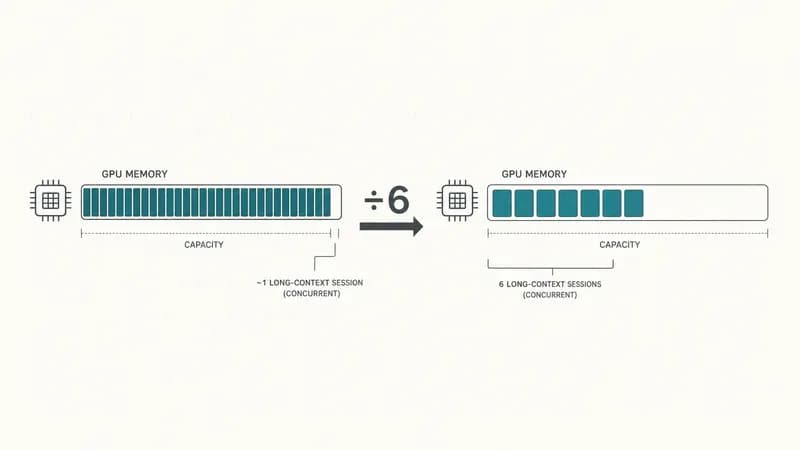
A 10M-vector RAG index that needs ~31GB of RAM at full precision drops to roughly ~4GB with TurboVec's TurboQuant-based compression, small enough to fit a commodity instance instead of a memory-heavy tier. For KV cache, the ~6x reduction means roughly 6x more concurrent long-context sessions on the same GPU. That's the part that actually shows up on an invoice.
We ran the numbers competitors won't. A quick honesty note first: everything below is estimated and modeled (June 2026) from public cloud pricing and the paper's stated ratios. We have not run TurboVec in production, so treat these as the math, not a benchmark we physically measured. The pricing tiers follow the same basis we use in our guide to reducing LLM API costs.
Here's a 10M-document embedding index, full precision vs TurboVec-compressed, mapped to the cloud RAM tier you'd actually need:
| 10M-vector RAG index | RAM needed | Typical instance tier | Rough monthly RAM cost band |
|---|---|---|---|
| Full precision (float32) | ~31 GB | 32GB+ memory-optimized | higher (memory-optimized tier) |
| TurboVec-compressed | ~4 GB | 8GB general-purpose | far lower (commodity tier) |
The jump from a memory-optimized box to a small general-purpose one is the whole story. For a self-hosted index, that's often the difference between a bill that makes you wince and one you barely notice. If you're building the pipeline that sits on top of it, our walkthrough on building a RAG application covers where this index lives.
Now the KV-cache side, modeled at a fixed 24GB GPU serving 128k-context sessions:
| KV cache, 24GB GPU @ 128k context | Concurrent sessions (modeled) |
|---|---|
| Full precision | baseline (call it ~N) |
| ~3-bit TurboQuant (~6x) | roughly 6x N |
A 6x KV-cache cut doesn't just save RAM. It can turn one GPU into six for long-context serving.
That's why this matters more for long-context workloads than anything else. If you're serving lots of short chats, your KV cache was never the bottleneck. If you're running 128k-token agents or document analysis, a 6x cut changes your per-GPU economics overnight. VentureBeat's reporting puts the upper-bound throughput gain at up to 8x on an H100 with 50%+ cost savings, which lines up with our modeled concurrency math.
Why Did Memory-Chip Stocks Drop, and Did Wall Street Over-React?
After TurboQuant's reveal, Micron, Western Digital, and Seagate shares fell on fears that radically cheaper AI memory shrinks future DRAM and HBM demand, the so-called "DeepSeek moment" framing. Analysts including Wells Fargo argued the opposite: cheaper memory drives more total usage, not less, via Jevons' paradox.
The narrative wrote itself. AI is the biggest buyer of high-bandwidth memory right now, so if a Google algorithm cuts memory needs 6x, the logic goes, demand for chips falls and so do the chipmakers. TechCrunch even reached for the "Pied Piper" comparison, the fictional compression startup from HBO's Silicon Valley that promised to shrink the world's data. The stocks dropped on that fear.
Here's the calmer take, and it's one the news cycle mostly skipped. Wells Fargo pointed to Jevons' paradox: when something gets cheaper and more efficient, we usually consume more of it overall, not less. Cheaper AI memory means more apps ship long-context features, more teams self-host bigger RAG indexes, and more inference happens, period. Efficiency gains have a long history of growing total demand rather than killing it.
The market priced TurboQuant as a demand killer. History says cheaper compute usually means we just use more of it.
So was the drop an over-read? Probably, at least in the short term. A research paper isn't an instant industry-wide retrofit. The market reacted to a headline; the actual deployment will take quarters, and the demand-induction effect may well swamp the savings.
Can You Actually Use TurboQuant Today?
Yes, partially. TurboQuant's official Google release is the paper and algorithm, not a drop-in product. But community implementations already exist: TurboVec (RyanCodrai/turbovec, on PyPI) for vector indexes, and AmesianX/TurboQuant for llama.cpp (about 5.2x, with support for DeepSeek-V2/V3 and GLM-4.7-Flash via MLA). The ecosystem is young but usable.
If you want to try the vector-index side, TurboVec is a pip away:
pip install turbovec
# Rust + Python bindings, implements Google's TurboQuant for vector search
# llama.cpp KV-cache impl (DeepSeek/MLA): github.com/AmesianX/TurboQuant
# Python reference impl: github.com/yashkc2025/turboquant
For the KV-cache side on local models, the AmesianX/TurboQuant llama.cpp implementation is the one to watch, especially if you run DeepSeek or GLM models with multi-head latent attention. It pairs nicely with a local LLM setup, since a smaller KV cache means you can push a bigger context on the same card. And if you're picking which open model to run it against, our best open-source LLM benchmarks cover the DeepSeek and GLM families directly.
The honest caveat: this is paper-now, ecosystem-maturing. The official Google deliverable is research, not a supported product with an SLA.
The honest answer: TurboQuant is shippable math, not a download button. Yet.
Is TurboQuant Hype or the Real Deal? An Honest Verdict
TurboQuant is real and genuinely clever. Its training-free design is the true unlock, and the KV-cache win matters most for long-context workloads. But it's not magic: it's one quantization advance among many, the headline 31GB→4GB belongs to TurboVec rather than Google, and the stock panic over-read a research result.
In our experience tuning inference and RAM cost for clients, the thing that decides whether a technique like this is worth adopting is friction. Training-free wins big here, because there's no fine-tuning cycle, no codebook to maintain, no model surgery. You can bolt it onto something you already run.
What it changes:
- Cheaper long-context inference, which is where memory cost actually hurts.
- Smaller self-hosted RAG indexes that fit cheaper hardware.
- A compression option you can adopt without retraining anything.
What it doesn't change:
- It won't do much for short-context, small-model workloads, where the KV cache was never the bottleneck.
- It doesn't obsolete your existing quantization overnight; it's an addition, not a replacement.
- The official Google release is still a paper, so production-grade tooling is up to the community for now.
If you're trying to figure out what this means for your own inference or RAM bill, that's exactly the kind of cost modeling we do for clients at Techsy. Get a free consultation if you want a second set of eyes on it.
Frequently Asked Questions
Did Google actually release TurboVec?
No. TurboQuant is Google's algorithm. TurboVec is a separate third-party Rust and Python library (RyanCodrai/turbovec) built on top of TurboQuant by an independent developer. Some outlets incorrectly credited Google with releasing TurboVec when the viral 31GB→4GB benchmark went viral, but GitHub shows it's a community project.
Is this just hype, why did memory stocks drop?
It's a real advance, but the panic over-read a research result. Micron, Western Digital, and Seagate fell on fears that cheaper AI memory cuts chip demand. Wells Fargo countered with Jevons' paradox: cheaper, more efficient memory usually increases total usage. A paper also isn't an instant industry retrofit, so the short-term reaction looks overdone.
How is TurboQuant different from the quantization I already do?
Most quantization studies a sample of your data to build a tuned codebook. TurboQuant is training-free and data-oblivious, so it hits its ratio without ever looking at your distribution. It also targets the KV cache and vector indexes specifically, with near-optimal distortion, rather than just compressing model weights.
Does TurboQuant work with DeepSeek or llama.cpp?
Yes, through the AmesianX/TurboQuant llama.cpp implementation, which reports about 5.2x compression and supports DeepSeek-V2/V3 and GLM-4.7-Flash via multi-head latent attention (MLA). That makes it a practical option if you self-host those models and want a smaller KV cache for longer contexts on the same hardware.
When does TurboQuant actually help most?
It helps most with long-context inference and large self-hosted RAG indexes, where memory is the real bottleneck. A 6x KV-cache cut means more concurrent 128k-context sessions per GPU, and a compressed embedding index fits cheaper instances. It helps least for short-context chats and small models, where the KV cache was never your cost driver.