Claude Fable 5 vs Opus 4.8: Should You Actually Switch? (Mythos-Class, Benchmarked)
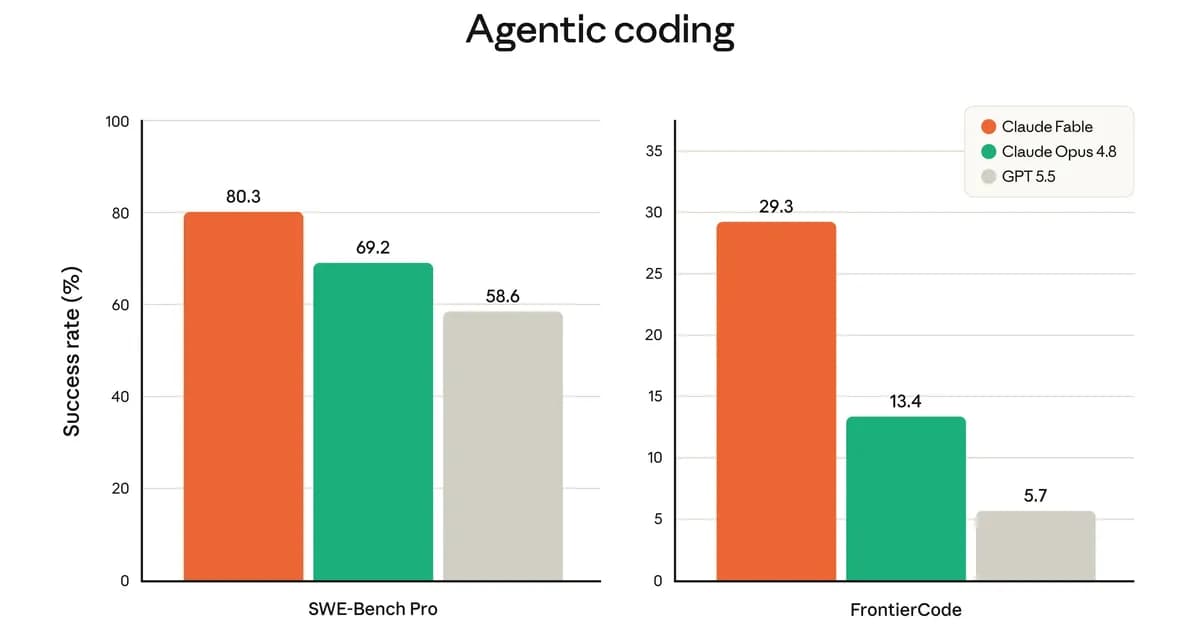
Anthropic shipped Claude Fable 5 on June 9, 2026, and the six weeks since have not been a straight line: a government-ordered suspension, a full restoration, a security patch, and two new rival launches. It still scores 80.3% on SWE-Bench Pro, the agentic-coding benchmark where Opus 4.8 manages 69.2% and GPT-5.5 trails at 58.6%. That's not a rounding-error gap, though GPT-5.5 is no longer the only model worth checking it against. And there's a twist: Fable 5 is the public, safeguarded half of a new "Mythos-class" model, with a gated sibling called Claude Mythos 5 kept behind a restricted access program. Here's what changed, what happened since launch, what a real task costs at $10/$50 per million tokens, and whether you should actually move your stack off Opus 4.8.
Quick Answer
- Fable 5 scores 80.3% on SWE-Bench Pro vs Opus 4.8's 69.2% and GPT-5.5's 58.6%, but Claude Sonnet 5 and GPT-5.6 Sol (both shipped after Fable 5) close part of that gap on agentic and terminal benchmarks.
- Pricing is $10 input / $50 output per million tokens, less than half of Mythos Preview.
- Fable 5 auto-falls back to Opus 4.8 for high-risk cyber/bio/chem queries; a July 1 classifier update also blocks a prompting technique Amazon researchers found, in over 99% of cases.
- Access was suspended for every user June 12-30, 2026 under US export controls, then fully restored July 1. The free-until-a-date pricing is gone too: Max/Team Premium keep Fable 5 included, Pro/Team Standard get a one-time $100 credit then API rates, per TechTimes and XenoSpectrum (Anthropic hasn't confirmed this on its own site).
What Actually Launched: Fable 5, Mythos 5, and the "Mythos-Class" Line
Mythos-class is Anthropic's new top capability tier, and it ships as two models. Claude Fable 5 is the public, safeguarded version you can call today. Claude Mythos 5 is the same frontier model with the safeguards removed, kept behind gated access. Same brains, two release postures.
The split is the whole story here. According to Anthropic's newsroom announcement, Mythos 5 retains full frontier capability, including offensive-cyber skills that could cause real damage, so Anthropic doesn't hand it to everyone. Fable 5 takes that same model and wraps it in classifiers that detect high-risk requests and quietly route them to Opus 4.8 instead.
So when you call Fable 5, you get Mythos-class reasoning on everything that isn't dangerous, and a safer fallback model on the small slice that is. CNBC framed it as Anthropic releasing a "Mythos-like AI to the public," which is accurate, but the precise mechanic matters more than the headline.
Fable 5 and Mythos 5 are the same frontier model split in two: one you can use today, one Anthropic keeps gated. If you only remember one thing about the naming, remember that. Mythos-class is the tier; Fable and Mythos are the two doors into it.
What Changed vs the Opus 4.x Line
On every coding and reasoning eval covered here, Fable 5 clears Opus 4.8, not by a hair but by double-digit margins. SWE-Bench Pro jumps 69.2% to 80.3%, a number Anthropic published and Vellum, llm-stats, and Weights & Biases have independently corroborated. FrontierCode Diamond goes from 13.4 to 29.3, a number Anthropic itself doesn't publish; it comes from Vellum and llm-stats tracking. The pricing dropped too, and the model scales with a new reasoning-effort dial. This is a genuine frontier step over the Opus 4.x line, not a point release.
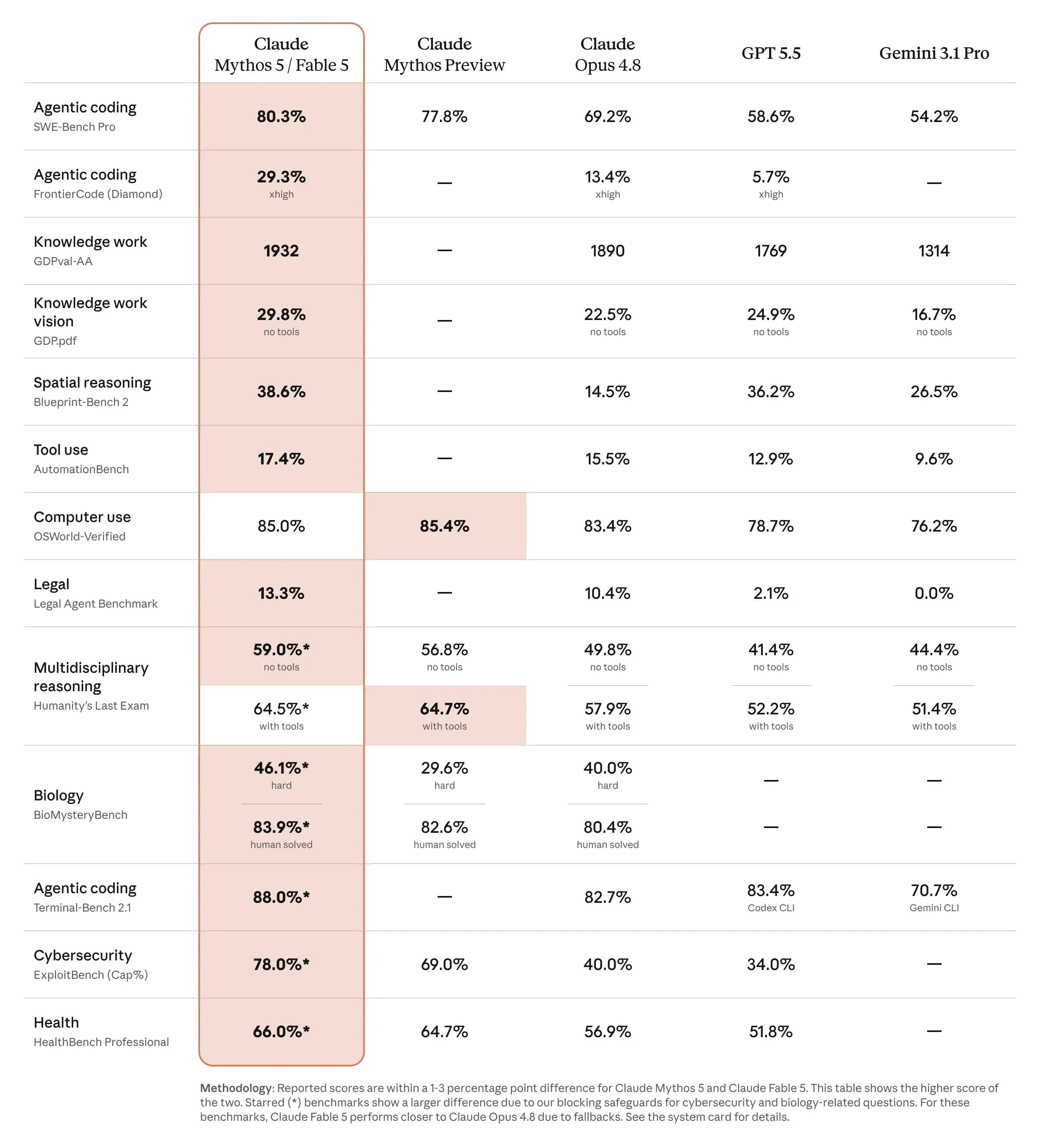
The 13-benchmark sweep above is the at-a-glance version. Here's the headline subset against the three models most teams actually compare:
| Benchmark | Claude Fable 5 | Claude Opus 4.8 | GPT-5.5 |
|---|---|---|---|
| SWE-Bench Pro (agentic coding) | 80.3% | 69.2% | 58.6% |
| FrontierCode Diamond (hardest coding) | 29.3 | 13.4 | 5.7 |
| Terminal-Bench 2.1 (agentic shell) | 88.0% | n/a | n/a |
| GPQA-AA (graduate reasoning, Elo) | 1932 | n/a | n/a |
| ExploitBench | 78.0% | n/a | n/a |
The comparison anchor here is Claude Opus 4.8, the model Fable 5 replaces at the frontier, and the same model Fable 5 falls back to on high-risk queries. If you've tracked the Opus 4.x line across the last two releases, the pattern was incremental gains. Fable 5 breaks that pattern.
Two things to flag before you read the table as gospel. First, SWE-Bench Pro is Anthropic's own published eval, independently corroborated elsewhere; FrontierCode Diamond is not an Anthropic-published number at all, it's a third-party benchmark tracked by Vellum and llm-stats. Second, the reasoning-effort dial means a single benchmark number hides a cost curve. More on that in the pricing section, because it changes the math.
The Benchmarks That Matter for Builders
Four numbers carry the practical weight: SWE-Bench Pro 80.3%, FrontierCode Diamond 29.3, Terminal-Bench 2.1 88.0%, and GPQA-AA 1932 Elo. Together they cover real repo work, the hardest synthetic coding problems, agentic shell tasks, and graduate-level reasoning. If your workload touches any of those, this is the section that tells you whether the number maps to your job.
The hero chart at the top of this post is the proof: SWE-Bench Pro 80.3 vs 69.2 vs 58.6, and FrontierCode 29.3 vs 13.4 vs 5.7. Now what do those actually measure?
- SWE-Bench Pro tests whether a model can ship a real pull request to a real repo: clone, understand, patch, pass tests. SWE-Bench Pro measures whether a model can ship a real pull request to a real repo, and Fable 5 lands 8 in 10. This is the closest proxy to "can it do my actual job."
- Terminal-Bench 2.1 scores agentic shell tasks: running commands, reading output, recovering from errors. 88.0% matters if you're building AI coding agents that live in a terminal.
- FrontierCode Diamond is the hardest tier of coding problems, the ones where most models score single digits. 29.3 is low in absolute terms but more than double Opus 4.8's 13.4.
- GPQA-AA is graduate-level science reasoning, scored as an Elo rating. 1932 signals strong multi-step reasoning beyond code.
In our Claude Code workflows across the Opus 4.x line, the recurring ceiling was long-horizon agentic tasks: the model would lose the thread halfway through a multi-file change. Fable 5's Terminal-Bench and SWE-Bench Pro numbers suggest that ceiling moved. Whether it moved for your repo is the only test that counts, but the published numbers are the right kind of number to care about.
Real Test Cases: What Fable 5 Does That Prior Models Couldn't
Anthropic published three concrete examples that show the class of problem Fable 5 can now handle: a Stripe codebase migration compressed from months to a day, a video game completed on vision alone, and a 3× performance jump from self-validation. Each one points at a capability prior models couldn't reach. All three are Anthropic-sourced; we're citing their announcement, not a test of our own.
Here's what each one proves:
-
Stripe Ruby migration. Anthropic reports Fable 5 compressed a Ruby codebase migration from roughly two months to about one day. Stripe compressed a Ruby migration from two months to a single day, and that's the size of problem this model changes. This is the class of long-horizon refactor that used to need a human team holding the whole codebase in their heads.
-
Pokémon FireRed on vision alone. Per Anthropic, Fable 5 completed Pokémon FireRed using vision only, where prior models needed complex custom harnesses to feed game state in as text. That's a spatial and visual-reasoning leap: the model reads the screen and acts, no scaffolding.
-
Slay the Spire, 3×. At max reasoning effort, Anthropic says Fable 5 self-validates its own moves and reached 3× better performance via persistent memory. The takeaway isn't the game; it's that the model can check its own work over a long planning horizon and improve from it.
None of these are things you should take on faith for your workload. But they map cleanly to the benchmark jumps in the table above: long-horizon coding (SWE-Bench Pro), spatial reasoning (vision), and self-validation (the reasoning-effort dial). The qualitative wins and the quantitative ones tell the same story.
Pricing and the Cost-Per-Task Reality
Fable 5 costs $10 per million input tokens and $50 per million output tokens. Anthropic frames that as "less than half the price of Claude Mythos Preview." It's also roughly 2× Opus 4.8 per token. Both are true. The catch is that token price is the wrong unit. What you actually pay for is a finished task, and that's where Fable 5's math gets interesting.
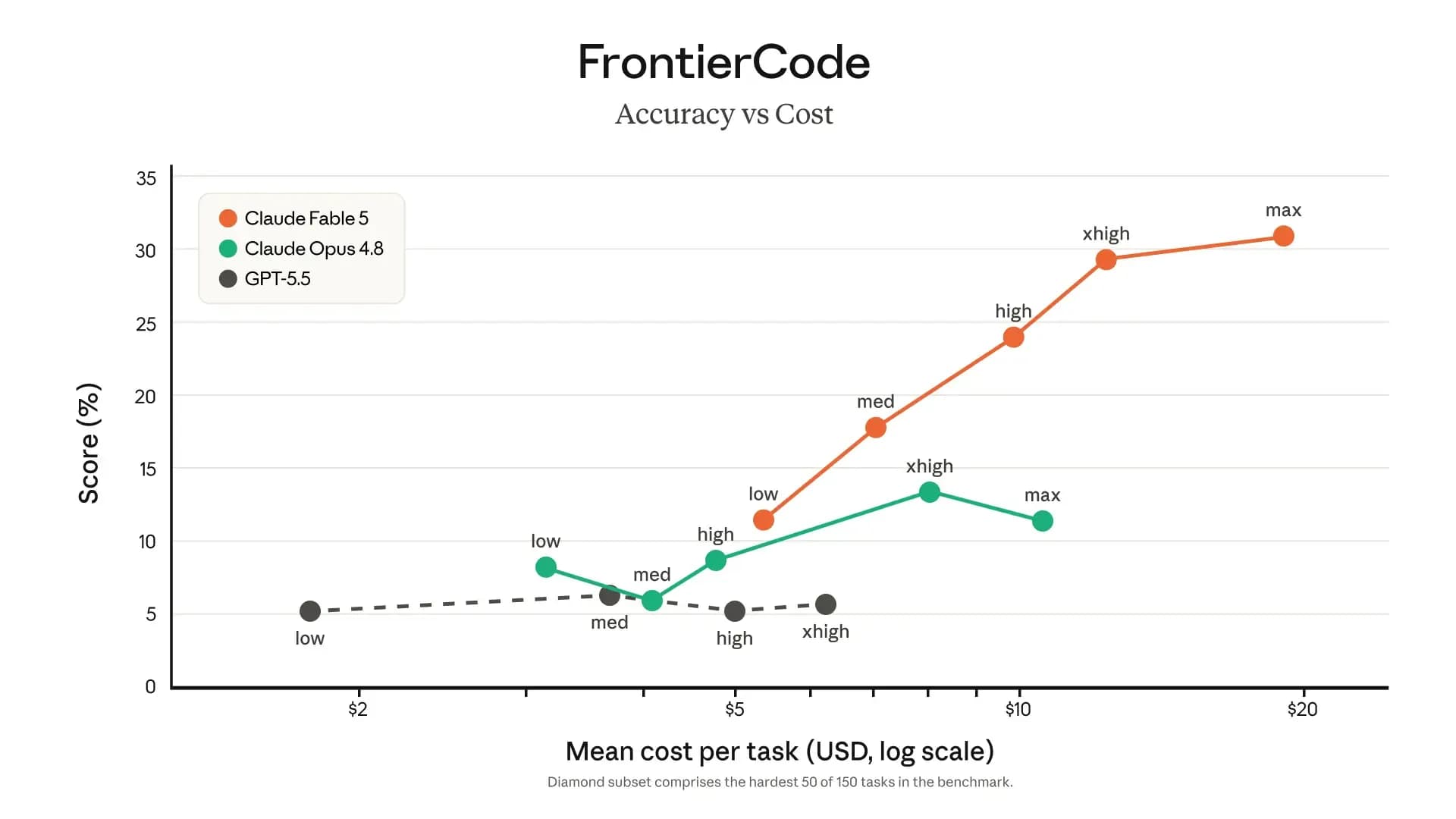
Reasoning effort is a dial you set per request. Low effort means fewer internal reasoning tokens and a cheaper, faster answer; max effort means the model thinks longer, spends more output tokens, and scores higher. The chart above shows Fable 5 climbing from ~11% to ~31% on FrontierCode as effort scales low to max, while Opus 4.8 peaks around 13% and GPT-5.5 sits flat near 5-6%. So cost per task isn't one number; it's a curve you choose a point on.
Let's work a concrete example from the published $10/$50 pricing. This is arithmetic from Anthropic's posted rates, not a benchmarked result.
Take a single agentic call with 50,000 input tokens and 15,000 output tokens at high effort:
Input:  50,000 / 1,000,000 × $10 = $0.50
Output: 15,000 / 1,000,000 × $50 = $0.75
Per call:                          $1.25
A real agentic task chains many such calls: read repo, plan, edit, run tests, fix, repeat. Say the loop runs 12 calls at that shape: roughly $15 for the finished task. At max reasoning effort with heavier context, Anthropic's own cost curve puts hard FrontierCode tasks closer to the $20-per-task range. Run the same task on GPT-5.5 and you'll pay less per token. But if it can't finish the task at any effort level, your cost-per-finished-task is infinite. Fable 5 costs more per token than GPT-5.5, and still wins on cost-per-finished-task, because it completes work GPT-5.5 can't.
Here's a minimal call. The model id is claude-fable-5 on the API (anthropic.claude-fable-5 on Bedrock). Since the 4.6 generation, Anthropic's model ids are dateless, so there's no versioned alias to hunt down, this string is the pinned snapshot:
import anthropic

client = anthropic.Anthropic()

message = client.messages.create(
    model="claude-fable-5",          # dateless id; this is the pinned snapshot
    max_tokens=4096,
    thinking={"type": "enabled", "budget_tokens": 8000},  # reasoning effort
    messages=[
        {"role": "user", "content": "Migrate this module from Ruby 2.7 to 3.3 and run the tests."}
    ],
)

print(message.content)
The economics thesis in one line: you pay more per token than GPT-5.5, but you finish tasks GPT-5.5 can't finish at any price. For low-stakes high-volume work, that math favors a cheaper model. For hard agentic coding, it favors Fable 5.
The Safeguards Split: Why Fable Falls Back to Opus 4.8
Fable 5 runs classifiers on every request. When it detects a high-risk query (offensive cyber, bio, chem, or model-distillation attempts), it falls back to Opus 4.8 instead of answering with full Mythos-class capability. Anthropic says this fallback fires on under 5% of sessions, so most users never trigger it. The point is to keep the dangerous capability behind the gate while leaving everyday work untouched.
The harder number is attack-success rate: how often an automated attacker can jailbreak the model into doing something it shouldn't. Lower is better. Gray Swan and the UK AI Security Institute ran agent red-teaming at k=100 with thinking on, and the results put a real number on the gap:
| Model | Attack success rate |
|---|---|
| Claude Fable 5 | 4.8% |
| Claude Opus 4.8 | 9.6% |
| GPT-5.5 | 30.8% |
| Gemini 3.1 Pro | 45.5% |
Fable 5 still leads the field, but the margin over Opus 4.8 is roughly 2x, not the order-of-magnitude gap sometimes quoted. Against GPT-5.5 and Gemini 3.1 Pro, the gap is much wider, 6-9x.
Why should you care? If you deploy an agent with tool access (shell, file system, network), a jailbreak isn't a bad chat reply, it's a model executing real commands an attacker steered it into. A sub-5% attack-success rate, roughly half of Opus 4.8's, is still worth the switch for anything touching live tools. IT Pro's coverage led with the fallback mechanic for exactly this reason: it's the feature that makes a frontier model safe enough to hand the public.
The trade-off is latency. If your workflow legitimately touches security tooling, the fallback can fire mid-task and swap models on you, something to plan around.
Claude Mythos 5 and the Dual-Use Question
Claude Mythos 5 is the gated sibling, the same model without the safeguard fallback. It keeps offensive-cyber capability that Fable 5 blocks, which is exactly why Anthropic doesn't release it publicly. Access runs through Project Glasswing, a vetted program for defenders and researchers who need full capability. Same model, two release postures: one open, one gated.
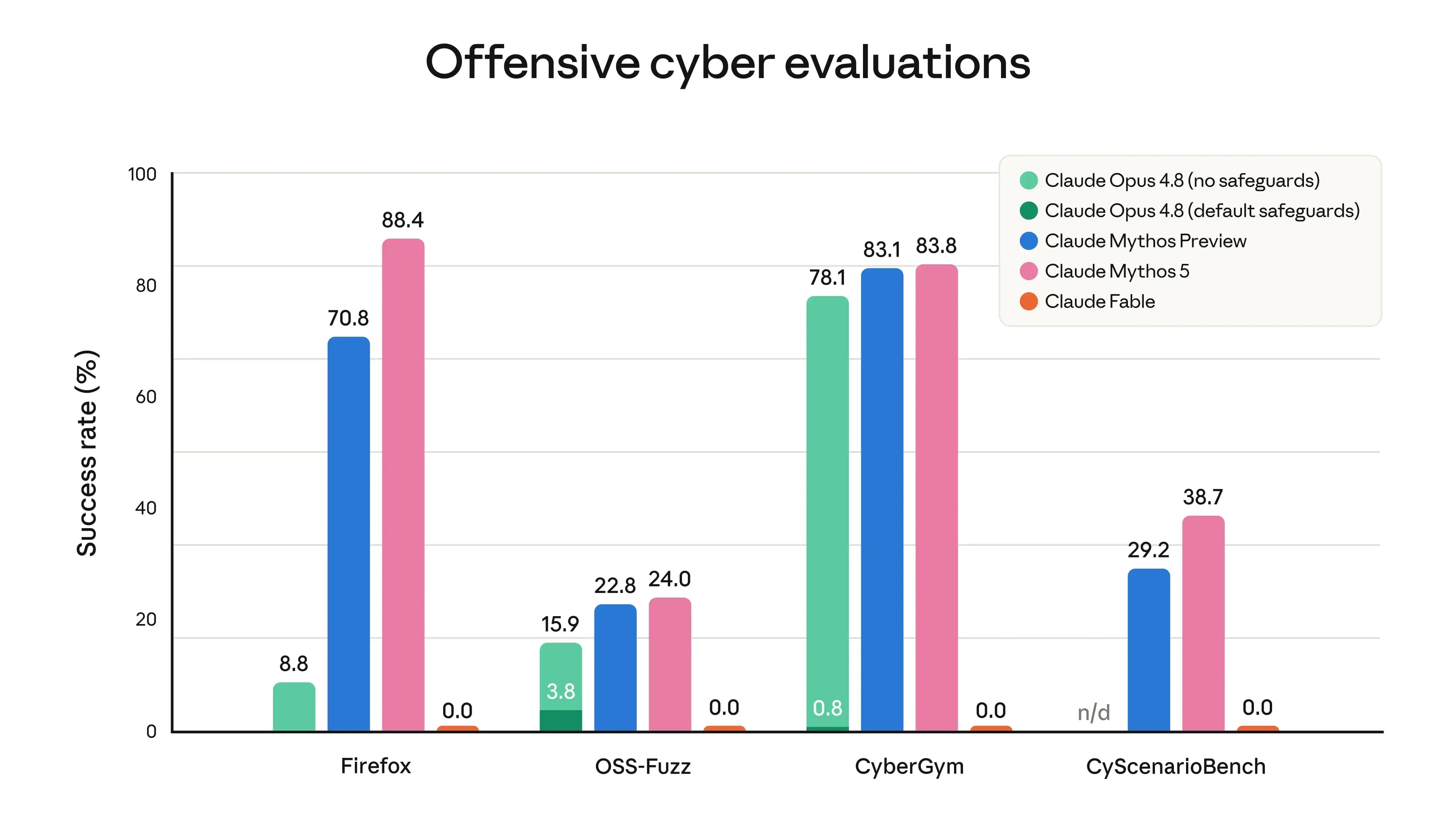
The chart makes the gating visible. On offensive-cyber evals (Firefox, OSS-Fuzz, CyberGym, CyScenarioBench) Mythos 5 scores 88.4, 24.0, 83.8, and 38.7. Fable 5 returns a flat 0.0 across all four. On offensive-cyber evals, Mythos 5 scores up to 88.4 where Fable 5 returns a flat 0.0: the safeguard split, made visible.
That zero isn't a capability gap. It's the fallback firing every time, blocking the request before the Mythos-class model answers. TechCrunch noted the timing: Anthropic shipped this days after warning that AI is getting too dangerous to release openly. The Fable/Mythos split is the policy answer to that warning, publish the capability, gate the danger.
For most developers, Mythos 5 is irrelevant. You'll never qualify for Project Glasswing and you don't need to. What matters is knowing that the model you're calling is deliberately capped on a narrow band of tasks, by design.
What Happened After Launch: A Two-Week Suspension, Then a Security Patch
Fable 5's first six weeks were not a straight line. Three days after the June 9 launch, the US government applied export controls to Anthropic's newest models, and on June 12, 2026, access was suspended for every user, everywhere, because Anthropic had no way to verify who was actually calling the API. Government approval came through on June 26, restoring Mythos 5 first to a set of vetted US organizations (Anthropic hasn't published how many). Full restoration for everyone landed July 1, 2026, the same day GitHub re-enabled Fable 5 in Copilot. See our full timeline of the suspension for the back-and-forth in detail.
That suspension was a licensing problem, not a safety one. Separately, and unrelated to the export-control freeze, Amazon researchers found a prompting method that got around Fable 5's safeguards well enough to pull out software vulnerabilities the classifier was supposed to block. Anthropic didn't pull the model over this; it shipped a fix alongside the July 1 restoration, a classifier update that blocks that specific technique in over 99% of cases, with the rest falling back to Opus 4.8 as before. Two different problems, two different fixes, landing in the same calendar week, is not the same as one causing the other.
If you're planning around Fable 5 for anything customer-facing, the practical lesson is that a frontier model's launch-day terms don't always hold six weeks out.
The Competitive Field Has Moved: GPT-5.6 and Claude Sonnet 5
Comparing Fable 5 only against GPT-5.5 made sense on June 9. It doesn't anymore. Two launches since then change the calculation, and the bigger one comes from Anthropic's own lineup, not a rival.
Claude Sonnet 5, shipped June 30, 2026, is the omission that matters most. It's priced at $3/$15 per million tokens standard, $2/$10 as an intro rate through August 31, 2026, a fraction of Fable 5's $10/$50. On SWE-Bench Pro it scores 63.2%, behind Fable 5's 80.3% and behind Opus 4.8's 69.2%. But on Terminal-Bench 2.1 it hits 80.4%, which beats Opus 4.8's 74.6%, and its OSWorld-Verified score is 81.2%. A same-family model at a fifth of Fable 5's price beating the previous flagship on an agentic benchmark isn't a detail a "should you switch" post can leave out.
GPT-5.6, OpenAI's follow-up shipped July 9, 2026, arrives as three tiers: Sol, Terra, and Luna. Sol is priced at $5/$30, roughly half of Fable 5's input cost, with Terra at $2.50/$15 and Luna at $1/$6. Head-to-head, per Vellum's July 9 benchmark comparison:
| Benchmark | GPT-5.6 Sol | Fable 5 |
|---|---|---|
| SWE-Bench Pro | 64.6% | 80.0% |
| Terminal-Bench 2.1 | 88.8% | 86.0% |
| Coding Agent Index | 80 | 77.2 |
| Agents' Last Exam | 53.6 | 40.5 |
| OSWorld | 62.6% (2.0) | 85.0% (Verified) |
Sol wins on Terminal-Bench, the Coding Agent Index, and Agents' Last Exam, reportedly using under half the output tokens, under half the time, and about a third less cost per task than Fable 5. Fable 5 still wins decisively on SWE-Bench Pro and OSWorld.
Put both updates together and the honest verdict shifts from "Fable 5 sweeps the field" to "Fable 5 wins on real-repo work and computer-use, loses ground on agentic and terminal tasks and cost, to models that didn't exist when this post first published." If your workload is SWE-Bench-shaped, real pull requests against real repos, Fable 5 is still the pick. If it's terminal-and-agent-shaped, or budget-constrained, run the newer field before committing. Anthropic's own next release is still an open question; see our Claude Fable 6 release-date piece for what the naming pattern suggests.
For current API pricing across the family: Fable 5 and Mythos 5 both run $10/$50 per million tokens, Opus 4.8 is $5/$25, Sonnet 5 is $3/$15 ($2/$10 intro through August 31, 2026), and Haiku 4.5 is $1/$5.
What This Means: Should You Switch?
Switch to Fable 5 for hard agentic coding, long-horizon multi-step tasks, and vision or spatial reasoning, anywhere finishing the task beats saving pennies per token. Stay on Opus 4.8 for cost-sensitive high-volume work, or for anything that triggers the fallback anyway. That's the whole framework. The rest is matching your workload to the right side of it.
When Fable 5 wins:
- Hard agentic coding where Opus 4.8 stalls; the SWE-Bench Pro gap is real
- Long-horizon tasks (multi-file refactors, migrations) where self-validation pays off
- Vision and spatial reasoning workloads
- Any job where one finished task is worth more than the token premium
When Opus 4.8 still wins:
- High-volume, cost-sensitive work where per-token price dominates
- Cyber/bio/chem workloads, where Fable 5 falls back to Opus 4.8 anyway, so call it directly
- Latency-sensitive flows that can't tolerate a mid-task model swap
| Use case | Recommended model |
|---|---|
| Hard agentic coding / migrations | Claude Fable 5 |
| Vision / spatial reasoning | Claude Fable 5 |
| High-volume cheap classification | Claude Opus 4.8 |
| Security / red-team tooling | Claude Opus 4.8 (direct) |
On availability: the free-until-a-date framing from launch is gone. The pricing deadline got pushed four times, June 22 → July 7 → July 12 → July 19, 2026, and the July 20 resolution replaced the date with a tier split instead: Max and Team Premium keep Fable 5 permanently included at 50% of plan limits, while Pro and Team Standard move to usage credits, a one-time $100 credit followed by API rates. That split is reported by TechTimes, XenoSpectrum, and Basic Tutorials; Anthropic hasn't published it on its own pricing page, so treat it as reported, not confirmed. Fable 5 is generally available on the Claude API, Amazon Bedrock, Google Cloud/Vertex AI, Microsoft Foundry, GitHub Copilot (re-enabled July 1, 2026 per the GitHub changelog; Business and Enterprise admins have to opt in, since the policy defaults to off), and the consumer Pro/Max/Team/Enterprise apps. Context window is 1M tokens, max output 128k tokens, knowledge cutoff January 2026. Two details worth flagging for enterprise buyers: Fable 5 and Mythos 5 are Covered Models under Anthropic's mandatory 30-day data retention, so they aren't available under zero data retention, and US-only inference carries a 1.1x pricing multiplier.
Frequently Asked Questions
What is Claude Fable 5?
Claude Fable 5 is Anthropic's first publicly available Mythos-class model, launched June 9, 2026. It scores 80.3% on SWE-Bench Pro and runs safeguard classifiers that fall back to Opus 4.8 on high-risk queries. It costs $10 input / $50 output per million tokens.
What's the difference between Fable 5 and Mythos 5?
They're the same frontier model with different release postures. Fable 5 is public and safeguarded; it falls back to Opus 4.8 on dangerous queries. Mythos 5 is the gated full-capability version, accessible only through Anthropic's Project Glasswing program for vetted defenders and researchers.
Is Claude Fable 5 actually better than Opus 4.8?
Yes on hard agentic coding, vision, and spatial reasoning: Fable 5 hits 80.3% on SWE-Bench Pro vs Opus 4.8's 69.2%. But Opus 4.8 still wins on cost-sensitive high-volume work, and Fable 5 falls back to Opus 4.8 for high-risk cyber/bio/chem topics anyway. "Better" depends on your workload.
Can I access Claude Mythos 5?
Probably not. Mythos 5 is gated behind Project Glasswing, Anthropic's vetted access program for defenders and security researchers who need full offensive-cyber capability that Fable 5 blocks. Most developers won't qualify and don't need to, since Fable 5 covers everyday agentic and coding work.
Where can I use Claude Fable 5?
Claude Fable 5 is generally available on the Claude API, Amazon Bedrock, Google Cloud/Vertex AI, Microsoft Foundry, GitHub Copilot (re-enabled July 1, 2026, opt-in for Business/Enterprise admins), and the consumer Pro/Max/Team/Enterprise apps. Pricing is no longer a free-until date: Max and Team Premium keep it permanently included, while Pro and Team Standard get a one-time $100 credit, then API rates, as reported by TechTimes and XenoSpectrum.
The Bottom Line
Claude Fable 5 is a real frontier step over Opus 4.8: 80.3% vs 69.2% on SWE-Bench Pro, double the FrontierCode score, and a 4.8% attack-success rate against Opus 4.8's 9.6% under Gray Swan / UK AISI red-teaming, still the safer pick for tool-using agents, though the margin is roughly 2x, not the order of magnitude sometimes claimed. Switch for hard agentic coding, long-horizon tasks, and vision work; check Claude Sonnet 5 and GPT-5.6 Sol first if your workload is terminal-and-agent-shaped or budget-constrained, since both shipped after Fable 5 and neither existed to compare against at launch. Access is no longer free-until-a-date either: Max/Team Premium keep it included, Pro/Team Standard get a one-time credit then API rates. The Techsy team builds production agents on exactly this stack, so reach out if you want a hand.