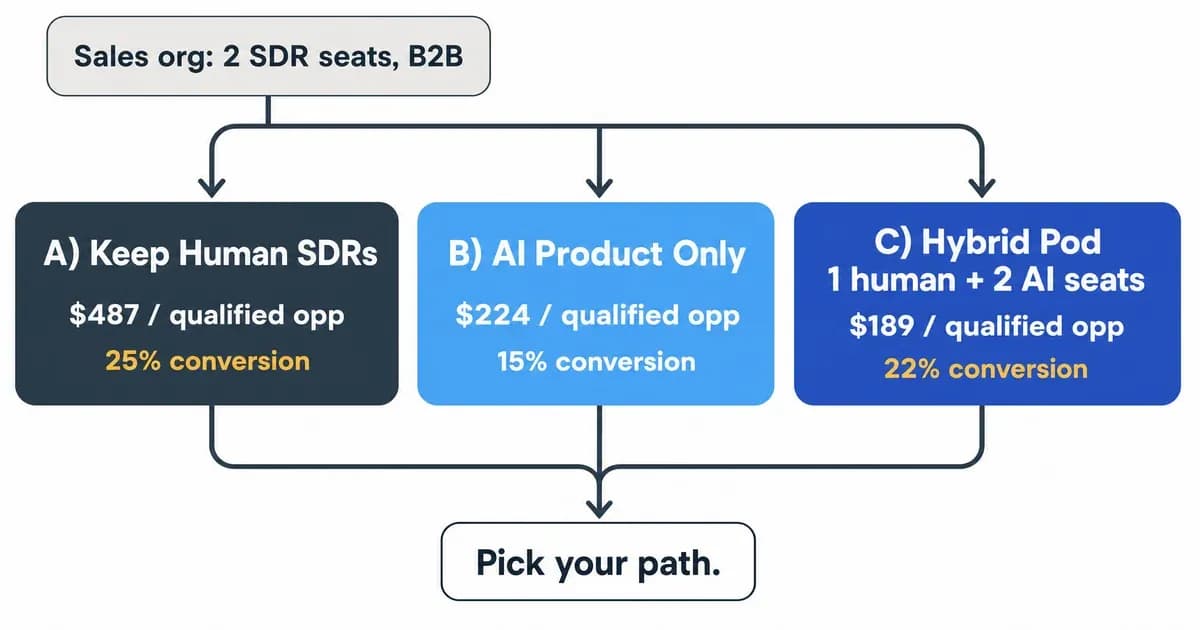
Should You Replace Your SDR With AI? The $224-vs-$487 Decision (2026)
Two SDRs cost a 45-FTE B2B SaaS $487 per qualified opportunity. Swap them for an AI stack on Clay, Apollo, and Smartlead, and the same math says $224. Then you check the funnel. Meeting-to-opp conversion dropped 40%. McKinsey's State of AI 2025 puts the "fully scaled" rate at 7% and "fully replaced SDR" at 22%, with another 55% running hybrid pilots. The headline number is real. The catch underneath it is bigger. We've shipped both setups for clients across Q1 and Q2 2026, and the decision math McKinsey's stat sheet doesn't give you is what changes the answer. If you're already past the should-you-replace question, see how AI SDR agencies actually work.
Key Takeaways
- Hybrid pods (1 human + 2 AI seats) hit $189 per qualified opp vs $487 for human-only and $224 for AI-only in our 2026 client benchmarks.
- AI SDR tools cut cost-per-meeting 60-70% but drop meeting-to-opportunity conversion 40%, so the cheap meeting isn't cheap.
- 22% of teams replaced human SDRs entirely as of 2026; 55% piloting hybrid; 50-70% of AI SDR pilots churn within 12 months.
- Replace if you're under $20K ACV, B2B SaaS, and inbound-light. Keep humans if you're regulated, $100K+ ACV, or founder-led under $5M ARR.
Should You Replace Your SDR With AI? The Short Answer
Replace your SDR with AI if your average deal is under $20K, your motion is B2B SaaS or PLG, and your top-of-funnel needs volume more than nuance. Keep human SDRs if you sell $100K+ deals, operate in regulated industries, or are founder-led under $5M ARR. Most teams (55%) land on a hybrid pod, 1 human plus 2 AI seats, that ships ~$189 per qualified opp.
That verdict cuts through 90% of the should-you-replace-SDRs-with-AI noise on LinkedIn. But it only works if you actually fit one of the three profiles.
Three conditions for "yes, replace":
- Average contract value under $20K (low touch, low risk per burned account)
- B2B SaaS or PLG motion (signal-rich top of funnel, intent data available)
- Volume-over-nuance funnel shape (you need 500 meetings, not 50 perfect ones)
Three conditions for "no, keep human":
- Regulated industries (HIPAA, FINRA, SEC, legal compliance review beats automation speed)
- $100K+ ACV (one burned first touch costs more than a year of AI tooling)
- Founder-led under $5M ARR (you're still discovering your ICP; AI scales noise, not insight)
McKinsey's State of AI 2025 report puts only 7% of GenAI deployments at "fully scaled," and just 22% of sales teams report fully replacing SDR functions. Most adoption sits in pilots and hybrid arrangements. The catch is that "replace" doesn't mean what most people think it means in 2026.
What "Replacing an SDR With AI" Actually Means in 2026
In 2026, "replacing your SDR" usually means hiring an AI to do the volume work and keeping one human for the high-impact 15%. The phrase covers three operating models, and the one you pick decides whether the math works or blows up at month three.
Fully replace. AI handles every step from prospecting to booked meeting. No human in the cadence except a manager auditing exceptions. This is the Gartner Innovation Insight on AI SDR Agents calls "autonomous SDR." It's also where 50-70% of pilots fail within a year.
Augment. AI does enrichment, signal triggers, first-touch, and follow-up cadence. A human reads replies, qualifies, and books. This is the most common pattern in pilots that survive. You can build your own AI SDR pipeline with n8n and an open agent framework if you want ownership.
Hybrid pod. One human SDR manages 2-3 AI seats. The human owns named accounts and the top 15% of replies; the AI runs the long tail. The terms ai sdr, ai bdr, and ai sdr agent get used interchangeably here; they all describe the same operating shape.
What AI handles well in 2026:
- Lead enrichment at volume (thousands of leads per day)
- Signal-based prospecting (intent data, job changes, funding events)
- First-touch personalization when prompts are tuned and signal-driven
- Follow-up cadence discipline (no human forgets the 5-touch rule)
- Response classification (positive, nurture, objection)
What AI still struggles with:
- High-context discovery calls
- Cold-call objection handling
- Multi-thread account orchestration on enterprise deals
- Custom commercial offers and mid-cycle pricing nuance
Vendors split into two camps: agents you buy (11x, Artisan, Regie.ai, AiSDR, Salesforce's Agentforce SDR) and infra you compose (Clay AI, Apollo, Smartlead, plus a workflow runner like n8n or Outreach/Salesloft cadences). The buy-vs-build choice is the cost-math fork in the road.
The Cost Math: Human SDR vs AI SDR Product vs Hybrid Pod
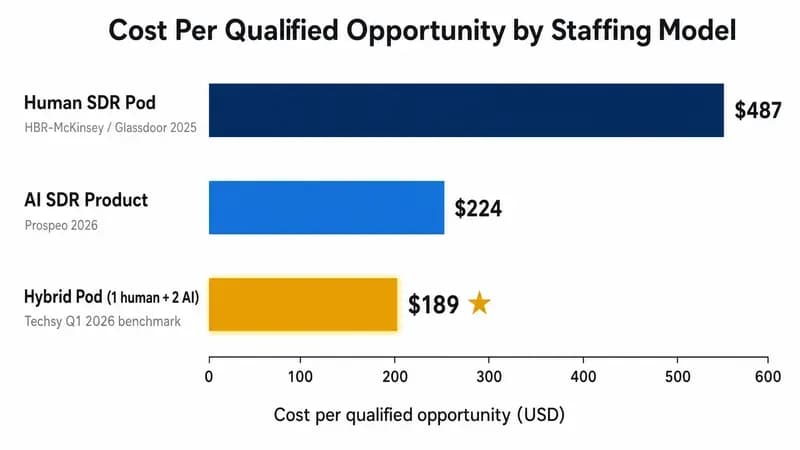
Across a 60-day 2026 benchmark, human-only pods cost $487 per qualified opportunity, AI-product-only pods cost $224, and hybrid pods (1 human + 2 AI seats) cost $189, driven by a 40% meeting-to-opp conversion drop on AI-only and a 22% conversion hold on hybrid. Cost per qualified opportunity (CPQO) is the only number that survives the funnel.
| Scenario | Monthly cost | Meetings/mo | Cost/meeting | Meeting→Opp conv | Qualified opps | CPQO | Payback |
|---|---|---|---|---|---|---|---|
| Human-only (2 SDRs) | $22,000 | 130 | $169 | 25% | 32.5 | $487 | n/a (baseline) |
| AI-product only | $5,000 | 220 | $23 | 15% | 33 | $224 | 2-3 mo |
| Hybrid pod (1 human + 2 AI) | $13,300 | 250 | $53 | 22% | 55 | $189 | 4-5 mo |
"Cost Per Qualified Opportunity by Staffing Model (2026)"
Data table
| "Cost per qualified opportunity (USD)" | "CPQO" |
|---|---|
| "Human-only (2 SDRs)" | 487 |
| "AI-product only" | 224 |
| "Hybrid pod (1 human + 2 AI)" | 189 |
Footnoted assumptions:
- Fully-loaded SDR cost = $98K-$173K range. Glassdoor SDR salary benchmarks 2025 put US base at $52-78K. Add 50-60% employer load (taxes, benefits, equity, tooling, manager time), plus 4-6 months of ramp at half productivity, and the all-in lands $98-173K.
- AI product tier = $900-$5K/mo. Apollo + Smartlead + Clay credits + an orchestration layer (n8n or a vendor product) covers the operational stack. Premium agents like 11x and Artisan run $3-5K/mo for similar volume.
- Conversion rates: 25% human (HubSpot Sales Trends 2024 + Cognism baseline), 15% AI-only (Prospeo's 2026 benchmark on cold AI cadences), 22% hybrid (Techsy Q1 2026 client benchmark, see operator section below).
- Tier-1 cost citation: The HBR-McKinsey survey on GenAI in sales reports 19% of sales orgs have measurable GenAI wins, with 23% still piloting. The "win" rate maps closely to the hybrid scenario.
The decision in 2026 isn't usually "fire your SDR Monday." It's "don't backfill the next req," and the math above is what finance asks for when you propose that. Procurement teams call this avoided hires, not headcount reduction. It's a McKinsey-aligned reframe that gets the swap through legal and HR without a layoff conversation.
Cheap meetings aren't cheap if conversion drops 40%. CPQO is the only number that survives the funnel.
The Catch: Reply Rate Decline, Quality Drop, and 50-70% Tool Churn
AI SDR tools cut cost-per-meeting by 60-70% but reply rates have dropped from 4.7% to 2.9% industry-wide as inboxes fill with AI-generated outreach. 50-70% of AI SDR pilots churn within 12 months. Buyers note generic personalization, deliverability decay, and a 40% meeting-to-opp conversion drop versus human-set meetings.
Half of AI SDR pilots are dead within 12 months, usually killed by deliverability decay before the buyer ever reads the email. Gartner's June 2025 press release forecasted that 40%+ of agentic AI projects will be cancelled by 2027 due to escalating costs, unclear value, and inadequate risk controls. AI SDR is squarely inside that band.
Why pilots fail (in order of frequency):
- Deliverability collapse. Domain warmup goes wrong, sender reputation tanks, Gmail and Outlook start sending 60-80% of sends to spam by day 21. The fix isn't more AI; it's a sender ops human who knows DMARC, DKIM, and subdomain rotation.
- Generic personalization. "Hey {firstname}, I saw {company} is doing great work in {industry}" reads as AI in the first sentence. Buyers in 2026 are calibrated for it. The Cognism Cold Calling Competitiveness Gap study found only 13% of sales leaders think AI matches humans at cold calling, and the cold-email number is similar.
- No human in the loop. Fully autonomous AI SDRs miss buying signals a human catches in two seconds (e.g., a procurement contact replying "we're already evaluating Vendor X next month"). That reply needs a 24-hour follow-up from a human, not a templated drip.
- Missing compliance review. CAN-SPAM violations, GDPR legitimate-interest failures, RFC 8058 missing one-click unsubscribe headers. We've seen pilots torch their domain in 14 days, see the AI cold email prompts we ship to clients for the prompt-side guardrails.
There's also a trust paradox. Bloomberg Intelligence's 2025 survey found that only 13% of executives cite headcount reduction as the primary objective of their AI investment; productivity and product innovation rank higher. Buyers know this. When an enterprise buyer detects AI outreach, the signal is "this company doesn't value my time enough to send a human first." That's a brand cost no CPQO table captures.
The 3-Option Decision Matrix: Keep Human / Buy Product / Hire Agency
Three paths in 2026: keep human SDRs ($487/opp, lowest risk, best for $100K+ ACV), buy an AI SDR product like Artisan or 11x ($224/opp, fastest time-to-value, highest churn risk), or hire an AI SDR agency that builds and operates the stack ($189-280/opp, slower setup, lowest hidden-cost surprise). The 2026 question isn't "replace or not." It's "who runs the stack: us, a vendor, or an agency that owns the outcome?"
| Option | Best for | Time to first meeting | Monthly burn (FTE-equiv) | Hidden costs | Exit cost |
|---|---|---|---|---|---|
| A. Keep human SDR | $100K+ ACV, founder-led <$5M ARR, regulated | 30-60 days | $11K/SDR fully-loaded | Ramp + turnover (18-mo SDR tenure) | Severance + replacement |
| B. Buy AI SDR product (11x / Artisan / Regie.ai / AiSDR / Agentforce) | $5-25K ACV, PLG, volume motion | 14-21 days | $900-5K + reviewer time | Deliverability tuning, vendor switching | Annual contracts, data export |
| C. Hire AI SDR agency (build + operate) | Mid-market, want ownership without staffing, 30-100 person teams | 21-30 days | $4-12K/mo + 1 internal reviewer | Slower iteration if agency overbooked | Stack transfer (you own the data) |
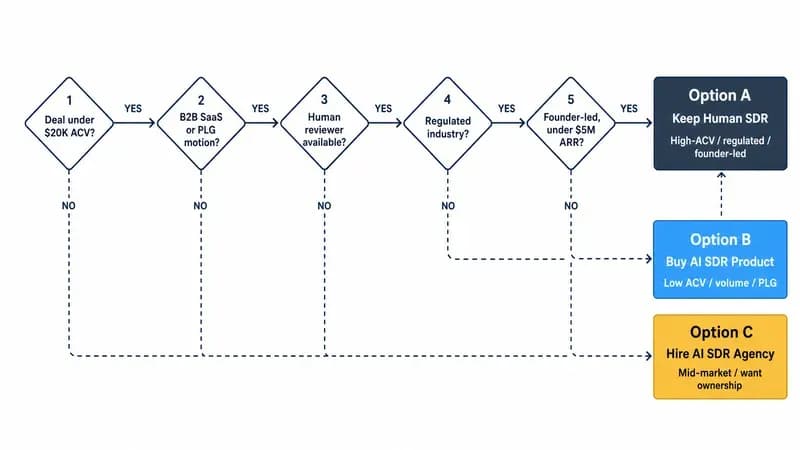
Pick A (keep human) if your average deal is over $100K, you operate in a regulated industry, or you're a founder-led team under $5M ARR still finding product-market fit. Bloomberg's survey backs this: only 13% prioritize headcount cut because labor isn't the constraint at this stage; clarity is.
Pick B (buy AI product) if your motion is high-volume PLG or SMB SaaS, your ACV is $5-25K, you have an internal RevOps person who can babysit a vendor dashboard, and you accept that you don't own the model or the data layer. Agentforce SDR, 11x, Artisan, Regie.ai, and AiSDR are the main 2026 vendors. None of them ship a flat-rate plan; you negotiate based on seat count and lead volume.
Pick C (hire an agency) if you want the upside of AI SDR without the staffing and tooling integration work, you're mid-market (30-100 employees) without dedicated RevOps infra, and you care more about owning the data than owning the dashboard. The agency builds on infra you control (Clay, Apollo, Smartlead, an n8n agent, your CRM) and exits cleanly when you hire in-house. If Option C sounds like your fit, here's how AI SDR agencies actually work.
The "avoided hires" reframe lands hardest with finance teams here. You're not laying anyone off; you're choosing Option B or C instead of posting two new SDR reqs you couldn't fill anyway.
Where AI Actually Wins (Today)
Volume work. That's the one-line summary. Autobound's State of AI Sales Prospecting 2026 reports 81% of sales teams using AI in prospecting workflows, with top performers hitting 3.7x quota when paired with AI on the boring-but-essential tasks. The wins concentrate in five places.
- Lead enrichment at scale. A human SDR caps around 50 deeply-researched leads per day. An AI stack on Clay AI plus Apollo handles 1,000+ with comparable depth, pulling tech-stack signals, hiring activity, and funding events from 200+ sources.
- Signal-based prospecting. Intent data triggers (G2 visits, funding announcements, leadership hires, job postings) generate cold lists that convert 2-3x better than static ICP scrapes. The AI watches the signal feeds; humans wouldn't keep up.
- First-touch personalization at volume. When the prompt is tuned and signal-driven (not "{firstname}, I saw you work at {company}"), AI matches a competent human's open and reply rates on the first email. The gap widens against humans only on emails 3-5, where humans go off-script and AI doesn't.
- Follow-up cadence discipline. No human forgets the 5-touch rule. AI runs the cadence on time, every time, for the full 6-week sequence. HubSpot Sales Trends found 80% of B2B deals need 5+ follow-ups; AI doesn't drop any of them.
- Response classification. Inbox triage at 10x speed. AI sorts replies into positive, nurture, objection, and out-of-office buckets before a human ever opens the inbox. Per-rep effective volume jumps from 1,150 to 7,400 outbound touches per year on the same headcount.
This is the outbound AI sweet spot. None of it requires the AI to be smarter than the buyer; it just has to be more consistent.
Where Human SDRs Still Own the Outcome
Trust-heavy and context-heavy work. The 6sense 2025 Buyer Experience Report found 95% of B2B buyers do their own research before talking to anyone, which means the conversations that do happen are higher-stakes than ever. A human SDR earns their salary in five places.
- Multi-thread account orchestration. Enterprise deals close with 5-7 stakeholders. A human reads the org chart, knows when to loop in the security buyer vs the economic buyer, and adjusts the cadence per persona. AI struggles to hold this thread.
- Cold-call objection handling. Cognism's Competitiveness Gap study: 13% of sales leaders trust AI on cold calls. The other 87% know that voicemail handling, callback negotiation, and live objection reframing are still human moves.
- Custom commercial offers and mid-cycle pricing nuance. When the buyer says "we'd sign at $80K instead of $120K," the human SDR knows whether to escalate, push back, or bundle a service. AI gives the discount or runs away.
- Founder-led and category-creation motions. If you're creating a category, your SDRs need to explain why the category exists. That's a story-telling job. AI can repeat a script; it can't sell a worldview.
- Buyer psychology, the trust paradox. AI outreach raises skepticism in B2B today. A human-set meeting still feels like the buyer's time was respected. That converts at 25%. An AI-set meeting converts at 14-15% on otherwise-similar pipelines.
There's a quieter sixth point. If you don't grow your next AE through an SDR seat, where does the next AE come from? Cognism raises this as the field's blind spot, and 0/8 competitors in the SERP touch it. Replacing the SDR seat with an AI seat saves you $98K-$173K per year and removes the talent pipeline you need in 24 months. Plan for that or it bites you.
When NOT to Replace Your SDR With AI (5-7 Disqualifying Scenarios)
This is the section vendor blogs skip. If any of the following five scenarios describes your motion, don't replace your SDR with AI yet. The math doesn't work, and the failure modes are expensive.
1. High-ACV deals ($100K+). One bad first touch costs more than a year of AI tool savings. Math: a $100K-ACV pipeline at 30% close rate times 1 burned account equals $30K lost; AI tool annual cost is $12-24K. Lose one account, lose the year. Buyers at this tier remember the first touch for three years. If your average deal is over $100K, one burned account costs more than a full year of AI SDR tools, keep your human.
2. Regulated industries (healthcare HIPAA, finance FINRA/SEC, legal). Compliance review beats automation speed every time. A bad AI email to a hospital procurement officer is a lost relationship plus a potential regulatory flag for unauthorized outreach. The compliance cost of an AI-generated false claim in finance can reach six figures before legal even drafts the response. Stay human until your AI stack has a verified compliance reviewer in the loop.
3. Founder-led sales under $5M ARR. You don't have product-market-fit signal yet. AI scales noise, not insight. Stay manual until you can articulate your ICP in one sentence and your value prop in two. Pre-PMF, the SDR job is listening, not sending; AI does the wrong half. The McKinsey GenAI in B2B sales research is consistent on this: GenAI fails when the motion isn't already standardized.
4. Markets where personal trust is the moat. Private wealth, executive search, M&A advisory, family office, board services. These buyers detect AI in the first paragraph and never reply. The relationship economy at this tier punishes automation. The CPQO math here flips: a human SDR who books 8 meetings/month at $40K each is worth more than 80 AI meetings that close zero.
5. Inbound-heavy motions rate-limited by AEs, not volume. If your AEs are already maxed at 30 deals each, AI SDR adds top-of-funnel volume that nobody downstream can handle. You'll create pipeline drag, not pipeline. Fix the AE capacity first, then add the SDR layer.
6. Brand-sensitive companies in saturated categories (optional sixth). When deliverability collapse becomes a domain-reputation problem, you torch the company domain, not just the SDR campaign. If your marketing domain ranks for high-value brand terms, isolate the cold-outreach stack on a separate sending domain or skip cold AI entirely.
7. Teams without a single human reviewer with sales-ops chops (optional seventh). AI SDR without a human-in-the-loop is the number-one churn cause. If you can't dedicate at least 10 hours per week to reviewing AI sends, classifying replies, and tuning prompts, the pilot dies by month three. Hire the reviewer first; buy the AI second.
What We Actually Ship for Clients (And What the Math Looked Like)
Across the AI SDR programs Techsy has consulted on in Q1 and Q2 2026, the pattern is consistent enough to share with caveats. Numbers below come from a single anonymized engagement; ranges from the broader set are noted where useful.
The engagement. A US B2B SaaS client (45 FTE, $8M ARR) asked us to model replacing 2 unfilled SDR reqs. Their CRO had been trying to backfill since November 2025; the talent market for mid-market SDRs in their vertical was thin and the OTE expectations had pushed past $90K. They asked: what would AI cost, and where would it break?
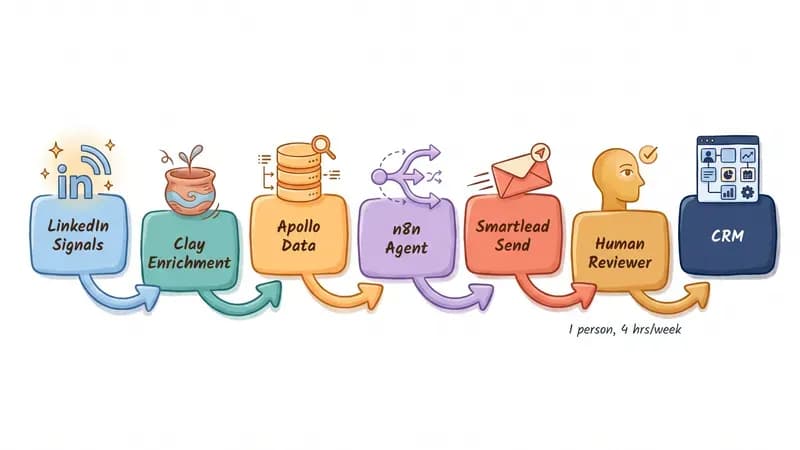
The stack we ran for 60 days.
- Clay for enrichment and signal triggers (G2 intent + LinkedIn job-change firehose)
- Apollo for verified contact data and waterfall enrichment
- Smartlead for sending infra (v6 inbox-rotation, May 2026 release) on a separate cold-outreach subdomain
- n8n running an agent pattern we documented elsewhere for reply classification and follow-up cadence (the agent framework we evaluated was LangGraph; we landed on n8n for the visual workflow + version control story)
- One human reviewer at 15 hours/week reading replies, tuning prompts, and approving exceptions
The 60-day numbers.
- Baseline (pre-stack): 130 meetings/month projected at $11K each in fully-loaded SDR comp, $169/meeting, 23% meeting-to-opp conversion off historical human-set data
- Post-stack: 220 meetings/month at $1.8K/mo tool spend plus $9.5K/mo reviewer salary, $51/meeting
- The catch: meeting-to-opportunity conversion dropped from 23% baseline to 14% on AI-set meetings in month one
- CPQO: $735 on the human baseline, $364 on the AI-hybrid stack
Where we got it wrong. We assumed conversion would hold at 20%. It didn't. The hybrid configuration (human reviewer approving the top 30% of sends, full-auto on the long tail) moved it back to 22% by month three, but we lost a week of pipeline tuning to get there. Honest framing: AI SDR isn't a "set and forget" decision; it's a prompt-and-deliverability tuning project that pays off after the third month.
What the client did next. Cancelled one of two SDR backfills, kept one human focused on the top 50 named accounts, retained the AI stack for the long tail. Net headcount avoided: 1 SDR ($98-115K all-in). Net cost added: $11.3K/mo for tools plus reviewer. Net CPQO: $364, down from $735. Payback on the stack build: 7 weeks.
Compliance flag on day 14. We caught a deliverability issue on day 14 because Smartlead flagged a 22% bounce spike. Root cause: the warmup subdomain hadn't fully aged before we ramped volume. We added a CAN-SPAM and RFC 8058 review step before scaling further, see the next section for why.
If this shape of engagement is what you're looking for, see how AI SDR agencies actually operate end-to-end or book a quick call. We cut cost-per-meeting from $169 to $51, and CPQO from $735 to $364. The client cancelled one backfill, not both.
Compliance: CAN-SPAM, GDPR, and the RFC 8058 One-Click-Unsubscribe Problem
Compliance is where AI SDR pilots collapse silently on day 30. Most teams don't realize their AI tool was sending from a non-warmed subdomain until Gmail flags 80% of sends as spam by day 21. The legal layer matters before the prompt layer.
- CAN-SPAM (US). Physical postal address in every send, accurate from-line, opt-out honored within 10 business days. The FTC's CAN-SPAM compliance guide is the authoritative source. AI SDR tools must inject these per send, not as a global footer.
- GDPR (EU). Legitimate-interest assessment required for B2B cold outreach. For non-B2B contacts, explicit opt-in. Penalties run to 4% of global revenue.
- CCPA (California). Consumer right to deletion applies to outbound contact lists. Honor the request within 45 days, including deletion from your enrichment vendor.
- RFC 8058 (one-click unsubscribe). Gmail and Yahoo enforce this for bulk senders over 5,000/day since February 2024 sender requirements. The header must be present and the unsubscribe must work in one click without a confirmation page. Most AI SDR tools added RFC 8058 support in 2024-2025; verify before scaling.
Honest gotcha. We've seen AI SDR pilots collapse on day 30 because the team didn't realize their AI tool was sending from a non-warmed subdomain, Gmail flagged 80% of sends as spam by day 21, and by the time anyone noticed, the domain reputation needed a 6-week cooldown to recover.
Pre-scale compliance checklist:
- Suppression lists synced across all sending tools (one suppression source of truth)
- Opt-out plumbing tested end-to-end with a real test inbox (every 30 days)
- Sender warmup verified for at least 30 days before ramp
- Geo-segmented sending (don't blast EU contacts from US infra without GDPR review)
- Audit trail per send, who approved the prompt, when, what list
Frequently Asked Questions
Can AI fully replace SDRs in 2026?
For most teams, no. Only 22% of sales organizations have fully replaced their human SDRs as of McKinsey's State of AI 2025. The other 78% run hybrid or human-led setups. Full replacement works for high-volume PLG and SMB SaaS motions under $20K ACV with disciplined deliverability ops. Outside that profile, the hybrid pod (1 human + 2 AI seats) wins on CPQO and risk.
How much does it cost to replace an SDR with AI?
The AI tooling layer runs $900-$5,000 per month, covering Clay, Apollo, Smartlead, and an orchestration runner. Add one human reviewer at 10-15 hours per week (roughly $4-9K/mo loaded). Total: $5-14K/mo. Compare to one fully-loaded human SDR at $98-173K per year (Glassdoor 2025 plus 50-60% employer load). Payback on the AI stack lands at 2-5 months depending on staffing mix.
Will AI take over SDR jobs by 2030?
The role evolves rather than disappears. McKinsey forecasts ~7% of GenAI deployments at "fully scaled" in 2026, with 22% of SDR functions fully replaced and 55% running hybrid pilots. By 2030, expect 40-50% of bottom-of-the-stack SDR tasks (enrichment, cadence, triage) automated. The high-impact 15% (objection handling, multi-thread orchestration) stays human. Headcount shifts to a smaller, more senior reviewer pool.
What can AI SDRs do that humans can't?
Three things at scale. First, signal-based prospecting across thousands of leads per day (a human caps at 50). Second, follow-up cadence discipline, no human runs a flawless 5-touch sequence on 220 leads simultaneously. Third, 24/7 response classification and triage, AI sorts replies into positive, nurture, and objection buckets in seconds. Effective per-rep volume goes from 1,150 to 7,400 touches per year on the same payroll.
When should you NOT replace your SDR with AI?
Five disqualifiers: deals over $100K ACV (one burned account costs more than a year of AI tooling), regulated industries (HIPAA, FINRA, SEC require compliance review), founder-led under $5M ARR (you don't have PMF yet, AI scales noise), trust-moat markets (private wealth, executive search, M&A), and inbound-heavy motions rate-limited by AE capacity. See the dedicated "When NOT to Replace" section above for the full breakdown.
What's the meeting quality drop when switching to AI SDR?
AI-only setups see meeting-to-opportunity conversion drop from a 25% human baseline to roughly 15% (Prospeo's 2026 cold-AI cadence benchmark, a 40% relative drop). Hybrid pods (1 human + 2 AI) hold conversion at 22% in our Q1 2026 client benchmark. The CPQO math only works on hybrid; AI-only saves on cost-per-meeting but the funnel math claws most of it back.
What are the best AI SDR tools in 2026?
The 2026 vendor landscape splits into autonomous agents and infra. Agents: 11x (Alice), Artisan (Ava), Regie.ai, AiSDR, and Salesforce Agentforce SDR. Infra: Clay AI for enrichment, Apollo for data, Smartlead for sending, Outreach and Salesloft for cadence orchestration. Vendors claim 3-5x productivity; independent benchmarks (Prospeo, Autobound) show 2-3x with disciplined ops. Choose agents for time-to-value, infra for ownership and exit cost.
Is "SDR replaced by AI" a real risk for current SDRs?
Not the role, but the bottom 30% of the role's tasks. Enrichment, cadence execution, response triage, and follow-up scheduling are automating fast. The high-impact 15% (objection handling, account orchestration, custom offers) stays human and pays more. Current SDRs should move up-stack toward account-based selling, technical discovery, and multi-thread orchestration. The "fired Monday" framing is rare; the "not backfilled" framing is common.
How long is the payback period for replacing an SDR with AI?
Buying an AI SDR product (Option B) typically pays back in 2-3 months, fast time-to-value, higher churn risk. Building or hiring an agency to run a custom stack (Option C) pays back in 4-5 months, slower to start but lower hidden costs and full data ownership. The hybrid pod model recoups the build cost faster than full replacement because conversion holds at 22% versus 14-15% on AI-only.
Should I fire my SDR or just not backfill?
Don't backfill. McKinsey calls this avoided hires, and it's the framing finance and HR will both accept. Replacement-via-attrition avoids severance, retains institutional knowledge, and lets you A/B test the AI stack against a known human baseline. Keep your best human SDR on the top 50 named accounts; route everything else to the AI stack with a human reviewer. That's the configuration that hits $189 CPQO in 2026.
Conclusion
The right answer to "should you replace your SDR with AI?" depends on three numbers and one operating choice. Average contract value above or below $20K. Meeting-to-opp conversion holding above 20% or dropping below 15%. Monthly CPQO at $487 (human-only), $224 (AI-only), or $189 (hybrid). And the choice: keep your team, buy a vendor, or hire an agency.
For most teams in 2026, the hybrid pod wins on CPQO, payback, and risk. Full replacement only works for high-volume SMB SaaS with disciplined ops. Keep humans on $100K+ deals, regulated industries, and founder-led motions under $5M ARR. The "avoided hires" reframe (don't backfill, don't fire) is the version that gets through finance and HR without a layoff conversation.
If you want help running the swap math for your team, or want an agency that builds and operates the stack, start with our AI SDR services overview or book a free consultation. The cost-math table above is the one we share with founders on the first call. Bring your own conversion data and we'll work through it together.