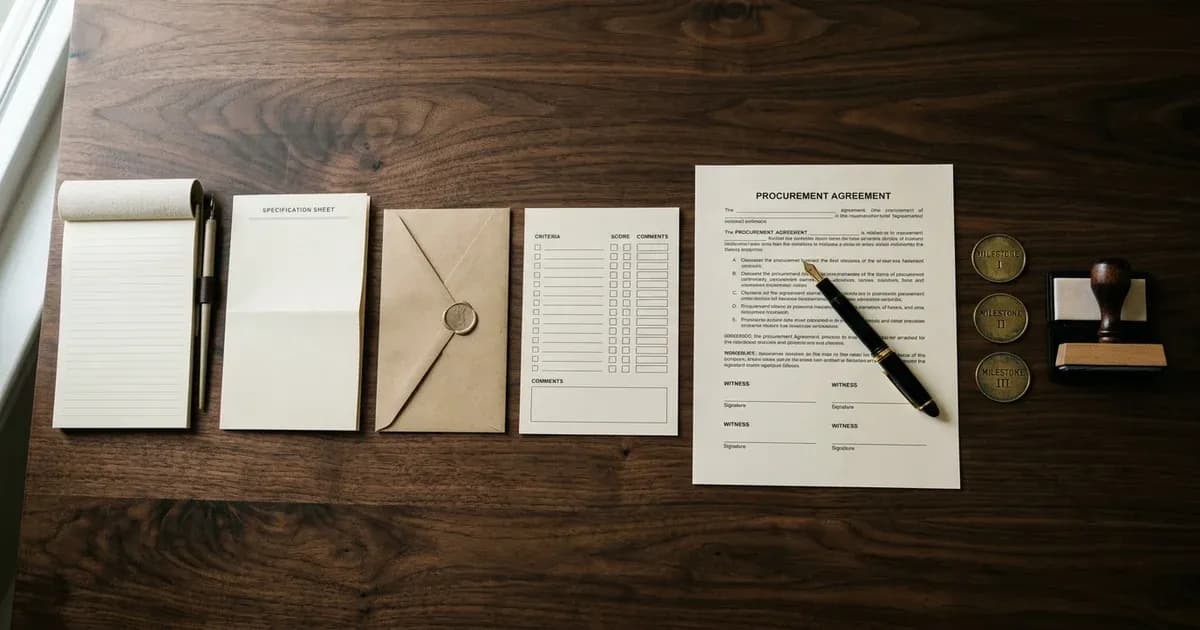
Custom Software Procurement: A Buyer's 2026 Playbook in 7 Steps
Custom software procurement is the process of commissioning bespoke software from an outside development vendor: the business case, the statement of work, the RFP, vendor evaluation, the contract, and the acceptance test that closes it out. It is not a product. It is a buying process you run.
Search it and Google hands you nine tool catalogs plus one 900-word UCLA policy page. The process itself is uncovered, because tool vendors write what ranks. This guide answers the second question: how do you buy software that does not exist yet?
Key takeaways:
- Custom software procurement is the process of commissioning bespoke software from a vendor, not buying a purchasing tool.
- A full procurement run takes 7 steps from business case to accepted delivery, usually 10–16 weeks before build.
- Nine contract clauses protect your budget; IP ownership, acceptance criteria, and milestone payments bite hardest.
Custom Software Procurement Is Not Procurement Software
Procurement software is a tool that automates purchasing: purchase orders, approvals, invoicing, supplier catalogs. Custom software procurement is the process of commissioning bespoke software from a development vendor. One is a product you license. The other is a project you run, with a contract and an acceptance test. This guide is the second.
The mix-up is understandable: the tool market is enormous and well-covered. Art of Procurement's provider directory lists 200+ platforms across 19 categories, and Brex's 2026 buying guide runs nearly 4,000 words comparing five of them. Nobody in that stack explains how to commission software from scratch. That is the gap this post fills.
Before You Start: Is Custom Actually the Right Buy?
Custom is the right buy when the software is core to how you operate and no existing product fits the workflow without duct tape. It is the wrong buy when a licensed product covers 80% of the need already. Decide honestly before you spend a dollar on a custom software procurement RFP.
| Option | Wins when | Watch out for |
|---|---|---|
| Off-the-shelf SaaS | The need is generic (payroll, CRM, invoicing) and 80% coverage is enough | Per-seat fees compound; you rent, you never own |
| Customize a platform | A platform mostly fits, and your edge case is a configuration, not a rebuild | Customization debt; upgrades break your modifications |
| Full custom build | The software is your process, competitors cannot buy it, and you need the IP | You carry the build risk, so the contract must allocate it |
Still unsure which row you belong in? Our build-vs-buy scoring framework answers build-or-buy; this guide answers the next question, how to run the buy once you have decided.
Then write the business case down. A one-page software purchase justification template is enough:
Problem:       What is broken, in one sentence
Current cost:  What it costs today (hours per week x rate, or lost revenue)
Outcome:       The measurable result the software must produce
Ceiling:       The maximum budget, and the date the money runs out
Even a two-person procurement benefits from a written procurement policy: one paragraph on who approves spend and who signs. It prevents the "founder approved it on a call" mess that sinks acceptance.
The 7-Step Custom Software Procurement Process
The custom software procurement process has seven steps, and six happen before anyone writes code. The whole run, one line each:
- Need and business case: prove the problem is worth money
- Statement of work (SOW): write down exactly what "done" means
- Market scan: shortlist vendors who do this kind of work
- RFP / RFQ: send the same brief to all of them
- Vendor evaluation: score the responses on evidence, not vibes
- Negotiation and contract: put the nine clauses in writing
- Delivery and acceptance: test against the criteria from step 2
These ranges are our interpretation of typical SME engagements, not a measured benchmark: a sole-source renewal runs in three weeks, a regulated tender takes six months.
| Stage | Typical weeks | Artifact produced | Who owns it |
|---|---|---|---|
| 1. Need and business case | 1–2 | One-page justification | You (buyer) |
| 2. Statement of work | 2–4 | SOW plus acceptance criteria | You, with vendor input |
| 3. Market scan | 1–2 | Vendor shortlist of 5–8 | You |
| 4. RFP / RFQ | 2–3 | Sent brief and responses | You, then vendors |
| 5. Vendor evaluation | 1–2 | Scored scorecard | You |
| 6. Negotiation and contract | 2–3 | Signed agreement | Both, plus legal |
| 7. Delivery and acceptance | runs through the build | Acceptance sign-off | Both |
| Total pre-build | 10–16 | Signed contract and a testable SOW | You |
1. Need and business case
Start with the one-pager above. In our engagements, the projects that skip it re-scope mid-build, when changes cost real money instead of a paragraph. It also sets the budget ceiling you quote in the RFP.
2. Statement of work (SOW)
A statement of work turns the business case into a spec both sides can argue about: features in and out, integrations, timeline, and the acceptance criteria the delivery gets tested against. How to scope a web app project pays for itself here, or scope the requirements with AI for a faster draft.
3. Market scan
Build a shortlist of five to eight vendors with recent, relevant-domain references. Ask peers who shipped similar work; check case studies for your industry, not homepages. Skip directories ranked by referral fee.
4. RFP / RFQ
Send every shortlisted vendor the same brief and demand the same response format. An RFP (request for proposal) asks how they would build it; an RFQ (request for quotation) asks what a defined scope costs. For custom software procurement, the RFP comes first.
5. Vendor evaluation
Score every response against the same scorecard, weighting references and code-audit rights over price. The cheapest proposal is usually the one that priced the least work. Call the references yourself.
6. Negotiation and contract
Take the winning proposal and bolt on the nine clauses below. Negotiate acceptance criteria and milestone payments first, price last: price is the easiest term to move, acceptance the one worth fighting for.
7. Delivery and acceptance
Delivery is not "they sent the code." Acceptance means the software passes the SOW's criteria in your environment, with the IP assignment signed and the source handed over. Hold the final milestone payment until that test passes.
The RFP That Gets You Real Quotes
An RFP without acceptance criteria is a price quote for work nobody has defined. The skeleton below is the custom software procurement template we wish every buyer sent us. Copy it, fill the blanks, and five vendors price one scope, not five guesses.
CUSTOM SOFTWARE RFP

1. Company context
   Who you are, team size, the system this replaces or connects to

2. Problem statement
   The broken process, what it costs you today, who feels it

3. Scope
   In:  the features and integrations the first release must ship
   Out: anything you have decided to defer

4. Technical constraints
   Stack preferences, hosting rules, compliance (GDPR, HIPAA), SSO

5. Timeline
   Hard dates, and what happens if you miss them

6. Budget range
   A ceiling, not a target. Vendors price to the number you give.

7. Acceptance criteria
   The pass/fail tests the final delivery must clear before sign-off

8. Evaluation criteria
   How you will score responses, and the weight of price vs. references

9. Response format
   Page limits, the questions to answer, and the reply deadline
Include three things above all: budget ceiling, acceptance criteria, response format. They are what turn vague pitches into comparable quotes.
Cut three things: implementation prescriptions ("use microservices"), NDAs before shortlisting, 40-page requirements appendices. You are buying an outcome, not an architecture.
Two practical notes: send every vendor the same document, because uniform responses are the only way a scorecard means anything; and name your evaluation weights in the RFP itself. Vendors write sharper proposals when they know references outweigh price.
How Do You Evaluate a Custom Software Vendor?
Vendor evaluation means scoring every proposal against the same evidence-weighted scorecard, so the decision survives a second look. Price deserves less weight than most buyers give it: proposals that underbid the field usually priced the least work. The scorecard we recommend for SME budgets:
| Criterion | Weight | Scoring guide |
|---|---|---|
| Relevant-domain references | 25% | 5: two references you actually called, in your domain. 1: a logo wall |
| Code audit rights | 15% | 5: agrees in writing to third-party code review before final payment |
| Financial health | 10% | 5: profitable, multi-year track record. 1: cannot show it |
| Security posture | 15% | 5: documented SDLC, dependency scanning, least-privilege access |
| Team continuity and tenure | 15% | 5: named team, low turnover. 1: "we will staff after signing" |
| Communication cadence | 10% | 5: weekly demo committed in writing. 1: "we use Slack" |
| IP discipline | 10% | 5: clean work-for-hire assignment, no reused proprietary core |
The weights are a starting point. Move them, but make them sum to 100 and write them down before you read a single proposal. How we rank development companies applies the same discipline; what development services actually include helps you compare line items like for like.
Software acquisition due diligence checklist
Run this on the top two vendors before you sign, not on all five:
- References checked with real questions (what broke, how they handled it, would you rehire)
- Code audit rights agreed in writing, before the final milestone payment
- Financial health confirmed (years trading, profitability, client concentration)
- Security posture reviewed (SDLC, access control, incident history)
- Key-person continuity confirmed (the pitch team is the project team)
- IP assignment reviewed by your lawyer, not theirs
9 Contract Clauses That Protect Your Budget
The clause that protects your budget is not the price. It is the acceptance test. UCLA's purchasing guidance, the one institutional page in Google's top ten for this topic, builds its custom-software advice around that idea: statement of work, IP ownership, acceptance testing, and warranty, before price enters the room. We expanded that taxonomy into nine clauses for commercial buyers.
If you are assembling a software purchase agreement template, these nine rows are the spine:
| # | Clause | Why it bites | One-line example wording |
|---|---|---|---|
| 1 | IP ownership / work-for-hire | Without it the vendor keeps copyright and licenses the software back to you | "All deliverables are work made for hire; upon payment, buyer owns all IP outright" |
| 2 | Acceptance criteria and procedure | The only objective definition of "done"; without it, disputes become opinions | "Delivery is accepted only when all tests in Schedule B pass in buyer's environment" |
| 3 | Milestone-linked payments | Keeps cash behind progress; kills the 100%-upfront risk | "20% at kickoff, then 20% per milestone, 20% on final acceptance" |
| 4 | Change control | Stops scope arguments from becoming invoice arguments | "Scope changes require a written change order with price and timeline impact signed by both parties" |
| 5 | Warranty period | Forces the vendor to stand behind the code after handover | "Vendor fixes defects found within 90 days of acceptance at no charge" |
| 6 | Price protection | Caps the blast radius of optimistic estimates | "T&M rates fixed for 12 months; not-to-exceed ceiling without written re-approval" |
| 7 | Performance specs | Makes "it's slow" a breach, not a complaint | "p95 page load under 2s; API p99 under 300ms at 500 concurrent users" |
| 8 | Key personnel | Stops the senior-pitch, junior-build switch | "Named leads may not be reassigned without buyer's written consent" |
| 9 | Termination and source-code escrow | Your exit if the vendor stalls, folds, or walks | "Buyer may terminate for cause with 14 days' notice; escrowed source released on insolvency" |
Miss any one and you are funding a hope. If your lawyer has time for three clauses, hand them 1, 2, and 3.
What Does Custom Software Cost, and How Should You Structure Payment?
Scope sets the price, which is why the SOW exists before any quote means anything. The published anchor is ScienceSoft's estimate of $200,000–$400,000 and roughly 10 months for enterprise-grade custom procurement software; ScienceSoft attributes the 315% ROI figure there to a Forrester Total Economic Impact study.
Those are their numbers for large enterprise builds, not ours. Smaller SME builds, an internal tool, a customer portal, a mobile app, land well under that band; treat our SME reading as interpretation, and get three quotes before trusting any of it. For a per-app anchor, our mobile app cost breakdown prices builds by app type.
The structure of the payment matters as much as the total:
| Model | Wins when | Risk sits with | Typical use |
|---|---|---|---|
| Fixed-price | Scope is frozen and the SOW is airtight | Vendor (they absorb overruns) | Well-defined first releases |
| Time-and-materials | Scope will evolve and you trust the team | You (every extra hour bills) | Discovery-heavy or long-running builds |
| Milestone-linked | Either model, with payments tied to accepted deliverables | Shared (cash follows proof) | Most SME custom builds |
| Buy vs. license vs. subscribe the IP | You own code outright only when the contract assigns IP; licensing and SaaS subscriptions rent it | Vendor lock-in with license and subscribe | Buy when the software is core; subscribe when it is commodity |
Our recommendation: default to milestone-linked payments on a fixed scope, 20% or less at kickoff, final tranche gated on the acceptance test. Fixed-price only if your SOW survives a hostile reading; time-and-materials only with a vendor you have shipped with before. Never 100% upfront; that structure appears again below.
Red Flags: How Custom Software Procurements Actually Fail
Paying 100% upfront does not buy you priority. It transfers all delivery risk to you. Every red flag below hands the vendor bargaining power you will not get back:
- Vague SOW. "Build us a CRM," no feature list. Every undefined term becomes a change order, priced without competition.
- No acceptance test. "We'll know it when we see it." Then you never see it, because "done" was never defined.
- 100% upfront payment. Cash is your only bargaining chip after signing; spend it all on day one and you have none left.
- No change control. Scope grows, invoices grow, nobody signed the growth.
- Missing IP assignment. You paid for the software and licensed it back without noticing.
- No key-person clause. The senior team that won the pitch vanishes the week after signing.
We answer custom-software RFPs every quarter from the vendor side, and two patterns recur so reliably we treat them as the base rate of procurement failure: RFPs with no acceptance criteria at all, and payment schedules that put the majority upfront, handing the vendor every incentive to deprioritize the project once the cash lands. Our reading, and it is interpretation, not measurement: the buyers who negotiate price hardest are the ones who skipped the two clauses, acceptance and milestones, that would have protected it.
The industry data points the same way. The Standish Group has tracked project outcomes for three decades through its CHAOS research; its recurring finding is that challenged projects, over budget, late, or short on features, outnumber clean successes, with vague requirements and weak sponsorship near the top of the cause lists.
If you fix only one thing, fix the acceptance criteria. It is the clause that makes every other clause enforceable.
How Techsy Approaches Custom Software Procurement
Our intake follows the same seven steps from the other side of the table. We produce the SOW and acceptance criteria before quoting a number, because quoting against a vague brief is how vendors lowball and buyers overpay. Builds run on milestone-linked payments, weekly demos, code-audit rights in every contract. When acceptance passes, you own the IP and the repository, not a license.
Honest limits: if you need a licensed SaaS tool that automates purchasing, we are the wrong call. That is a product purchase, not a build; a tool vendor serves you faster and cheaper. We take custom work where the software is the process and the IP matters.
If your project sits in that second bucket, get a free consultation.
Frequently Asked Questions
What is software procurement?
Software procurement is the process of acquiring software: defining the need, evaluating options, negotiating terms, accepting delivery. It covers licensed products and custom builds alike. This guide focuses on the second: the process from business case through RFP, contract, and acceptance test.
What are the 4 types of procurement?
The four commonly cited types are direct (production inputs), indirect (operating goods and services), goods, and services procurement. Software straddles indirect and services: a licensed tool is an indirect purchase; a custom build is a services engagement ending in delivered goods.
What is the difference between procurement software and custom software procurement?
Procurement software is a tool that automates purchasing workflows, like Tradogram or Tipalti. Custom software procurement is the process of commissioning bespoke software from a development vendor. Searching for the best purchasing platform? You want the first; this guide is the second.
How long does custom software procurement take?
Plan for 10–16 weeks from business case to signed contract on a typical SME engagement, before the build starts; treat that as interpretation, not a benchmark. A sole-source renewal compresses to weeks; a regulated tender can stretch past six months.
How much does custom software cost?
ScienceSoft estimates $200,000–$400,000 and about 10 months for enterprise-grade custom procurement software, attributing a 315% ROI figure to a Forrester study. Smaller SME builds land well below that band. For custom software procurement, scope sets the price: the RFP and SOW exist before any quote means anything.
Who owns the IP in custom software?
Whoever the contract says. Without an explicit work-for-hire or IP-assignment clause, the vendor keeps copyright and licenses the software back to you. Put ownership in writing, tied to payment: upon final payment, the buyer owns everything. Tie that transfer to the acceptance-gated final tranche, not the kickoff payment, so ownership moves only when the software does.
RFP vs RFQ, which do I need?
An RFP (request for proposal) asks how vendors would solve your problem; an RFQ (request for quotation) asks what a defined scope costs. For custom software, send the RFP first: vendors must propose an approach before a price means anything. The RFQ comes once the SOW is frozen.
Fixed-price or time-and-materials?
Fixed-price protects you when the SOW is airtight: the vendor absorbs overruns. Time-and-materials fits discovery-heavy work where scope will evolve, but you carry the overrun risk. Most SME buyers do best with milestone-linked payments on a fixed scope, final tranche gated on the acceptance test.
What should be in a statement of work?
A statement of work should name features in and out of scope, integrations, timeline, the acceptance criteria the delivery gets tested against, and payment milestones tied to each deliverable. If a term is not in the SOW, it is not in the project.
Conclusion
Custom software procurement comes down to artifacts, not negotiations: the one-page business case, the SOW with acceptance criteria, the RFP skeleton, the scorecard, the nine-clause contract. Get those five documents right and the vendor conversation takes care of itself. Run the seven steps in order, hold final payment behind the acceptance test, and if you want a second opinion on your RFP, get a free consultation.