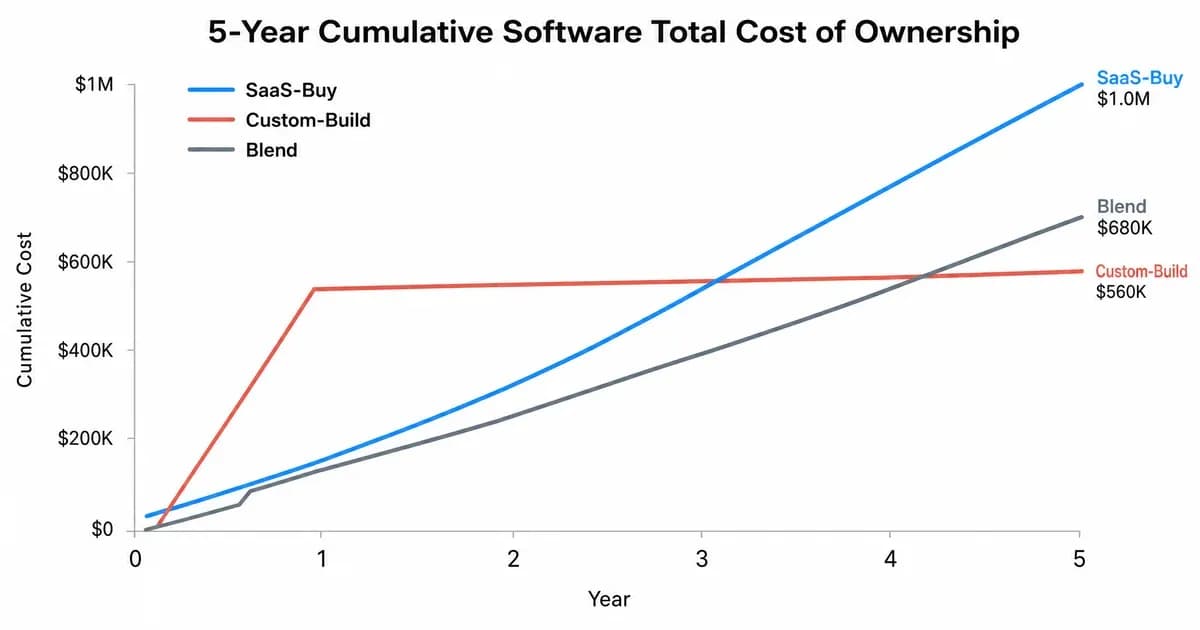
Build vs Buy Enterprise Software: The Vendor-Neutral Framework (With a 12-Point Scoring Rubric, 2026)
Last September a $50M-ARR SaaS client asked us a question that costs enterprises millions to answer wrong: stay on a $487K Salesforce + Tableau + Outreach stack for the next five years, or build a custom revenue-ops platform for $312K? The "cheaper" answer was wrong. Here's the framework we used to figure that out: a 12-point scoring rubric, a 5-year TCO model, and Gartner's Buy/Build/Blend trichotomy that none of the top-10 build-vs-buy guides currently on Google bother to name. And yes, we're an engineering agency, so we'll tell you when to buy SaaS instead of hiring us.
Key takeaways (TL;DR):
- Most build-vs-buy advice comes from vendors who profit from one answer. Name your sources' bias before trusting them.
- Gartner's Buy/Build/Blend framework now covers 76% of enterprise software spend. Pure build or pure buy is the minority case in 2026.
- Score your decision on 12 weighted criteria, not gut feel. Custom build wins when total >45; SaaS wins under 30.
- AI coding agents (Cursor, Claude Code) cut senior-engineering hours per feature by 40–60% in 2026. The build math changed.
What Is the Build vs Buy Decision in Enterprise Software?
The build vs buy decision is the choice between licensing existing SaaS or COTS software (buy), developing custom software in-house (build), or contracting a partner agency to build proprietary software (partner). Gartner's modern framing extends this to Buy/Build/Blend, and 76% of enterprise software spend now flows into combinations of standard products and custom extensions, not pure-build or pure-buy.
The decision turns on three questions:
- Is the capability a competitive differentiator or a commodity?
- What is the true 5-year TCO of each path?
- Can you staff a senior engineering team to own it long-term?
Heads-up: Techsy is an engineering agency. We make money when you build. So we're going to tell you all the cases where you should buy SaaS instead and not hire us, because long-term, posts like this only work if the math is honest. We've named our funnel target at the bottom; everything in between is the framework, not the pitch.
Most build-vs-buy guides are written by people who profit from one of the two answers. SaaS marketplaces want you to buy. Dev agencies want you to build. COTS vendors want you to do whatever protects their renewal. Read three of them and you'll get three confident, opposite recommendations, each one buried under a sales hook. If you're specifically evaluating a voice-AI build, we wrote a vertical version of this framework that runs the same logic on a narrower decision. The rest of this post is the general procurement framework you can actually run in a meeting.
What Gartner Actually Says: The Buy / Build / Blend Framework
Gartner's procurement framework rejects the binary build-vs-buy question and replaces it with a three-way decision: Buy (license COTS or SaaS), Build (in-house custom development), or Blend (combine SaaS for commodity workflows with custom code for differentiated workflows). According to the Gartner Buy/Build/Blend model, 76% of enterprise software spend now flows into blended stacks. Pure build or pure buy is the minority case.
Buy = License What's Commoditized
Buy when the capability is a solved problem and someone else has already shipped the solution at scale. CRM, payroll, email, expense management, observability. The economics of buying are best when you have <100 users on the workflow, you need it live in <90 days, and the SaaS solves more than 80% of your need out of the box.
Build = Own What's Differentiated
Build when the capability is your moat. The thing customers buy you for. Stripe didn't license a payments stack. Figma didn't license a rendering engine. Build also wins when SaaS literally can't model your data structure (think complex multi-entity finance or unusual compliance regimes) or when your 5-year SaaS bill at scale exceeds custom-build TCO by 2x or more.
Blend = The Math Most Enterprises Actually End Up With
Blending means you keep COTS for the boring 80% and build custom for the differentiated 20%. The classic pattern: Salesforce as the system of record + a thin custom layer for the workflows Salesforce can't model. Thoughtworks calls this Buy/Build/Partner; Gartner calls it Buy/Build/Blend. Same idea, slightly different vocabulary. The trichotomy traces back to McKinsey's Make-or-Buy Matrix from the 1990s, but the cloud era made the third option dominant.
| Path | Time to value | Upfront cost | Ongoing cost | Ownership | Vendor risk |
|---|---|---|---|---|---|
| Buy (SaaS) | Days to weeks | Low | High, predictable | Low | High |
| Build (Custom) | 4–12 months | High | Medium, variable | Full | None |
| Blend | Weeks to months | Medium | Medium | Partial | Medium |
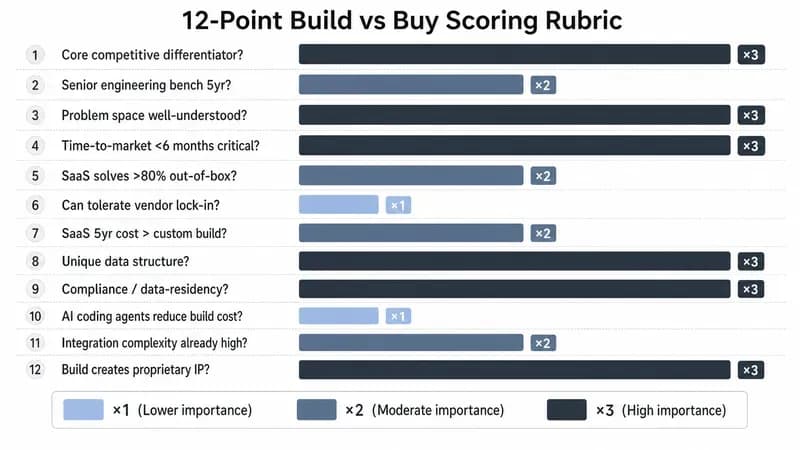
The 12-Point Scoring Rubric (Copy This Into a Spreadsheet)
Score each criterion 1–5 based on how strongly it applies to your situation. Multiply by the weight. Add the totals. The threshold legend at the bottom tells you which path the math points to. Use this in a real procurement meeting and you'll cut the debate from two hours to twenty minutes.
| # | Criterion | What it means | Weight | Score (1–5) |
|---|---|---|---|---|
| 1 | Competitive differentiator | Is this capability a core part of why customers buy you? | ×3 | __ |
| 2 | Senior engineering bench | Can your team realistically own it for 5+ years? | ×2 | __ |
| 3 | Problem novelty | Is the problem novel (5) or well-understood (1)? | ×1 | __ |
| 4 | Time-to-market urgency | Is shipping in <6 months critical? Lower = more urgent | ×2 | __ |
| 5 | SaaS coverage gap | Does no existing SaaS solve >80% of your need? | ×2 | __ |
| 6 | Lock-in tolerance | Can you live with vendor pricing changes and roadmap risk? Lower = less tolerant | ×1 | __ |
| 7 | 5-year SaaS TCO at scale | Will SaaS cost exceed custom-build TCO over 5 years? | ×2 | __ |
| 8 | Data uniqueness | Does your data have structure SaaS can't model? | ×1 | __ |
| 9 | Compliance / residency | Are there constraints that rule out major SaaS vendors? | ×1 | __ |
| 10 | AI build-cost reduction | Will AI coding agents materially cut your build cost vs 2023? | ×2 | __ |
| 11 | Integration complexity | Is integration to surrounding systems already heavy? | ×1 | __ |
| 12 | IP value capture | Will building create proprietary IP that lifts company valuation? | ×1 | __ |
Threshold legend:
- Total <30 → Buy SaaS
- Total 30–45 → Blend
- Total >45 → Build
Worked example, using our case-study client (the one we walk through in detail in H2 #8): they scored 38. Differentiator was a 3 (revenue ops is important but not their moat), bench was a 2 (they couldn't dedicate engineers long-term), SaaS coverage gap was a 4 (Salesforce missed about a third of their workflows), AI build-cost reduction was a 5. Net: solidly in Blend territory, which is where the recommendation landed.
One caveat. The rubric is a decision aid, not a decision maker. If your score is borderline (28–32 or 43–47) run the TCO model in the next section before you commit. Numbers shift the call.
TCO Modeling: How to Honestly Compute 5-Year Cost
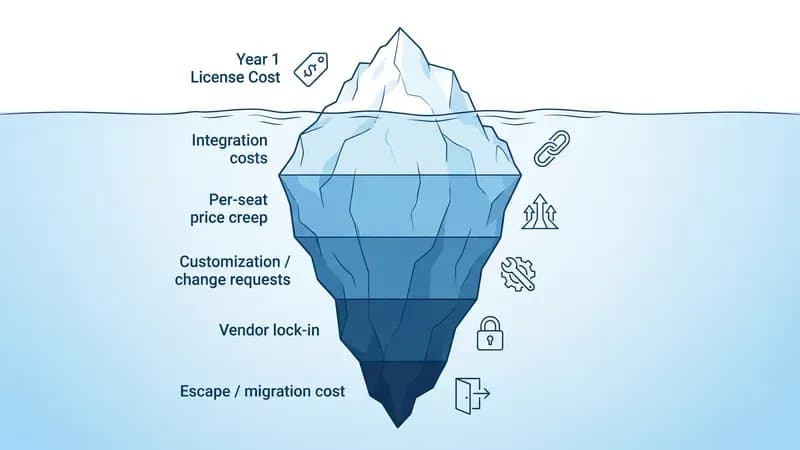
According to Gartner research on software cost analysis, enterprises miss 50–70% of TCO when calculating software ownership. The most-missed lines: integration, admin FTE, and escape cost. Year-1 sticker price is the smallest part of the bill, and almost every vendor demo gives you exactly that number.
Here's how to compute 5-year TCO honestly for each path.
Buy (SaaS) line items: licensing × users × years, implementation and setup, training, admin FTE allocation (typically 0.5–2 FTEs at enterprise scale), integration to existing systems, and escape cost when you eventually migrate off.
Build (Custom) line items: engineering upfront (engineer-months × fully-loaded rate), maintenance per year (industry rule of thumb: 15–20% of initial build cost), infrastructure and tooling, and opportunity cost of the engineering capacity you're committing.
Blend line items: the SaaS subscription for the commoditized layer, plus the custom integration/extension cost, plus the maintenance for the custom layer. Lower upfront than full build, lower ongoing than full buy.
Use $230K as a US-coast fully-loaded engineer cost: BLS median was $130,160 in May 2024, then add ~30% for benefits and ~25% for overhead. Adjust ±30% for your geo. European teams typically run 20–30% lower; non-coastal US teams 15–20% lower.
| Cost category | Buy (SaaS) | Build (Custom) | Blend |
|---|---|---|---|
| Year 1 licensing or upfront dev | $60K | $230K | $90K |
| Implementation / setup | $40K | included | $20K |
| Years 2–5 ongoing licensing | $240K | $0 | $120K |
| Maintenance @ 15–20%/yr | n/a | $35K/yr | $15K/yr |
| Integration to other systems | $25K | $40K | $30K |
| Admin / ops FTE allocation | $80K | $20K | $50K |
| Escape / migration cost | $40K | n/a | $20K |
| 5-year total | $485K | $465K | $390K |
Generic illustrative ranges. Your numbers will differ; the categories won't.
When to BLEND (The Middle Path Most Enterprises End Up Taking)
Blending wins when neither pure buy nor pure build maps cleanly to your workflow. You keep COTS for commoditized layers (CRM, billing, identity, observability) and build custom for the workflows that are either your competitive differentiator or simply impossible to model in the SaaS. The glue between them is APIs, MCP servers, or low-code workflow engines.
Four concrete blend patterns we see repeatedly:
- Salesforce + custom RevOps layer. Salesforce stays as the system of record. Custom layer handles the multi-step revenue workflows that Salesforce's process builder can't model cleanly. The client case study below is exactly this pattern.
- SAP/NetSuite + custom data layer. Keep the ERP for ledger and procurement. Build a warehouse + custom dashboards for the financial analyses your CFO actually wants.
- HubSpot + custom enrichment pipeline. Use HubSpot for sequencing and CRM but build your own enrichment when commercial data vendors aren't accurate enough on your ICP.
- COTS HR + custom workflow automation. BambooHR or Rippling for the records, n8n or custom code for the onboarding + offboarding orchestration nobody packages well.
The blend got materially cheaper in 2026 because adding AI features incrementally to an existing SaaS no longer requires a research team, and MCP servers that let you stitch SaaS and custom code compress the integration tax that historically made blends expensive. The blend isn't a compromise. It's the answer for 76% of enterprises, per Gartner.
When to BUILD (3 Scenarios Where Custom Wins)
Build wins in three clear scenarios. If none of them describe your situation, you probably shouldn't build.
1. The Capability Is Your Competitive Differentiator
If customers buy you because of this specific capability, you cannot license it from a vendor whose other clients are your competitors. Stripe didn't license a payments stack. Notion didn't license a document engine. The capability has to be the moat, not just a feature you happen to use.
2. SaaS Can't Model Your Unique Data Structure
If your data has structure existing SaaS literally cannot represent (complex multi-entity finance, unusual regulatory schemas, real-time multiplayer state) you'll spend more in customization fees and consulting hours than you would building from scratch. Test this by getting two SaaS vendors to do a paid POC. If both fail, build.
3. 5-Year SaaS TCO Exceeds Custom Build by 2x+
The math flips on usage. 500 users on a $200/seat/mo SaaS = $1.2M/year = $6M over 5 years. A focused custom build for the same workflow might land at $400K upfront + $80K/yr maintenance = $800K over 5 years. When the multiple is 2x or more and the workflow is stable, build.
Honest risk callout: building means owning project risk. The Standish Group CHAOS Report shows 69% of IT projects fail partially or completely. Building isn't free even when the math says so. Mitigate with scope discipline, real product ownership, and an early MVP. For internal AI tooling specifically, self-hosted enterprise AI tooling is a build pattern we see working in 2026 where the off-the-shelf options don't meet data-residency requirements.
When to BUY (And the Hidden Costs Nobody Talks About)
Buy wins when the capability is commoditized, you need it live fast, and SaaS solves most of your need out of the box. Three scenarios:
1. The Capability Is Commoditized
CRM, email, accounting, observability, identity, expense management. These are solved problems. The SaaS vendors have shipped thousands of edge cases you'd otherwise hit yourself. Building any of these from scratch in 2026 is almost always wrong.
2. You Need It Live in <90 Days
If the workflow is blocking revenue and you don't have engineering bench to spare, buy. The opportunity cost of a 6-month build vs a 6-week SaaS rollout dwarfs the license fee in almost every case.
3. SaaS Solves >80% Out of the Box
If the customization debt of the last 20% costs less than the total SaaS premium, just buy. Test this by writing the gap list before signing. If the gaps are workflow-light (settings, integrations, light reporting) you're fine. If they're workflow-heavy, you're not.
The hidden costs nobody puts on the demo slide:
| Hidden cost | What it is | Typical scale |
|---|---|---|
| Vendor lock-in | Switching to a competitor takes 6–18 months | Doubles negotiating power at next renewal |
| Customization/change-request fees | Per-feature billable hours from the vendor | $200–500/hr, often capped |
| Per-seat creep at scale | License count grows with org | 7–15%/yr compound |
| Integration costs | Every connector you bolt on | $20K, $100K per system |
| Escape/migration cost | Getting your data out cleanly | 3–6 months of engineering |
| Annual price increases | Renewal hikes regardless of usage | 7–15%/yr typical |
SaaS pricing creeps. Zylo's 2025 SaaS Management Index shows the average enterprise wastes about $21M per year on unused or duplicated SaaS seats. The license fee is the first cost, not the total cost.
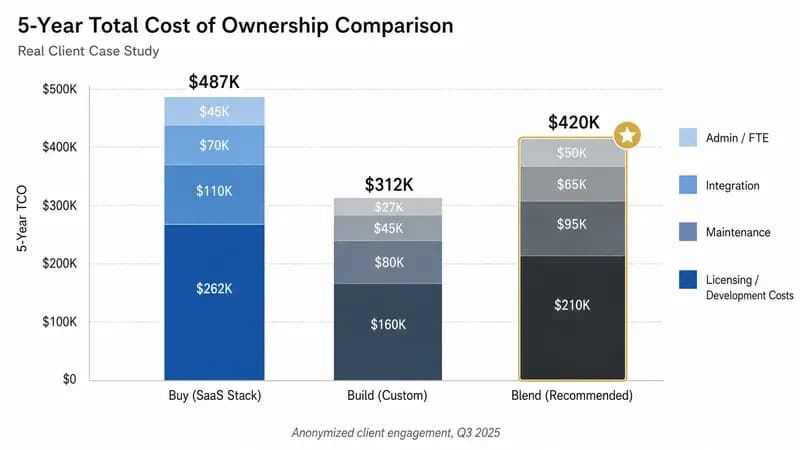
Worked Example: We Helped a $50M SaaS Client Decide, $487K Salesforce Stack vs $312K Custom Build
In Q3 2025 a $50M-ARR B2B SaaS client asked us whether to expand their existing Salesforce + Tableau + Outreach stack (estimated $487K 5-year TCO) or build a custom revenue-ops platform on Next.js + Postgres + their own pipeline tooling (estimated $312K 5-year TCO). Here is the actual line-item math we walked them through, why the $312K "cheaper" option was the wrong call for them, and what they shipped instead.
The headline question looked binary: keep paying SaaS premiums or build something cheaper. The line items told a different story.
| Line item | Buy (SaaS stack) | Build (Custom RevOps) |
|---|---|---|
| Salesforce Sales Cloud Enterprise (60 seats × $165/mo × 5yr, post-negotiation) | $340K | , |
| Tableau Creator (20 seats × $75/mo × 5yr) | $90K | , |
| Outreach.io (40 seats × $120/mo × 5yr) | $288K (list) → ~$57K net incremental | , |
| Admin FTE allocation (1.5 FTE × 5yr) | included | , |
| 2 senior engineers ($230K fully-loaded each) × 6 months upfront | , | $230K |
| 0.5 FTE maintenance × 5 years (at 15% utilization) | , | $57K |
| Vercel + Neon + Linear infra (5yr) | , | $30K |
| 5-year total | ~$487K | ~$312K |
On paper, build won by $175K. The recommendation went the other way.
Why the "cheaper" custom build was wrong for them: they didn't have a senior engineering bench that could absorb 0.5 FTE of maintenance indefinitely. The engineering org was already shipping the core product. Allocating 10–15% of senior capacity to revenue-ops maintenance for the next five years meant either slowing the product roadmap or hiring (which would push the real Build TCO past $800K once you factor in actual hires at market rate, not absorbed capacity). The "cheap" number assumed free engineers. Engineers are never free.
What we actually shipped: a Blend. Keep Salesforce as the system of record. Build a thin custom revenue-ops layer ($85K upfront, near-zero ongoing) for the 4 workflows Salesforce couldn't model cleanly. Net 5-year TCO landed at ~$420K, between the two headline numbers, and they got the workflows they actually needed. Shipped in 11 weeks, no new hires, no roadmap slip.
18 months later: the custom layer is still in production, Salesforce renewals went through without drama, and the engineering team didn't have to context-switch back into RevOps maintenance after the initial build. Net call: the Blend was the right answer because it respected the engineering-bench constraint that the Build math had ignored.
Numbers anonymized and rounded per our consulting agreement. Costs assume 2025–2030 window. Salesforce pricing reflects post-Aug-2025 list increases. AI coding agent productivity gains (Q3 2025 baseline) already baked into the $312K engineering estimate. Engineering fully-loaded at $230K = US-coast median per BLS 2024 + 30% benefits + 25% overhead, adjust ±30% for your geo. We are an engineering agency. This was a real recommendation against our own commercial interest.
How AI Has Changed the Build vs Buy Math in 2026
The crossover point moved. AI coding agents have compressed senior-engineering hours per feature by 40–60% in our internal measurements across client work in 2026. That means a build estimate you ran in 2023 is materially wrong now. Gartner projects that 75% of enterprise software engineers will use AI code assistants by 2028, up from 10% in 2023, and our pipeline data already reflects most of that adoption ahead of schedule.
Three concrete shifts:
- 18-month custom builds now ship in 6–8 months when scope is held constant. The case-study Blend above shipped in 11 weeks; the same scope in 2023 would have run 18–20 weeks.
- Team size for internal tools dropped. We routinely run 2-engineer pods for builds that needed 5 engineers two years ago, because AI coding agents like Cursor and Claude Code absorb the boilerplate that used to soak mid-level capacity.
- The case-study client's $312K build estimate was roughly 30% lower than the same estimate would have been in 2023, before AI-native enterprise software development became the default working mode.
Honest counterpoint: AI cuts build cost, but it also cuts the cost SaaS vendors pay to ship features. Vendor pricing pressure is real, some SaaS prices will come down, and the crossover-point shift isn't entirely one-sided. The directional effect still favors build (especially Blend), because in-house engineering throughput compounds with AI faster than vendor pricing does.
Common Decision Traps (False Economy, Sunk Cost, NIH Syndrome, Vendor Optimism)
Four traps we see derail the call repeatedly:
- False economy. Picking the cheaper Year 1 number while ignoring 5-year TCO. The case study above almost went this way. Year-1 sticker price is the smallest part of the bill on every path.
- Sunk cost. Staying on a SaaS you've outgrown because the migration looks expensive. The migration is usually cheaper than another 3 years of the wrong tool. Compute it.
- NIH (Not Invented Here) syndrome. Building things that should be bought because the engineering team finds the problem interesting. A CRM is not interesting. A payment processor is not interesting. Buy them.
- Vendor optimism. Believing every line of the vendor demo will work in your environment without integration tax. The demo is the best case. Your case is harder. Discount the demo by 30% before you compare.
The most expensive mistake we see: picking the cheaper Year 1 number and ignoring the 5-year escape cost.
How Techsy Approaches Build-vs-Buy Assessments
Techsy ships custom enterprise platforms, integrates SaaS into existing stacks, and does technical due diligence on COTS evaluations for B2B clients. The work splits roughly 40/30/30 across those three.
A Techsy build-vs-buy assessment runs like this: one-hour discovery call to scope the workflow, we run the 12-point rubric live with you on a shared spreadsheet, we ship a TCO model in one week, and we send a written recommendation that may say "buy SaaS, don't hire us." Our last 3 assessments: 1 recommended build, 1 recommended buy, 1 recommended blend. We don't have a quota. If you're thinking bigger picture about broader enterprise AI transformation, the assessment is usually the right starting point. Book a free 30-min build-vs-buy assessment.
Frequently Asked Questions
What is the difference between build, buy, and partner in software?
Buy means licensing existing SaaS or COTS software. Build means developing custom software in-house with your own engineers. Partner means hiring an agency or contractor to build proprietary software you own. Gartner reframes this as Buy/Build/Blend, where Blend combines licensed COTS for commodity workflows with custom code for differentiated ones, which now covers 76% of enterprise software spend.
When should you build software instead of buying?
Build when three conditions hold: the capability is a competitive differentiator customers buy you for, you have a senior engineering bench that can own it for 5+ years without slowing your roadmap, and 5-year SaaS TCO at your user count exceeds custom-build TCO by at least 2x. If any of the three is missing, blend or buy almost always wins on honest math.
When is buying SaaS cheaper than building custom software over 5 years?
Buying wins on TCO when you have fewer than ~100 users on the workflow, the capability is commoditized (CRM, email, accounting, observability), and you need it live in under 90 days. Below those thresholds the SaaS subscription, even with annual price increases, lands lower than fully-loaded engineering plus maintenance plus infrastructure plus opportunity cost.
What does Gartner say about build vs buy?
Gartner rejects the binary framing and uses a three-way Buy/Build/Blend model. Their data shows 76% of enterprise software spend now flows into blended stacks (licensed COTS plus custom extensions), not pure-build or pure-buy. Gartner also reports that enterprises miss 50–70% of true TCO in initial calculations, mostly on integration, admin FTE allocation, and escape cost line items.
Is build vs buy dead?
The binary framing is dead. The three-way decision is not. Calling the question "build vs buy" obscures the fact that most enterprises end up blending: SaaS for commodity workflows, custom for the differentiated ones, glue between them. The decision is alive and harder than it looks, because you're now picking the split point, not picking one side. Frame it as Buy/Build/Blend and the math gets cleaner.
How does AI coding (Cursor, Claude Code) change the build vs buy math in 2026?
AI coding agents like Cursor and Claude Code cut senior-engineering hours per feature by 40–60% in our 2026 measurements across client builds. That moves the crossover point: builds that didn't pencil out in 2023 do now. Gartner projects 75% of enterprise software engineers will use AI code assistants by 2028, so this shift is durable, not temporary. 18-month builds now routinely ship in 6–8 months.
What is the typical maintenance cost of custom enterprise software per year?
The industry rule of thumb is 15–20% of the initial build cost per year, ongoing. A $300K custom platform should budget $45K, $60K annually for maintenance (bug fixes, dependency updates, security patches, small enhancements). This excludes major feature work, which is treated as new build. Underbudgeting maintenance is the single most common mistake in custom-build TCO models.
What are the hidden costs of buying enterprise SaaS?
The six hidden costs most demos skip: vendor lock-in (6–18 months to switch), customization and change-request fees ($200–500/hr), per-seat creep at 7–15% per year as your org grows, integration costs ($20K, $100K per connected system), escape and migration cost (3–6 engineering months), and annual price increases at 7–15% regardless of usage. The Year 1 license fee is rarely more than 30–40% of true 5-year cost.
What is total cost of ownership (TCO) for software?
TCO is the full 5-year cost of a software path including licensing or development, implementation, training, integration, ongoing maintenance, admin FTE allocation, opportunity cost, and escape/migration cost when you eventually leave. Gartner research shows enterprises typically miss 50–70% of true TCO in initial calculations. Compute it before you commit, not after.
How big does a company need to be to justify building custom enterprise software?
Rough rule: ~$10M+ ARR or ~50+ users on the specific workflow. Below that threshold the SaaS subscription almost always wins because you can't amortize engineering and maintenance over enough usage. Above it, the math starts favoring build or blend, especially when the workflow is core to your competitive position. AI coding agents in 2026 nudge that threshold down by 20–30% vs the 2023 baseline.
Conclusion
If you remember one thing from this post: name the bias of every framework you read before you trust the recommendation. Vendors give vendor advice. Agencies give agency advice. Your CFO gives CFO advice. Read three, find the overlap, and trust that.
- Run the 12-point rubric live in a meeting. It cuts the debate from two hours to twenty minutes.
- Compute 5-year TCO honestly. Year 1 sticker price is never the answer.
- Default to Blend if your score lands 30–45. Most enterprises end up here anyway.
If you want a second pair of eyes on the call, book a free 30-min build-vs-buy assessment. We'll tell you to buy SaaS if that's the right call. It's happened. It'll happen again.