ElevenLabs vs Vapi vs Synthflow (2026): We Built the Same Agent on All Three
The ElevenLabs vs Vapi vs Synthflow question trips people up because these three aren't the same kind of tool. Synthflow got our test agent answering a real phone number in about 50 minutes. Vapi took most of an afternoon. ElevenLabs landed somewhere in between, and its eleven_flash_v2_5 voice was the only one a colleague mistook for a human on first listen. Three platforms, three jobs: voice quality, developer control, and no-code speed. Here's how to pick the one your team should actually use.
Pick in 30 Seconds: A Decision Tree
Skip the spec sheets for a moment. The fastest way to choose is to answer one question: who's building this, and what are they optimizing for?
- Your team has no engineers, and you need a working agent this week. Pick Synthflow. It's a drag-and-drop builder with telephony already wired in. No API keys, no Twilio account, no code. You'll trade some control and pay more per minute, but you'll be live by lunch.
- You have developers and you want to own every part of the stack. Pick Vapi. It's an orchestration layer that exposes every knob: which language model, which voice provider, which speech-to-text engine, how endpointing and interruptions behave. More work up front, far more control after.
- Voice quality is the whole point and a caller should never guess they're talking to AI. Pick ElevenLabs Conversational AI. Premium support lines, concierge experiences, brand-forward phone presence. The voices are the benchmark every other platform compares itself against.
Most teams land cleanly in one branch. If you're torn between two, the tiebreaker is almost always team capability, not features. A marketing team that picks Vapi will stall; an engineering team that picks Synthflow will hit the no-code ceiling and resent it.
If you've not yet decided whether to use a platform at all, read our build vs buy decision first, then come back here.
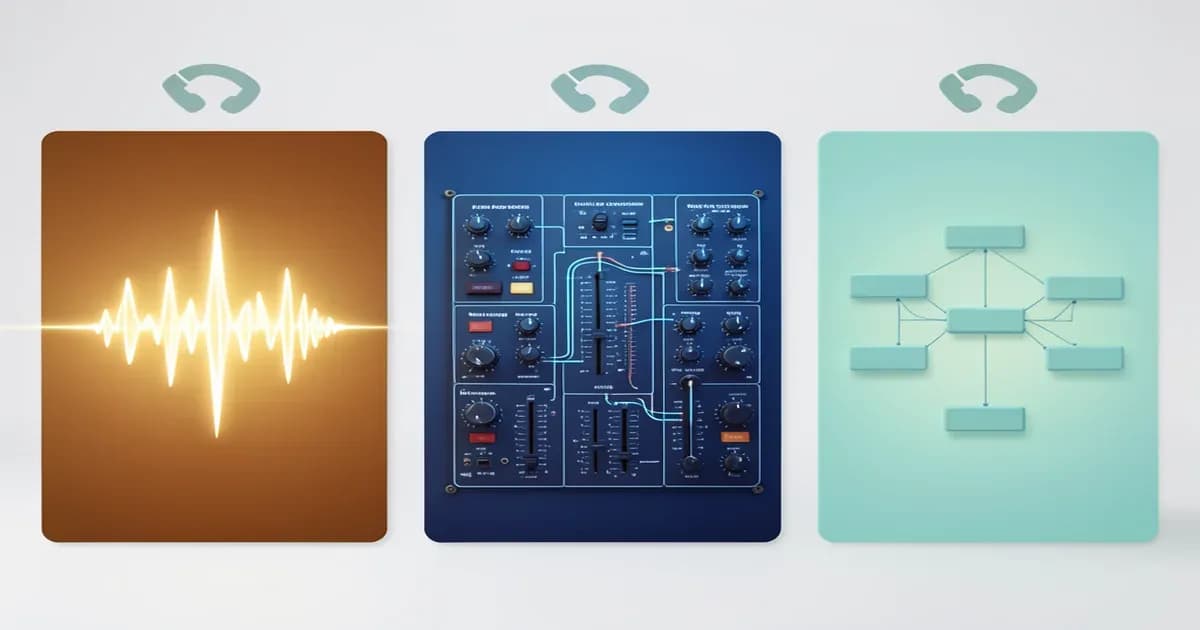
Three Tools, Three Layers of the Stack
Here's the thing nobody tells you in a verdict table: these products don't all live at the same level. They stack.
ElevenLabs started as the best text-to-speech engine on the internet and grew up into a full agent platform. Its core asset is still the voice. So good, in fact, that Vapi and Synthflow both let you use ElevenLabs voices inside their own agents. The voice layer and the orchestration layer aren't always rivals; sometimes they're partners.
Vapi is the orchestration layer. It doesn't make voices or language models; it wires them together in real time and handles the hard parts of a live call: detecting when the caller stopped talking, letting them interrupt, filling silence, routing to the right model. You bring the pieces; Vapi conducts.
Synthflow wraps that same orchestration job in a no-code interface and bundles the pieces for you. You don't see the model choice or the telephony plumbing; you drag boxes around a canvas. The trade is simple: less to assemble, less to control.
So when someone asks "ElevenLabs or Vapi?", the honest answer is sometimes "both", ElevenLabs for the voice, Vapi to run the call. The comparison below treats each as a primary platform, which is how most teams use them, but keep the layering in mind. For a deeper primer on the category itself, see what an AI voice agent is.
What Happened When We Built the Same Agent on All Three
We wanted a fair test, so we built the identical agent three times: an outbound lead-qualification caller for a B2B SaaS demo funnel. Same script, same four qualifying questions (budget, timeline, team size, decision-maker), same handoff to a calendar booking. Then we measured what actually mattered to us.
Synthflow was first to a live call by a wide margin. From signup to a real phone number answering our four questions: about 50 minutes, almost entirely spent writing the prompt and clicking through the flow builder. Telephony was already there. No keys to paste.
ElevenLabs Agents took us roughly 2 hours. Configuring the agent and connecting an LLM was straightforward, and the moment the eleven_flash_v2_5 voice spoke, the difference was obvious, natural pauses, a breath before a long answer. A teammate listening in genuinely asked whether we'd hired someone.
Vapi took most of an afternoon, we ran GPT-4o-mini for the brain, Deepgram Nova for speech-to-text, and a Flash-tier voice, then tuned endpointing so the agent stopped cutting people off. That tuning is the cost of control. Once dialed in, it felt the most configurable, and we could see exactly where every millisecond went.
On felt latency, ElevenLabs was the snappiest in clean conditions (its Flash voice targets ~75ms first-chunk latency). Vapi was close once tuned but drifted under load. Synthflow was fine for our structured call but the least adjustable when a caller went off-script.
| Synthflow | Vapi | ElevenLabs Agents | |
|---|---|---|---|
| Time to first live call | ~50 min | ~half a day | ~2 hours |
| Who it's built for | Non-technical teams | Developers | Brand/voice-critical teams |
| Control over the stack | Low (bundled) | Maximum (BYO everything) | Medium |
| Felt latency | Adequate | Low once tuned | Lowest in clean conditions |
| Per-minute cost shape | Highest | Lowest base + add-ons | Mid + separate LLM |
| No-code? | Yes | No | Partly |
The takeaway from our build: the platforms aren't better or worse than each other. They're better or worse for a specific team. That's the entire decision.
ElevenLabs Conversational AI: The Voice-Quality Play
ElevenLabs wins voice naturalness outright, and it isn't close. The voices carry emotional inflection, natural pauses, and breathing, across 70+ languages with native-quality accents. If your caller experience is the product, premium support, concierge, a brand that lives or dies on how it sounds, this is the one.
It's also no longer "just TTS." ElevenLabs Agents is a full conversational platform now: you build the agent, connect a language model, and run live calls. The eleven_flash_v2_5 model targets roughly 75ms first-chunk latency, which is why responses feel immediate.
On pricing, agent calls run about $0.08/minute on included plans, with additional minutes around $0.003 and burst usage at $0.16, per the official ElevenLabs Agents pricing. One catch worth circling: LLM cost is billed separately on top of the voice minutes, so your real per-call number depends on which model you connect.
Where it's not the answer: ElevenLabs' agent orchestration is younger than Vapi's. For deep multi-step tool flows or fine-grained telephony control, it can feel less mature, which is exactly why some teams use ElevenLabs voices inside another orchestrator rather than as the primary platform.
Vapi: Maximum Control for Developers
Vapi is the platform serious voice-engineering teams end up on. It exposes everything behind a clean API: model choice (GPT, Claude, Gemini, Groq), voice provider (ElevenLabs, Cartesia, Deepgram, PlayHT), telephony, and latency tuning. The features that make a call feel human, endpointing, interrupt detection, backchanneling, noise filtering, are all there as settings you control.
Its standout is Squads: chaining multiple specialized agents inside one call, so a single phone session can hand off from a qualifier to a scheduler to a support bot. Add function calling and knowledge-base RAG, and you can build genuinely complex logic.
Pricing is a $0.05/minute platform orchestration fee plus pass-through for the third-party pieces you choose, per Vapi's pricing. All-in, most teams land between $0.07 and $0.25/minute; a fully loaded stack can reach $0.30+. You get 1,000 free minutes a month to prototype.
Where it's not the answer: you own the whole stack. There's no hand-holding, and a non-technical team will stall on the first telephony config. If you want Vapi compared against its closest direct rivals instead of these three, read our Retell and Bland comparison, and if you'd rather skip the platform entirely, you can roll your own with the OpenAI Realtime API.
Synthflow: No-Code Speed for Non-Technical Teams
Synthflow is what you pick when your team has no engineers but still wants a production-grade agent. The flow designer is visual and forgiving, telephony is included (no Twilio config, no API keys), and pre-built templates cover the common jobs: booking, qualification, support. Our 50-minute build was almost all prompt-writing.
For an agency, a clinic, or an SMB that needs structured call types live this week, that speed is the entire value proposition. You don't manage a stack; you manage a conversation.
The honest cost story: Synthflow is the most expensive per minute of the three, roughly 2-6x what Vapi or Retell charge. And because it uses BYOK (bring your own keys) for the AI providers, the real cost often lands around 2-3x the advertised rate once you add model usage. Plans have moved toward pay-as-you-go from older tiers like Starter and Growth, per Synthflow's own pricing.
Where it's not the answer: the moment your call logic outgrows templates and branches, you'll hit the no-code ceiling fast, and the per-minute cost makes high-volume deployments pricey. At that point you're better off on Vapi.
How They Compare on Price (Without the Full Teardown)
We won't re-derive the full per-minute economics here; we already did that in our full per-minute cost math. What matters for this decision is the cost shape:
- Vapi has the lowest base ($0.05/min) but you add telephony, STT, TTS, and LLM on top, so your number depends on your choices.
- ElevenLabs sits in the middle on voice (~$0.08/min) but bills LLM separately, so budget for both lines.
- Synthflow has the highest sticker per minute, and BYOK pushes the real cost higher still.
The rule of thumb: at low volume, Synthflow's bundled simplicity can be worth the premium. At high volume, that premium compounds, and Vapi's lower base wins on raw cost, assuming you have the team to run it.
When NOT to Pick Each One
The fastest way to a bad choice is picking on features instead of fit. Our anti-recommendations:
- Don't pick Synthflow if you have engineers and high call volume, or if your call logic is complex and non-templated. You'll pay a premium for limits you don't need.
- Don't pick Vapi if your team can't write or maintain code. The control that makes it great is dead weight without someone to wield it.
- Don't pick ElevenLabs as your primary if you need deep orchestration today and voice quality is secondary, you may be paying for naturalness you don't strictly need while wanting orchestration it's still maturing on.
Notice the pattern: every "don't" is about team capability and use case, not about the product being bad. All three are good. Fit is the variable.
How Techsy Approaches Voice-Agent Platform Selection
When a client asks us to pick, we don't start with the platform. We start with their team and their call. We map who will maintain the agent (engineers or operators?), the call complexity (structured script or open-ended?), the voice sensitivity (commodity or brand-defining?), and the volume. Only then do we match: operators plus structured calls usually means Synthflow; engineers plus complex logic means Vapi; a brand line where the voice is the product means ElevenLabs, often piped through Vapi for orchestration.
We've shipped voice agents across all three for B2B clients, and the wrong-platform regret we see most is non-technical teams who bought a developer tool. If you want a second opinion before you commit, we're an AI voice agent development partner and you can get a free consultation.
The Bottom Line
- These three sit at different layers, voice quality (ElevenLabs), orchestration control (Vapi), no-code speed (Synthflow), so the right pick depends on your team, not a leaderboard.
- Synthflow gets non-technical teams live fastest (we hit ~50 minutes) but costs the most per minute.
- Vapi gives developers maximum control at the lowest base rate, with the most assembly required.
- ElevenLabs owns voice naturalness and is now a full agent platform; budget for LLM cost separately.
- Pick on fit. If you're still unsure, talk to us, we'll point you to the right one even if it isn't the one we'd build on.
Frequently Asked Questions
Is ElevenLabs a full voice agent platform now, or just text-to-speech?
It's both. ElevenLabs began as a text-to-speech engine and now offers ElevenLabs Agents, a full conversational platform where you build an agent, connect a language model, and run live calls. The voice quality remains its strongest asset and the reason many teams choose it.
Can you use ElevenLabs voices inside Vapi or Synthflow?
Yes. Both Vapi and Synthflow let you select ElevenLabs as the voice provider for an agent they orchestrate. That's why the "ElevenLabs vs Vapi" framing is sometimes misleading, many production setups use ElevenLabs for the voice and Vapi to run the call.
Why is Synthflow more expensive per minute?
Synthflow bundles telephony and a no-code builder into one product, and that convenience carries a premium, roughly 2-6x the per-minute rate of Vapi or Retell. Because it uses BYOK for AI providers, your real cost often lands around 2-3x the advertised rate.
Which platform is best for no-code voice agents?
Synthflow. Its drag-and-drop flow designer, included telephony, and pre-built templates get a non-technical team from signup to a live call in about an hour, with no API keys or code required. Vapi and ElevenLabs both expect more technical setup.
Which has the lowest latency?
ElevenLabs in clean conditions, its eleven_flash_v2_5 model targets roughly 75ms first-chunk latency. Vapi can get close once you tune endpointing and pick a fast stack, but measured production latency drifts higher under concurrency.
Is Vapi worth it for a non-developer?
Usually not. Vapi's value is the control it exposes, model choice, voice provider, telephony, latency tuning, and that control assumes someone can write and maintain code. A non-technical team is better served by Synthflow's no-code builder.
How does this compare to Retell vs Vapi vs Bland?
That's a different triangle. Retell, Vapi, and Bland are three direct orchestration rivals; ElevenLabs, Vapi, and Synthflow span three layers of the stack. For the Bland and Retell angle specifically, see our Retell vs Vapi vs Bland comparison.
Which is cheapest at scale?
Vapi, in most cases, because its base is only $0.05/minute and you control the third-party pieces. The catch is you need a team to assemble and maintain that stack. Synthflow's premium compounds at high volume, making it the priciest at scale.
How much voice traffic do I need before Vapi beats Synthflow on cost?
There's no fixed line, but the trade flips as volume grows: at a few hundred minutes a month, Synthflow's bundled simplicity often justifies the premium; at thousands of minutes, Vapi's lower base and your provider choices usually win. Model the breakeven against your actual call volume.