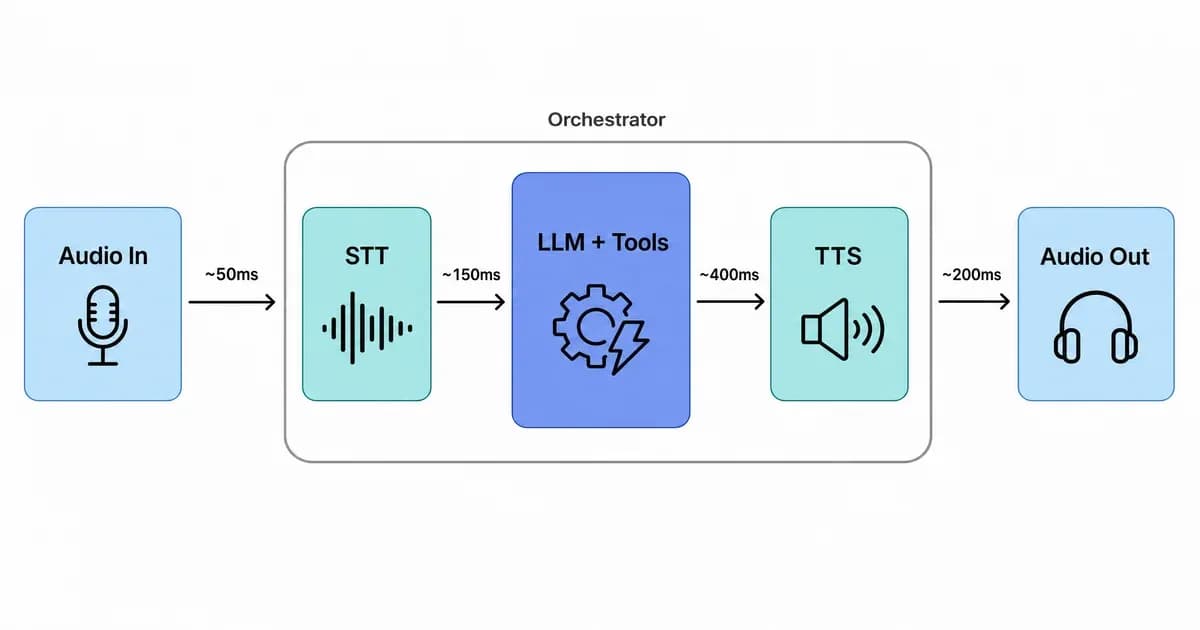
What Is an AI Voice Agent? The 5-Layer Stack Behind Every Real Phone Call (2026)
An AI voice agent is software that holds a live, spoken conversation, over the phone, in a browser, or inside an app, by stitching together speech recognition, a language model, and synthesized voice. If you've called a bank lately and the "press 1 for billing" robot suddenly started answering follow-up questions like a person, that's a voice agent, not the old IVR. We've shipped voice agents on Retell, Vapi, and OpenAI Realtime over the last 18 months, so the framing here is from hands-on builds, not vendor marketing.
Quick Answer:
- An AI voice agent is software that holds a real-time phone or web conversation using STT, an LLM, and TTS.
- It differs from IVR (no menu trees), chatbots (text-only), and voice assistants (single-turn commands).
- Real-time feel requires staying under a ~700ms response budget across speech-to-text, LLM, and text-to-speech combined.
- Most production voice agents in 2026 are built on streaming pipelines like OpenAI Realtime, Deepgram Voice Agent, Retell, or Vapi.
What Is an AI Voice Agent?
An AI voice agent is software that has a real-time spoken conversation with a person. It listens to audio, converts speech into text using speech-to-text (STT), sends that text to a large language model (LLM) that decides what to say and which tools to call, then turns the reply back into audio with text-to-speech (TTS). The whole loop runs continuously, with turn-taking, interruption handling, and the ability to fire off real API calls mid-conversation.
That last part is where voice agents earn their name. They don't just talk, they do things. Picture this: you call to reschedule an appointment. The agent says, "Sure, what day works?" You answer. It pings your calendar API, finds open slots, reads them back, books the one you pick, and texts you the confirmation. That's four tool calls inside one 90-second call.
The four core capabilities to lock in:
- Listen in real time, partial transcripts arrive while you're still speaking, not after you stop.
- Understand intent, the LLM parses what you actually want, not just keywords.
- Respond in voice, natural prosody, pauses, and the ability to be interrupted mid-sentence.
- Take actions, function calls to your CRM, calendar, booking system, or anything with an API.
An AI voice agent isn't a chatbot with a microphone, it's a real-time pipeline that has to listen, think, and speak inside the time a human waits before getting uncomfortable. Which is shockingly short. More on that in a minute.
How AI Voice Agents Actually Work: The 5-Layer Stack
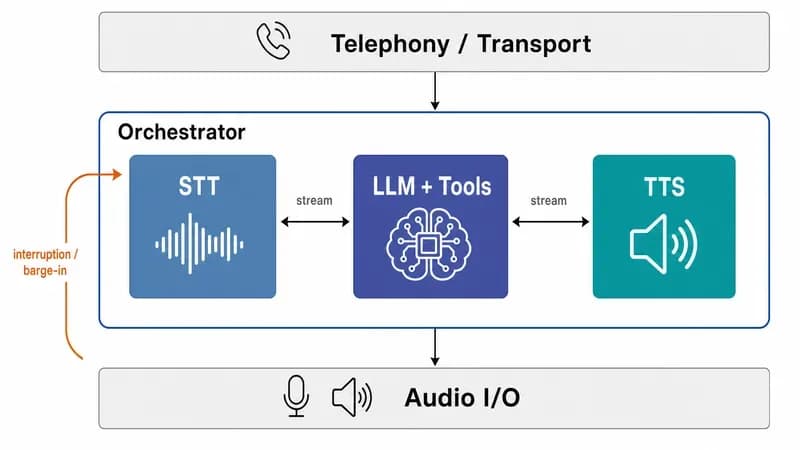
A production AI voice agent runs on five layers: telephony moves audio in and out, STT turns speech into text, an LLM with tool calling decides the response and any actions, TTS turns the reply back into voice, and an orchestrator conducts the whole pipeline, handling turn-taking, streaming, interruption, and state. Each layer is a separate model or service, racing against a 700ms clock.
Here's each layer, in the order audio flows:
- Telephony / transport, Twilio, Telnyx, SIP trunks, or WebRTC. This is the boring-but-critical layer that gets a phone call (or browser audio) into your stack and back out to the caller. Bad codec choice or a noisy SIP route, and the rest of your beautiful pipeline sounds like a 2007 Skype call.
- Speech-to-text (STT / ASR), Deepgram Nova-3, AssemblyAI Universal-2, OpenAI Whisper, NVIDIA Canary Qwen 2.5B, Kimi-Audio. These turn the streaming audio into text while the user is still speaking. The hard part isn't transcription accuracy, it's endpointing (deciding when the user finished their thought).
- LLM + tool calling, GPT-4o, Claude 4, Gemini 2.0. Same models you use everywhere else, now with a tighter latency budget and structured function-calling schemas pointed at your CRM lookup, your booking API, and your "transfer to human" tool. The orchestrator picks which one to call based on the conversation.
- Text-to-speech (TTS), ElevenLabs Flash, Cartesia Sonic, OpenAI TTS, Deepgram Aura. The reply text streams in token-by-token; TTS synthesizes audio in chunks so the voice starts playing before the LLM finishes its sentence.
- Orchestrator, Retell, Vapi, Bland, LiveKit Agents, OpenAI Realtime, or open-source Pipecat. The conductor that streams between the four layers, handles barge-in (you talking over the agent), recovers from errors, and keeps conversation state. If you want a head-to-head on which orchestrator platform fits best, the comparison spoke covers that.
A voice agent is not one model, it's five components racing against a 700ms clock.
There are two architectural flavors worth knowing: cascading (the 5-layer pipeline above, where STT → LLM → TTS are separate models) and end-to-end speech-to-speech (one model handles audio in and audio out, like the OpenAI Realtime API). End-to-end is faster and more natural; cascading is more controllable and cheaper. Most production stacks in 2026 are still cascading.
What Does "Streaming" Actually Mean Here?
Streaming is the unlock. STT emits partial transcripts every few hundred milliseconds, the LLM streams tokens as it generates them, and TTS synthesizes audio chunk-by-chunk that's cancelable if the user interrupts. The result feels like a conversation; without streaming, it feels like two-way radio.
Here's an illustrative agent config (Retell / Vapi-style, exact syntax differs by platform):
{
  "voice": { "provider": "cartesia", "voice_id": "sonic-en-female" },
  "stt": { "provider": "deepgram", "model": "nova-3", "language": "en" },
  "llm": { "provider": "openai", "model": "gpt-4o", "temperature": 0.3 },
  "tools": [
    { "name": "lookup_order", "url": "https://api.example.com/orders" },
    { "name": "book_slot", "url": "https://api.example.com/calendar/book" },
    { "name": "transfer_to_human" }
  ],
  "interruption_sensitivity": 0.7,
  "endpointing_ms": 400
}
The 500-700ms Latency Budget (And Why You Feel It)
Humans expect a reply within roughly 600-700 milliseconds in natural conversation. Stretch that to over a second and the call feels like a bad cell connection; past 1.2 seconds, users start talking over the agent or hanging up. That's why voice agent architecture is fundamentally a latency problem, not an intelligence problem.
The budget breakdown in a healthy stack looks like this:
| Layer | Typical latency | Notes |
|---|---|---|
| Telephony / network | 50-200 ms | depends on SIP route, WebRTC quality |
| Speech-to-text (streaming) | 100-500 ms | endpointing dominates |
| LLM time-to-first-token | 200-2,000 ms | the wildcard |
| Text-to-speech time-to-first-audio | 75-800 ms | streaming TTS is the unlock |
| End-to-end realistic target | 600-1,200 ms | >1,200 ms is where users start hanging up |
"Where the 700ms voice agent budget gets spent"
Data table
| "Milliseconds" | "Low end" | "High end" |
|---|---|---|
| "Telephony / network" | 50 | 200 |
| "Speech-to-text" | 100 | 500 |
| "LLM time-to-first-token" | 200 | 2000 |
| "Text-to-speech" | 75 | 800 |
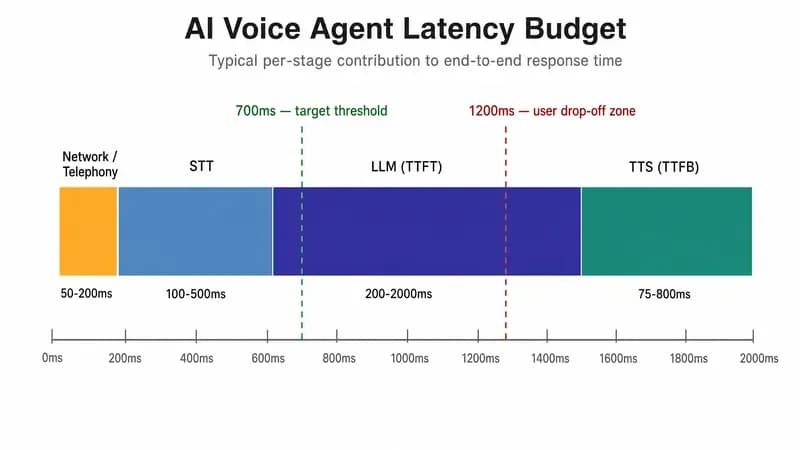
In our builds, the LLM time-to-first-token is the single biggest variable, we've seen it swing from 200ms (GPT-4o on a good day) to 2 full seconds (longer context window, cold model). That's also where most of your per-minute cost lives, which is why the real per-minute cost breakdown of running this stack is its own deep-dive.
Two other things eat your budget quietly. Endpointing is when STT decides the user is done talking, set it too aggressive and the agent interrupts you; too lax and it sits there awkwardly. Barge-in handling requires TTS chunks to be cancelable mid-playback, otherwise the agent keeps talking over you. Both are orchestrator-level concerns.
If your stack takes more than 1.2 seconds to reply, your users are already deciding you're broken.
AI Voice Agent vs IVR vs Chatbot vs Voice Assistant
These four get confused constantly. An AI voice agent has open-ended, real-time voice conversations with tool use. IVR is a linear phone menu. A chatbot is text-only. A voice assistant like Alexa or Siri handles short, single-turn voice commands. The differences come down to input modality, intelligence, real-time-ness, and what each one replaces.
| Attribute | AI Voice Agent | IVR | Chatbot | Voice Assistant |
|---|---|---|---|---|
| Input modality | Real-time voice (open-ended) | Voice menu or DTMF keypad | Text only | Voice (single-turn commands) |
| Understanding | LLM + NLU + tools | Keyword/menu matching | LLM or rules | NLU, intent-bounded |
| Output | Streaming TTS, natural prosody | Pre-recorded prompts | Text | Short voice replies |
| Real-time conversation | Yes | No (linear menu) | Yes (text) | Yes (single turn) |
| Tool / API calls | Yes (function calling) | Limited (DTMF routing) | Yes | Limited (skills/intents) |
| Replaces | Phone agents on bounded calls | Phone trees | Live chat tier-1 | "Hey [name]" device commands |
| Typical resolution rate | 40-80% (use-case dependent) | 10-25% | 30-60% (text) | High for single commands |
| Failure mode | Hallucination, latency stall | Dead-end menu loops | Misroute, text fatigue | Out-of-domain "I don't know" |
The real distinction: voice agents are the only one of the four that does real-time, open-ended, multi-turn voice with tool use. IVR is a menu. A chatbot is a text window. A voice assistant answers commands. A voice agent has a conversation.
So Is Alexa an AI Voice Agent?
No. Voice assistants like Alexa, Siri, and Google Assistant are single-turn, walled-garden command engines. They're optimized for "set a 10-minute timer," not "negotiate a delivery window with my contractor while looking up my order history." Different problem, different stack.
What AI Voice Agents Are Used For
Voice agents earn their keep on four high-volume call categories: inbound support (FAQ deflection, order lookup, password resets), outbound sales and qualification (appointment-setting, lead qualification, list cleanup), appointment scheduling (calendar lookups, rescheduling, confirmations), and surveys and follow-ups (NPS calls, churn-rescue, feedback collection). The pattern is the same: high call volume, narrow intent range, tool-driven resolution.
Inbound support. This is the easiest win. Agents answer the same 20 questions all day, look up an order status, reset a password, and route the genuinely hard stuff to a human. The math works because tier-1 calls are 60-80% of inbound volume in most contact centers, per McKinsey's contact-center automation data.
Outbound sales and qualification. Appointment-setting, lead qualification, and list cleanup. This is where compliance gets sticky, outbound voice in the US triggers TCPA (consent rules), A2P 10DLC (SMS bridges), and STIR/SHAKEN (caller-ID attestation). Not a place to ship fast and break things. If you're curious about the wider voice + video AI tool landscape, there's an adjacent guide.
Appointment scheduling. Probably the cleanest use case. The agent reads your Cal.com or Acuity calendar via a tool call, offers the next three slots, books one, sends a confirmation. Healthcare, salons, dental, auto repair, anywhere bookings happen by phone. If you run a restaurant, here's how it plays out in that specific vertical, reservations, cancellations, and waitlist on the same agent.
Surveys and post-call follow-up. Outbound NPS calls, feedback collection, churn-rescue. Lower stakes, lower compliance bar (existing-customer relationship usually covers consent), and easy to measure success.
Can It Actually Replace My Support Team?
Short answer: no, and anyone selling you that is selling vapor. Voice agents don't replace your team, they catch the 60-80% of calls that don't need a human, so the humans can do the work that actually does.
What AI Voice Agents Are NOT (4 Misconceptions That Tank Projects)
Most failed voice agent projects fail because of one of four wrong assumptions: that it's just a chatbot with a microphone, that the LLM is magic, that it's automatically cheaper than humans, or that it'll replace your whole team. Each of these breaks the project at a different stage, architecture, expectation-setting, ROI math, or change management. Let's reset each one.
Misconception 1: It's a Chatbot With a Microphone
Real-time audio is a different engineering discipline. Endpointing, barge-in, prosody, streaming buffer management, and SIP-quality jitter handling don't exist in chatbot-land. A team that ships a working text chatbot in two weeks will spend two months getting a voice agent to feel natural. Treating a voice agent like a chatbot with a microphone is the fastest way to ship something users hang up on.
Misconception 2: It's Magic
It's not. It's GPT-4o (or Claude, or Gemini) wrapped in voice plumbing. The same hallucinations, the same context-window limits, the same prompt-injection risks, now in audio form, which is harder to log and review. The "magic" is in the engineering glue, not the model.
Misconception 3: It's Always Cheaper Than Humans
At very low call volumes, say, under 500 calls a month, the per-minute cost plus setup investment usually exceeds the cost of a part-time human or a good chatbot. The TCO math only works at volume. If you're sizing this for your business, whether it's even the right move for your business walks through Year-1 economics with real numbers.
Misconception 4: It Replaces Your Whole Team
It doesn't. It's a deflection layer for tier-1 traffic. The humans you keep handle the escalations, the angry callers, the complex cases, and the situations where empathy and judgment matter. Plan for that org structure from day one or you'll end up with a stack that works and a team that's miserable.
When NOT to Deploy an AI Voice Agent (Honest Limits)
There are five scenarios where a voice agent is the wrong tool: emotional or sensitive calls (bereavement, medical bad news, crisis lines), low call volume (under ~500 calls/month where setup TCO exceeds savings), heavily regulated workflows without compliance maturity, multi-accent or low-resource language operations, and any workflow that genuinely needs visual context. Ship into the wrong one and you'll set the project back six months.
1. Emotional, sensitive, or high-stakes calls. Bereavement notifications, medical bad-news delivery, crisis hotlines, mental-health intake. Even state-of-the-art TTS prosody isn't there yet, and the brand cost of one bad call here is enormous. Humans only.
2. Sub-500-calls-per-month volume. Setup, configuration, prompt-tuning, and per-minute costs typically don't pencil out below a few hundred calls a month. Use a human, use a chatbot, or revisit at higher volume. If you're weighing options, should you build, buy SaaS, or hire an agency breaks down the decision.
3. Heavily regulated workflows without compliance bandwidth. Outbound voice in the US falls under TCPA (consent), A2P 10DLC (SMS bridges), and STIR/SHAKEN / ATIS-1000074 (caller-ID attestation). Healthcare adds HIPAA, EU calls add GDPR. If you don't have legal and compliance resources, don't ship outbound voice yet.
4. Multi-accent or low-resource language operations. STT word-error-rate (WER) spikes above 15% on non-mainstream accents and many low-resource languages, per the Hugging Face Open ASR Leaderboard. Production-grade accuracy requires accent-specific tuning, which most platforms don't yet offer.
5. Visual or screen-sharing workflows. Anything where the user needs to see something, walking through a UI, reviewing a document, comparing options visually, voice is the wrong modality. The fastest way to lose trust in a voice agent rollout is to deploy it on a call type humans should still be handling.
The 2026 AI Voice Agent Stack (At a Glance)
The 2026 voice agent stack didn't get smarter year-over-year, it got faster. Sub-100ms TTS time-to-first-audio is now standard, streaming STT with diarization is table-stakes, and speech-to-speech models like OpenAI Realtime and Gemini Live are starting to collapse the cascading pipeline into one model. Production teams still mostly run cascading stacks for control and cost predictability.
STT in 2026. NVIDIA Canary Qwen 2.5B leads the Open ASR Leaderboard at sub-7% average WER; Kimi-Audio reports 1.28% WER on LibriSpeech clean. Deepgram Nova-3 and AssemblyAI Universal-2 are the production defaults, both stream, both diarize, both endpoint reasonably well out of the box.
LLM in 2026. GPT-4o, Claude 4, and Gemini 2.0 all support production-grade function calling with stable latency. Speech-to-speech models (OpenAI Realtime, Gemini Live) skip the STT and TTS layers entirely, lower latency, more natural prosody, but less control over tool-call structure and more expensive per minute. Cascading is still the production default.
TTS in 2026. ElevenLabs Flash and Turbo, Cartesia Sonic (sub-100ms time-to-first-byte), OpenAI TTS, and Deepgram Aura. Streaming TTS with cancelable chunks is what makes barge-in feel natural. The 2026 stack didn't get smarter, it got faster. Sub-100ms TTS time-to-first-audio is what makes voice agents finally feel like a real conversation.
Orchestrators in 2026. Retell, Vapi, Bland, LiveKit Agents, OpenAI Realtime, and open-source Pipecat. Each makes different trade-offs, BYOK vs bundled, latency optimization vs feature breadth, OSS vs managed. For a head-to-head of the three most popular orchestrators, the comparison spoke goes deeper; teams that need full control can start with our open-source voice agent framework comparison. And if you're sizing a budget, what a stack like this actually costs in 2026 typically lands in the $0.05-0.30/minute range depending on which models you pick.
How Techsy Approaches This
We've built voice agents on Retell, Vapi, and OpenAI Realtime for production workloads, scheduling, support deflection, outbound qualification, and the framing in this post is what we've actually learned shipping them, not vendor talking points. Platform choice depends entirely on use case. BYOK plus tight latency control favors one stack; fastest time-to-pilot favors another; OSS-with-custom-orchestration favors a third. We don't pick a winner here because the right answer changes per project. If you want a build scoped to your specific call volume, compliance needs, and existing CRM, our team can scope a voice agent against your real constraints.
Frequently Asked Questions
How do AI voice agents work?
They stream audio through five layers: telephony moves the call in and out, STT transcribes speech to text in real time, an LLM with tool calling decides what to say and which APIs to hit, TTS synthesizes the reply as streaming audio, and an orchestrator manages turn-taking, interruption, and state. The whole loop has to finish in well under 1.2 seconds.
Can AI voice agents replace human agents?
No, and treat anyone who claims otherwise with suspicion. Voice agents deflect the 40-80% of calls that follow predictable patterns, FAQs, lookups, simple scheduling, so human agents can focus on complex, emotional, or high-value calls. The realistic outcome is a smaller, better-paid team handling the cases that genuinely need a human, not an empty contact center.
Is using an AI voice agent legal?
It depends on jurisdiction and direction. Inbound voice agents that answer your own customers' calls are generally fine. Outbound voice in the US is governed by TCPA (consent), A2P 10DLC (SMS bridges), and STIR/SHAKEN (caller-ID attestation). EU calls add GDPR. Healthcare adds HIPAA. Always check with your legal team, this isn't legal advice.
How is an AI voice agent different from a chatbot?
A chatbot is text-only and tolerates slow responses; users will wait two or three seconds for a typed reply. A voice agent has to respond in under 700ms, handle interruptions, manage audio buffering, and deal with prosody. The underlying LLM is often identical, the engineering around it is completely different.
How much does an AI voice agent cost?
Production stacks typically land in the $0.05-0.30 per minute range, plus a one-time setup cost that varies wildly with use-case complexity. The variance comes from which LLM you use, which TTS provider, and whether you bring your own keys. For the real per-minute breakdown by stack, see the pricing spoke, numbers here are illustrative.
What's the latency I should expect?
A well-built modern stack lands between 600ms and 1.2 seconds end-to-end, with the LLM's time-to-first-token being the biggest variable. Above 1.2 seconds, drop-off climbs sharply, users start talking over the agent or hanging up. Streaming TTS and aggressive endpointing tuning are the main levers to stay inside budget.
How do I build one?
At a high level: pick an orchestrator (Retell, Vapi, Bland, LiveKit Agents, or OpenAI Realtime), wire it to an LLM and your tools, and point it at a phone number via Twilio or the orchestrator's bundled telephony. Configure STT, TTS, and endpointing thresholds, then iterate on prompts. The head-to-head orchestrator comparison covers the platform-specific differences.
Should I build my own or buy a SaaS voice agent?
Depends on volume, customization needs, and compliance posture. Low-volume, standard use cases favor SaaS. High-volume, custom workflows or strict compliance environments often favor a build or a hybrid stack. The full decision framework with Year-1 economics is in the build-vs-buy guide.
Wrapping Up
Three things to take away. One, a voice agent is a real-time streaming pipeline, five layers, sub-700ms budget, not a chatbot with audio bolted on. Two, the real value isn't replacing your team; it's catching the 60-80% of calls that don't need a human so your humans can do work that actually requires one. Three, get the basics right (latency budget, honest limits, compliance) before you get fancy with custom voices or 12-tool function-calling graphs.
If you're trying to figure out whether a voice agent fits your business, our team builds them on the platforms above. Talk to us about your use case, no demo treadmill, just an honest scoping conversation.