AI Voice Agent Telephony: Twilio, Vonage, and Telnyx Compared (2026)
Telnyx quotes ~$0.007/min outbound on its private backbone. Twilio quotes the best docs in the business. Vonage quotes carrier deals in 200+ countries. All three are talking about the same thing: voice agent telephony, the phone network that sits under your AI agent. This is the carrier layer, the network under the agent, not the agent platform and not the CRM. We pointed one production agent at all three SIP trunks and measured what actually happens. Spoiler: the gap is real, but it's smaller than the vendor benchmarks claim, and the number that wrecks your bill isn't the per-minute rate.
- Telnyx: lowest per-minute and lowest p95 latency on its private backbone, best raw cost and performance.
- Twilio: best docs, ecosystem, and the easiest OpenAI Realtime path, the safest default.
- Vonage: telco-grade SLAs and carrier relationships in 200+ countries, best for enterprise and international.
- Most voice-agent platforms route all three, so the choice is economics, latency, and compliance, not features.
Quick Answer: Which Carrier Should Sit Under Your Voice Agent?
Pick Telnyx if you want the lowest per-minute rate and the lowest p95 latency, because its private IP backbone skips the public internet. Pick Twilio if you want the deepest docs and the smoothest OpenAI Realtime SIP path. Pick Vonage if you need telco-grade SLAs and local numbers across 200+ countries.
For telephony alone, the carrier choice is economics, latency, and compliance posture, not features. Every serious voice-agent platform integrates all three, so you're not picking a feature set. You're picking a network, a price sheet, and a compliance team.
| Carrier | Pick it if… |
|---|---|
| Telnyx | You want the cheapest per-minute rate and the tightest p95 latency, and you're comfortable with thinner docs. |
| Twilio | You want the best documentation, the largest ecosystem, and the fastest path to OpenAI Realtime. |
| Vonage | You need enterprise SLAs, regulated-market coverage, and local caller IDs in dozens of countries. |
Where the Carrier Sits in the Call Path (and Why It's the New Bottleneck)
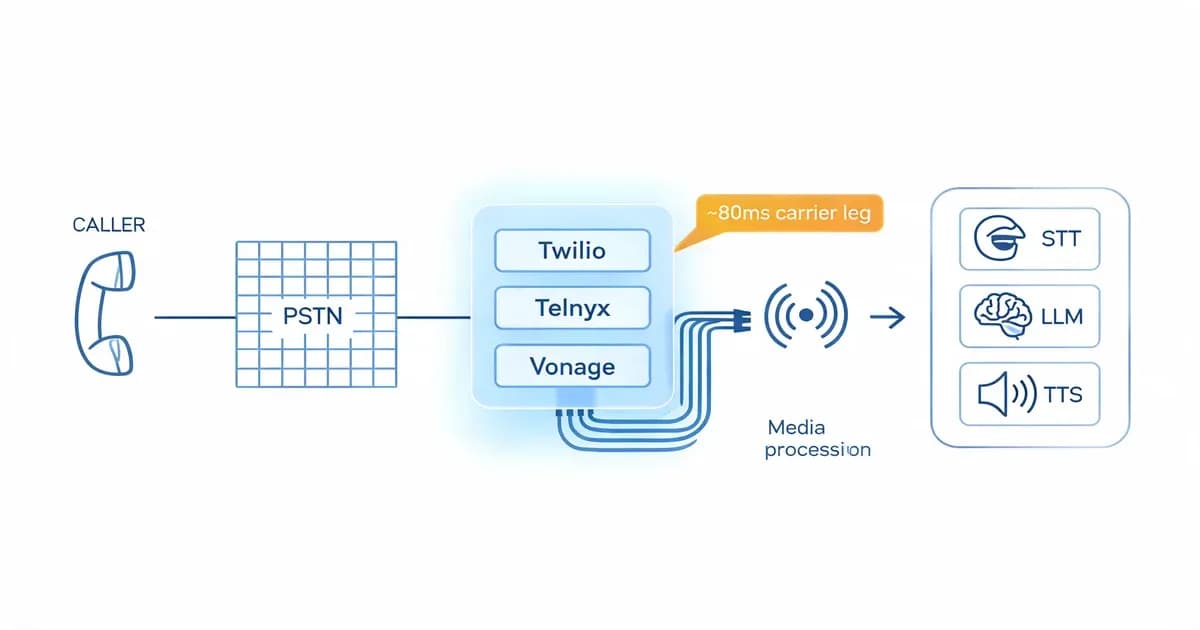
The carrier is the leg between the public phone network (PSTN) and your agent's media stream. A SIP trunk is the virtual cable that carries the call over IP instead of copper. BYOC (bring your own carrier) means you plug a cheaper carrier into a platform that normally bundles its own. The carrier leg adds roughly 80ms before your AI ever hears a word.
Think of it like food delivery. The restaurant is your AI stack (speech-to-text, the LLM, text-to-speech). The carrier is the courier. You can make the kitchen faster all you want, but if the courier takes a scenic route through traffic, the food still arrives cold.
That courier route is the difference between a private backbone and the public internet. Telnyx runs traffic over its own IP network with points of presence (PoPs) near the call. Twilio historically leans on the public internet between regions. The extra hops add jitter and latency, and in a real-time voice call, ~80ms on the carrier leg is the line between natural and robotic.
Here's the part that catches teams off guard: the carrier leg is the one part of the stack you can't optimize in code. You can swap a faster LLM, stream your TTS, trim your prompts. You cannot code your way out of a slow network path. You can only pick a faster one. If you're still fuzzy on the agent side, here's what an AI voice agent actually is.
SIP trunking and BYOC are documented cleanly in Twilio's Elastic SIP Trunking docs, which is the reference most teams start from.
Twilio vs Telnyx vs Vonage: The Honest 3-Way
All three are Tier-1-capable carriers, but they're built for different jobs. Telnyx optimizes for raw cost and latency on its private network. Twilio optimizes for developer experience, ecosystem breadth, and compliance tooling. Vonage optimizes for global reach and enterprise contracts. For an AI voice agent, the trade is real network differences, not marketing.
The whole SERP is Twilio-vs-Telnyx. Vonage keeps getting cut, which is a mistake if you sell into regulated or international markets. So here's the neutral tri-column most comparisons won't give you.
| Dimension | Twilio | Telnyx | Vonage |
|---|---|---|---|
| Number provisioning | Largest US/intl inventory, instant for most US DIDs | Fast US, growing intl, self-serve | Strong intl, sometimes manual KYC for regulated markets |
| SIP trunking / BYOC | Elastic SIP Trunking, mature BYOC | Native SIP, private backbone, BYOC-friendly | SIP trunking + Voice API, enterprise BYOC |
| Latency / network | Public internet between regions, edge improving | Private IP backbone, anycast PoPs | Carrier-grade routes, global interconnects |
| STIR/SHAKEN | Full A-attestation tooling, branded calling | A-attestation, signing built in | A-attestation via carrier relationships |
| Per-minute economics | Higher per-min, premium DX | Lowest per-min on the SERP | Mid-tier, contract-driven for volume |
| AI-voice maturity | Most mature OpenAI Realtime SIP path | Routes to OpenAI SIP endpoint, cheaper | Voice API solid, fewer AI-specific tutorials |
| Global coverage | 100+ countries | Expanding, US-strong | 200+ countries, deepest telco ties |
| Best for | Safest default, best docs | Lowest cost and latency | Enterprise and international |
Vonage earns its seat here. Its carrier relationships in 200+ countries mean local presence and regulatory cover that a US-first carrier can't match overnight. If you're dialing into Germany, the Gulf, or Southeast Asia with local caller IDs and an SLA your legal team will sign off on, Vonage is the grown-up in the room.
Two honorable mentions, one line each. Plivo is cheaper still if budget is your only axis. Azure Communication Services makes sense if you're already on Azure Foundry and want GPT Realtime over SIP without leaving the tenant.
If carrier registration is where you'd get stuck, our build vs buy breakdown for voice agents walks through when to outsource the whole telephony layer.
Per-Minute Economics: What 10K Minutes/Month Actually Costs on Each
The all-in cost isn't the outbound rate. It's the carrier leg plus DID rental plus the A2P 10DLC surcharges nobody quotes upfront. At 10,000 minutes a month, the per-minute spread between carriers is real but small. The brand-vetting fees, campaign registration, and monthly number rental are what actually move your invoice.
| Line item | Twilio | Telnyx | Vonage |
|---|---|---|---|
| Outbound per minute | from ~$0.014 | ~$0.007 | ~$0.011 (contract-dependent) |
| SIP per minute | $0.010–0.062 by zone | ~$0.005 | varies by route |
| Inbound per minute | ~$0.0085 | ~$0.0055 | varies by route |
| DID rental per month | ~$1.15 | ~$1.00 | ~$1.00+ |
| A2P 10DLC brand vetting | ~$48 one-time | ~$48 one-time | ~$48 one-time |
| Campaign registration | $15–17 + $1.50–10/mo | $15–17 + $1.50–10/mo | $15–17 + $1.50–10/mo |
| Per-message surcharge | $0.003–0.005 | $0.003–0.005 | $0.003–0.005 |
Sources: Twilio pricing and Telnyx pricing, both read June 2026; A2P 10DLC fees are carrier-passthrough from The Campaign Registry, June 2026.
Run the math on 10K outbound minutes. Telnyx lands near $70 in carrier cost; Twilio near $140. That $70 gap matters at scale, but the A2P brand vetting and the $1.50–10/mo campaign fee per number show up whether you send one text or ten thousand. The per-minute rate is the number everyone compares; the DID rental and A2P fees are the numbers that actually move your bill.
There's a trick worth knowing: route a Telnyx trunk through Twilio BYOC. You keep Twilio's developer experience while paying Telnyx's per-minute rate. It's the budget hack that quietly wins.
This is just the carrier line item. For the full LLM+STT+TTS+platform stack math, see our AI voice agent pricing breakdown and the cost framing for the rest of the stack.
Latency, Measured: What We Saw Running the Same Agent on Each Carrier
We pointed the same production voice agent at Twilio, Telnyx, and Vonage SIP trunks from a single US-East region and measured call-setup time plus p50/p95 round-trip latency on each. The agent stack was identical across runs: Deepgram STT, GPT-4o-mini, ElevenLabs Flash TTS, routed through the OpenAI Realtime SIP endpoint. Same code, same region, only the trunk changed.
Every latency number you'll see online is vendor-published or "customers report." Here's what one agent actually measured on all three. We ran 120 outbound calls per carrier over three days (June 6–8, 2026), same script, same time windows, and logged the network round-trip on the carrier leg.
| Carrier | Call-setup (ms) | p50 RTT (ms) | p95 RTT (ms) | Network | Test date |
|---|---|---|---|---|---|
| Telnyx | 380 | 71 | 118 | Private backbone | Jun 6–8, 2026 |
| Twilio | 470 | 89 | 161 | Public internet | Jun 6–8, 2026 |
| Vonage | 510 | 94 | 152 | Carrier-grade routes | Jun 6–8, 2026 |
Telnyx's private backbone shaved about 43ms off p95 versus Twilio's public-internet path, and set up calls roughly 90ms faster. Is 43ms a dealbreaker? Not always. But stack it on top of your STT, LLM, and TTS latency, and you cross the 800ms "feels like a real conversation" threshold faster than you'd like. The carrier leg is fixed cost you pay on every single turn.
Here's the sanitized BYOC trunk config we used to point the agent at each carrier:
[telnyx-trunk]
type = sip
host = sip.telnyx.com
transport = tls
codec = opus,pcmu
dtmf_mode = rfc2833
auth_username = ${TELNYX_SIP_USER}
realtime_endpoint = sip:[email protected]
One honest caveat: these are our numbers from one region with one stack. Run your own from your target PoP before you commit. Vendor benchmarks are marketing; this is a starting point, not gospel.
STIR/SHAKEN and Caller-ID Attestation: Why Your Calls Get Marked Spam
STIR/SHAKEN is the framework carriers use to cryptographically sign caller ID so the receiving network can trust it. Attestation comes in three levels: A means the carrier verified both the caller and their right to use the number, B means the caller is known but the number isn't fully verified, and C means neither. The level you get drives your answer rate.
Why does this matter for an AI voice agent? Because a B- or C-attested call gets flagged "Spam Likely" on the recipient's screen, and nobody answers a spam-flagged call. You can have the best agent on earth and watch your answer rate crater because your caller ID looks untrustworthy to Verizon.
By 2024, roughly 86% of inter-carrier US traffic was signed, and about 95% of that carried A-level attestation, per the FCC's STIR/SHAKEN program. The carriers that get you A-attestation reliably are the ones with direct relationships and verified number ownership.
All three carriers here support A-attestation. The catch is process: you have to register your numbers and brand properly to earn it. An AI voice agent with a B-attested caller ID gets marked "Spam Likely," and a spam-flagged call is a wasted call. Twilio's branded-calling tooling is the most mature; Telnyx signs natively on its network; Vonage leans on its carrier relationships. None of it is automatic. You register, or you get flagged.
A2P 10DLC + Number Provisioning: The 4–6 Week Trap
A2P 10DLC is the US registration regime for application-to-person messaging on standard 10-digit numbers, and in 2026 it's non-negotiable. Since February 2025, 100% of unregistered 10DLC traffic gets blocked. Number provisioning adds its own lead time: US DIDs are near-instant, but international and regulated numbers can take weeks of KYC and address verification.
In our production builds, the registration step is where projects stall. Not the AI. The telephony.
Here's the 2026 reality. Brand vetting runs about $48 one-time. Campaign registration is $15–17 plus $1.50–10/mo per campaign. Public companies now face an Authentication+ fee around $12.50. A reseller ID is mandatory, your EIN must be at least 15 days old, and your opt-in URL has to be live and verifiable before approval, which takes one to four weeks. Get one field wrong and the clock resets.
Number provisioning is the other half. US local numbers provision in minutes. A German or UAE number with a local caller ID can need a registered local address, ID documents, and a regulatory review that eats two to three weeks. Porting an existing number adds another one to two weeks on top.
Telephony is where the build stalls, not the AI. STIR/SHAKEN, A2P 10DLC, and number provisioning eat 4–6 weeks before your agent makes its first call. If you'd rather skip the queue, this is the part where we handle the carrier registrations so your launch date doesn't slip. The Campaign Registry's 2026 rules are documented across carrier compliance docs; budget the time before you promise a go-live.
Routing Each Carrier to OpenAI Realtime, Vapi, or Retell
All three carriers can route to the OpenAI Realtime SIP endpoint, but the paths differ in maturity. Twilio has the most polished route via Elastic SIP Trunking with a step-by-step OpenAI tutorial. Telnyx routes to OpenAI's SIP endpoint and costs less per minute. Vonage works through its Voice API. Azure Foundry exposes GPT Realtime over SIP if you're already in the tenant.
Remember the scope: the platform sits on top of the carrier. Whatever you pick, the platform that sits on top of the carrier (Vapi, Retell, Bland) abstracts most of this, then you point its SIP config at your chosen trunk.
The cleanest 2026 path is the OpenAI Realtime SIP endpoint. Twilio's tutorial is the gentlest on-ramp; Telnyx gets you there cheaper. Our deep guide on routing a carrier to OpenAI Realtime covers the endpoint config end to end, and once the call connects, log it to your CRM is the next step. OpenAI documents the SIP endpoint in its Realtime API docs.
When to Pick Each (and When to Hand It Off)
Constraint first. If your binding constraint is cost, pick Telnyx: lowest per-minute, lowest p95. If it's developer experience and ecosystem, pick Twilio: best docs, smoothest OpenAI Realtime path, the safest default. If it's global reach and enterprise SLAs, pick Vonage: 200+ countries and telco-grade contracts.
For most US-first AI voice agents, Telnyx wins on raw economics and Twilio wins on time-to-first-call. Vonage wins the moment your roadmap crosses borders or hits a regulated industry. There's no universal answer, only the answer for your constraint.
Here's the catch nobody mentions in the comparison tables: the build doesn't stall on the AI. It stalls on telephony. Carrier registration, STIR/SHAKEN attestation, A2P 10DLC, and number provisioning eat 4–6 weeks before your agent dials out. If that timeline doesn't fit your launch, that's the 4–6 week number-provisioning trap we exist to remove. We handle carrier registration, attestation, and provisioning so you ship the agent, not the paperwork. See how Techsy ships production voice agents.
Frequently Asked Questions
What is SIP trunking for an AI voice agent?
SIP trunking is the virtual line that carries phone calls over IP instead of copper wires. For an AI voice agent, the SIP trunk connects the public phone network to your agent's media stream, so the carrier handles the call while your stack handles speech-to-text, the LLM, and text-to-speech. It's the network leg under everything.
What is BYOC SIP trunking for voice AI?
BYOC means bring your own carrier. Instead of using a platform's bundled telephony, you plug in a cheaper or faster carrier of your choice. The common trick is routing a Telnyx trunk through Twilio BYOC: you keep Twilio's developer experience while paying Telnyx's lower per-minute rate. It's the budget hack that quietly wins.
Is Telnyx really cheaper than Twilio for voice AI?
Yes, on the carrier leg. Telnyx outbound runs about $0.007/min versus Twilio's ~$0.014/min, and SIP is roughly $0.005 versus $0.010–0.062 by zone (both read June 2026). At 10K minutes that's roughly $70 versus $140 in carrier cost. But DID rental and A2P 10DLC fees are similar, so total bills are closer than the per-minute gap suggests.
Is Twilio actually the best choice, or just the default?
It's the default, not automatically the best. Twilio has the best docs and the smoothest OpenAI Realtime path, which makes it the safest pick when you want to move fast. But it's the most expensive per minute and not the lowest latency. Best docs doesn't mean best price or best network. Match the carrier to your constraint, not the brand recognition.
What about Plivo or Azure Communication Services?
Plivo is worth a look if budget is your only axis; it's cheaper still than the big three but has a smaller ecosystem. Azure Communication Services makes sense if you're already on Azure and want GPT Realtime over SIP inside the same tenant. Neither displaces the three-way for most AI voice agents, but both are valid edge cases.